
Tag:australia

Christmas in Australia is a celebration like no other. While many associate the holiday season with snowflakes, roaring fires, and winter wonderlands, Australians celebrate Christmas during the peak of summer. The unique climate and a vibrant mix of cultural influences create an unforgettable holiday season that combines traditional festivities with a sun-soaked twist.
A Sun-Kissed Christmas
December is one of the warmest months in Australia, with temperatures often reaching well over 30°C (86°F). Instead of snow-covered streets, Australians enjoy sunny days and clear, blue skies. Beaches become popular holiday spots, with families and friends gathering for barbecues, picnics, and water sports. Christmas Day on the beach is an Australian staple. Many spend the holiday playing beach cricket, swimming, or simply relaxing in the sun.

This seasonal difference gives Australian Christmas a unique feel. Santa Claus is just as likely to be spotted wearing board shorts and sunglasses as in a red suit. Santa even arrives on a surfboard or by boat in some coastal towns, a refreshing twist that adds to the relaxed summer vibe.
Christmas Traditions: A Blend of Cultures
Australia is a multicultural nation, which is reflected in how Christmas is celebrated. While the country shares some customs with other Western nations, such as Christmas trees, gift-giving, and carolling, it also includes traditions unique to Australian culture.
- Carols by Candlelight
One of Australia’s most cherished Christmas traditions is “Carols by Candlelight.” This event sees people gathering in parks, beaches, or city squares to sing Christmas carols by candlelight. The tradition dates back to 1938 when Norman Banks, an Australian radio announcer, spotted an elderly woman singing carols alone by candlelight. Moved by her solitary celebration, Banks organised the first official Carols by Candlelight. Since then, it has grown into a beloved national event, with significant gatherings in Melbourne, Sydney, and other cities. Families come with picnic blankets, candles, and sometimes glow sticks to join the festive spirit.

- Boxing Day Tradition
Boxing Day is a public holiday in Australia. The day after Christmas is marked by several traditions, including the Boxing Day Test Match in Melbourne and the Sydney to Hobart Yacht Race. The cricket match at the Melbourne Cricket Ground is an iconic event that draws massive crowds. The yacht race from Sydney Harbour to Hobart, Tasmania, showcases world-class sailing and is eagerly followed by Australians nationwide. These events extend the holiday spirit and give families an extra day to celebrate.

Christmas Lunch: A Feast of Fresh Produce
Unlike the heavy roasts and puddings in colder climates, an Australian Christmas lunch often features fresh seafood, summer fruits, and salads. Prawns, lobsters, and oysters are holiday favourites, alongside platters of mangoes, cherries, and pavlova, a meringue-based dessert topped with cream and fresh fruit. This light, refreshing meal suits the hot weather perfectly, and many families choose to eat outdoors, either in their backyard or at the beach.
Christmas Bush
While many Australians decorate their homes with traditional Christmas trees, some embrace the native Christmas Bush, an Australian plant with small red and white flowers that bloom around Christmas time. The plant’s vibrant colours add a natural, festive touch to homes and are a reminder of Australia’s rich flora.

Christmas lights
The warm climate means many Australians spend time outdoors, so outdoor decorations are popular, too. Lights are strung up on homes, fences, and even garden plants. Inflatable Santas, reindeer, and kangaroos (a humorous Aussie touch) bring extra cheer to neighbourhoods. Some homes participate in decorating competitions, drawing crowds to see their elaborate displays.
Christmas Windows
The Myer Christmas Windows are a beloved holiday tradition in Melbourne, Australia. Since 1956, the Myer department store has unveiled an elaborate series of animated window displays each year to celebrate Christmas. These windows, located at Myer’s flagship store on Bourke Street, tell a different themed story annually, often based on popular children’s books, festive tales, or original stories created specifically for the display. Each window showcases a meticulously crafted scene with animated characters, intricate backdrops, and detailed props, all brought to life with movement, sound, and lighting effects.
Christmas for Kids: School Holidays and Santa Sacks
For Australian children, Christmas coincides with the end of the school year, adding an extra layer of excitement. December marks the start of the long summer holidays, and Christmas is often the beginning of weeks of adventure and relaxation.
Santa Claus is a big part of the celebrations, and children often write letters to Santa, hang stockings, or leave out a snack for him. However, some Australian children leave Santa a cold beer or a slice of pavlova instead of milk and cookies, a nod to the Aussie way of celebrating. Kids wake up on Christmas morning to find gifts under the tree or in Santa sacks, larger, pillowcase-sized versions of stockings filled with presents.
Christmas in the Cities: Lights and Festivals
Australia’s cities come alive during Christmas with light displays, parades, and festive markets. Each major city has its own unique celebration:
- Sydney hosts an annual Christmas concert in the Domain. Famous landmarks, including the Sydney Opera House and the Harbour Bridge, are lit with festive colours.
- Melbourne is known for its Christmas projections along Swanston Street, transforming buildings with colourful lights and images of Santa, reindeer, and more.
- Adelaide holds one of the largest Christmas parades in the Southern Hemisphere, the Adelaide Christmas Pageant. With floats, dancers, and music, it heralds the beginning of the holiday season.

Christmas Down Under: A Celebration of Diversity and Sunshine
For visitors and locals alike, Christmas in Australia offers a warm, vibrant, and inclusive holiday season. While the traditions may differ from the northern hemisphere’s classic winter wonderland, the spirit of joy, generosity, and celebration remains the same. From beach barbecues and outdoor carolling to cricket matches and sunny festivities, Australians have made Christmas their own, blending cultural traditions with the natural beauty of their homeland.

Sydney, the capital of New South Wales, is a world-renowned city. It’s known for its stunning harbour, beautiful beaches, and vibrant cultural scene. Every year, millions of visitors flock to this Australian gem to experience its charm. However, deciding how to spend your time could be overwhelming, with many things to see and do, especially if you have a tight schedule.

We had only 48 hours to explore the city during our recent trip to Sydney. Despite the time constraint, we still saw some must-see attractions. These included the iconic Opera House and Harbour Bridge, the world-class Taronga Zoo. It was a whirlwind tour, but we enjoyed every moment of it.
Getting around – Avoid the Car!
Try to avoid driving around inner Sydney. A new report commissioned by Australia’s motoring clubs has revealed Sydney is the nation’s most congested city. Melbourne wasn’t far behind, while Canberra came in third place. Additionally, the older parts of the city, particularly in the central business district, have narrower roads due to how they were designed and built many years ago. When Sydney was first developed, the focus was on creating a grid pattern of streets that could accommodate horse-drawn carriages and carts.

Additionally, as Sydney has grown and developed, it faced challenges expanding its road network due to limited available space. The city’s geography, sandwiched between the harbour and surrounding hills, made it difficult to build new roads without impacting the environment or disrupting established communities. As a result, many of the streets in Sydney have remained narrow, particularly in the city’s older areas. Car parking can be expensive with limited options, and traffic is heavy. The best option is public transport, taxis or rideshare.
Sydney has an excellent public transport system of buses, trains and ferries. However, even that is struggling to meet passenger demand. However, it remains the best way to get around. The Opal card is a rechargeable smart card used on all public transport.
QVB
The QVB (Queen Victoria Building) is a historic building in the heart of Sydney’s central business district. It was built in the late 19th century as a marketplace and shopping arcade. Since then, it has become one of the city’s most iconic landmarks. Designed by architect George McRae, it features a stunning Romanesque Revival style with intricate sandstone and granite facades, ornate arches, and a central dome with a striking stained-glass skylight. The interior of the building is equally impressive, with soaring ceilings, marble floors, and beautifully crafted balustrades.

However, like many other beautiful old buildings, as progress was made, its future became uncertain. In the 1950s, it was in danger of being demolished due to neglect and the city’s changing needs. Thankfully, a group of concerned citizens, including architects, heritage enthusiasts, and community leaders, banded together to save the QVB from demolition. After years of advocacy and lobbying, the QVB was finally granted heritage protection in the 1980s. It underwent a significant restoration and refurbishment project that took several years to complete and returned the building to its former glory.

Today, the QVB is home to over 180 retailers, including high-end fashion boutiques, gourmet food shops, and specialty stores. Visitors can also enjoy a range of dining options, from casual cafes to upscale restaurants.
Angel Place
Angel Place is a small laneway located between George Street and Pitt Street in the heart of Sydney’s central business district. The laneway is famous for its unique and thought-provoking art installation called “Forgotten Songs.”

Forgotten Songs is an outdoor artwork that features 180 birdcages hanging high above the laneway. Each birdcage plays the sound of a different bird that once inhabited the area before the arrival of European settlers. The installation is a tribute to the fifty lost bird species and their songs that once filled the skies over Sydney but were lost to development. As night falls, the daytime bird songs change to the nocturnal birds. Michael Thomas Hill created the artwork, which was installed in 2009 as part of the City of Sydney’s Laneways Public Art Program. It has since become a popular destination for locals and tourists, providing a peaceful and reflective space amid the busy city.

Angel Place is also home to several restaurants, cafes, and small shops. It’s a great place to stop and relax while exploring the city. The laneway’s cobblestone pavement, brick walls, and historic buildings add charm and character. This creates a unique and memorable experience for visitors.
Taronga Zoo
Taronga Zoo is a world-renowned zoological park located in Sydney, Australia. The zoo was founded in 1916 and is situated in a stunning harbourside location, providing visitors with breathtaking views of Sydney Harbour and the city skyline.

The zoo is home to over 4,000 animals from 350 different species, including Australian native wildlife and exotic animals worldwide. Highlights include the Great Southern Oceans exhibit, where visitors can see Australian Sea Lions, Penguins and fur seals, and the Wild Asia exhibit, featuring tigers, otters, and gibbons.

Taronga Zoo is not just a place to observe animals but also a hub for conservation and education. The zoo works closely with many organisations to protect and preserve endangered species and their habitats. Visitors can learn about these efforts through interactive exhibits and talks from expert staff.

Taronga Zoo offers a range of experiences for visitors, including behind-the-scenes tours, animal encounters, and wildlife shows. The zoo also has various cafes and restaurants, providing ample opportunities to relax and enjoy stunning views.
Hissou Tepanyaki
Hissou is a Japanese restaurant located in the heart of Sydney’s central business district. The restaurant is known for its delicious teppanyaki-style cuisine, prepared by skilled chefs right in front of guests at their own cooking stations.
At Hissou Tepanyaki, guests can choose from fresh seafood, meats, and vegetables, which are then expertly grilled and seasoned to perfection. The teppanyaki-style cooking allows guests to witness the artistry of the chefs as they prepare their meals, creating a fun and interactive dining experience.

In addition to its teppanyaki offerings, Hissou Tepanyaki also features a sushi bar, where guests can enjoy a variety of fresh and creative sushi rolls, sashimi, and nigiri. The restaurant’s sleek and modern interior and vibrant and energetic atmosphere make it the perfect spot for a night out with friends, a special occasion, or a romantic dinner for two.

The Palace Tea Rooms
A charming and elegant tea room located in the Queen Victoria Building (QVB) in the heart of Sydney. The tearoom features ornate decor and beautiful stained-glass windows. They offer a variety of teas and a selection of pastries, cakes, and sandwiches.

In addition, the Palace Tea Rooms also serves a variety of breakfast and lunch options. These include a range of classic British and Australian dishes. The tea room’s elegant and sophisticated atmosphere makes it the perfect spot for a special occasion, a catch-up with friends, or a romantic afternoon tea for two.


Australia is often associated with the image of kangaroos hopping across the horizon or on a beach. Just like the koala, the kangaroo is a global icon of Australia. They are prominently featured on Australia’s coat of arms alongside the emu, and the flying kangaroo serves as the emblem of the national airline. The animals represent a nation that is constantly moving forward, as they are unable to walk backwards.
These hopping macropods (the name means big foot) are the world’s largest marsupials. They are native to Australia and the offshore islands of Tasmania and Kangaroo Island, New Guinea and the Bismarck Archipelago. Varieties of Kangaroo include the eastern grey kangaroo, red kangaroo, western grey kangaroo, common and black wallaroo and antilopine kangaroo, as well as fourteen species of the Macropus genus, called Wallabies. Overall there are 45 varieties of kangaroo.

Male kangaroos are called bucks, boomers, jacks or old men. Females are flyers or jills. Their young are called joeys, and a group of ‘roos is a mob, court or troop.
Appearance
Kangaroos are marsupials with large feet and powerful hind legs, enabling them to travel at 70 km/h and jump more than 9 metres in a single bound. In addition, their small front legs and long, powerful tail provides balance when jumping. The red kangaroo is the tallest; the males can grow up to 2 metres tall, weigh 140 kg and is 3 metres long from nose to tip of the tail, which they use like a fifth leg.

In contrast, the smallest kangaroo is the musky rat-kangaroo at only 40 to 50 cm. Kangaroos have exceptional hearing and can swivel their ears to pick up sounds. They also have excellent eyesight but only react to moving objects. Their coat can be red, grey or light to dark brown, depending on the species. Kangaroos are superb swimmers and use their tails to propel them through the water and paddle with their front legs. They swim to avoid predators and can use their forepaws to drown pursuers.
Behaviour
Young kangaroos will playfight, but the fighting becomes more serious as they age. Fighting is either over access to the females, to establish dominance and move up the mob hierarchy or against enemies. They use their forelegs to grip an enemy, rock back on their tail and swiftly drop their huge, sharp, clawed hind feet. This action has been known to disembowel dogs and humans.

When chased by hunters with dogs, they often head for water and have been known to turn and hold down on the dog with their forefeet in an attempt to drown it. When alarmed, a kangaroo will hiss and growl. The females make clicking noises when communicating with their young. Males also ‘chuckle’ during courtship.
Reproduction
Like all marsupials, kangaroos have pouches where the joeys are reared. The pouches also contain four teats producing two different types of milk. A newborn is attached permanently to one (neonatal) teat and receives a protein-rich fluid. The other teats produce ‘mature’ milk for the joey at her feet. Grey kangaroos allocate more protein to sons than daughters.

Kangaroos produce one young annually. The joey is born at a very immature stage, is only about 2 cm long, and weighs less than a gram. Immediately following birth, it crawls up the mother’s body, enters her pouch, and attaches itself to the neonatal teat. The teat then enlarges to hold the joey in place. The joey leaves the pouch after nine months but continues to suckle until twelve months.

Within a few days of giving birth, the females enter heat again, mate and conceive. However, after one week of developing, the embryo enters a dormant state. This dormancy remains until the young Joey leaves the pouch. Development of the embryo will then resume, and the female gives birth after a 30-day gestation, and the cycle starts all over again. Female kangaroos are literally permanently pregnant!
Diet and Habitat
Kangaroos are herbivores and graze on grass, young shoots, leaves of heath plants, and grass trees. They get most of their water from the plants they eat; thus, they require very little water to survive and can go months without drinking water. They also conserve water by only being active when the weather is cooler. During the day, they will rest in the shade, coming out to eat in the late afternoon and at night when it’s much cooler. They can be found across woodlands, forests, plains and savannahs of Australia. Like cattle, kangaroos regurgitate their food. They chew it twice before it passes into their chambered stomach.

Population
The current kangaroo population in Australia is estimated to be around 50 million. To slow the rising population of kangaroos, which has doubled in the last six years, scientists are asking people to eat more kangaroo meat (which has been legal to consume since 1993). The rise in population is attributed to an abundance of food after three years of heavy rains due to La Niña. Concerns are a loss of diversity if the population keeps growing. Calls for a kangaroo cull are growing. Kangaroos have only three natural predators – dingoes, humans and wedge-tail eagles. Unlike many species, European settlement has actually benefited their numbers.

Settlers cleared vast forest areas and put in bores, dams and tanks, providing permanent water resources and abundant pasture grasses. Coupled with the extinction of the Tasmanian tiger and the dingo fence, they have become overabundant in some areas. As a result, there are now more kangaroos than people in Australia.
Caution Required
Kangaroos may look cute and friendly, and some are quite tame as they have become used to humans as they encroach on suburbia. But they are still wild animals, and not all are friendly and docile or as ‘smart’ as the star of the 1960s television show ‘Skippy’. Some have been known to attack humans and dogs.

While most attacks aren’t serious, in 1938, a New South Wales man died from injuries he received protecting his dogs. This year, in Western Australia, a 77-year-old man died after being attacked by the western grey kangaroo he had hand raised from a joey. Kangaroos are protected under federal conservation laws, and it is an office to harm or keep them as pets.

The echidna, (Tachyglossidae) also known as a spiny anteater, is Australia’s most widespread native mammal. Significantly, along with the Platypus, the echidna is the only mammal in the world that lays eggs. In zoological terms, the platypus and echidna are monotremes, primitive mammals that lay large yolky eggs and have a common opening for the urogenital and digestive systems.
Appearance
Echidnas eat and breathe through the bald, tube-like snout. While echidna species are referred to as short or long-beaked, they actually have snouts, not beaks. They have dome-shaped bodies covered in brown fur and 5cm long (2 inch) spines similar to a hedgehog. The spines are formed from a single hair. These modified hairs range in colour from cream to black. Echidnas have beady eyes, slits for ears, and a tiny mouth at the end of their snout. They also have a low body temperature and cannot tolerate extreme heat. Therefore, they shelter from the midday sun and can be active both day and night.

Echidnas grow between 35 to 76 cm long and weigh 2.5 to 10 kg. Both male and female echidnas have a belly pouch. They have poor vision but possess an excellent sense of hearing and smell. In addition, the long spines help provide camouflage in the bush. The male echidna has the most bizarre penis in the animal kingdom. More info on that odd appendage can be found on Australian Geographic.
Diet
When hunting food, they slowly and methodically probe along the ground, searching for prey. The echidna’s long, rear-facing claws also make them excellent diggers. They primarily eat worms, termites, ants, and other insects, and, like anteaters, they have no teeth. Instead, they poke their 7-8cm snout into rotting logs and termite mounds and then use their 18cm long, sticky tongues to scoop up insects under the bark.

Species and Habitat
There are four species of echidna. The long-beaked echidna is found almost exclusively in high-altitude alpine meadows and humid mountain forests in the highlands of New Guinea. The short-beaked echidna is found throughout Australia and New Guinea’s lowlands in various habitats, including rainforest, grassland, and desert. Sir David’s long-beaked echidna and the eastern long-beaked echidna are only found in New Guinea. Echidnas are solitary animals apart from the mating season. However, they are not territorial. During the winter months, they hibernate in their burrow.

Breeding
The breeding season is from the end of June to early September. During the breeding season, it’s not unusual for a female to be trailed by from one to ten males. This mating train can last for up to four weeks. When the female is ready to mate, she lies relaxed and flat on her stomach. The males that formed the ‘train’ dig a circular trench around her. Eventually, the largest male pushes the competing rivals out of this ‘mating rut’. The male then digs more dirt out from the spot where the female’s tail is resting, he then lies on his side and, placing his tail under hers, they mate.

Echidnas are one of only five egg-laying mammals in the world that drink milk. Apart from the four species of echidna, the only other egg-laying mammal is the duck-billed platypus. Female echidnas lay a single egg in their pouch, which then hatches after about ten days. At birth, the baby echidna (called a puggle) weighs just 0.5 grams and is less than half an inch long. The puggle stays in the pouch for 4 to 5 weeks. During this time, the puggle is fed from milk, the mother secretes, and the puggle laps up. Puggles in the pouch do not have spines. The mother moves the puggle into a burrow when its spines begin to break through its skin. She will return and feed it every few days until it is about seven months old when it can leave the burrow.
Spurs
Like the male platypus, the male echidna has spurs on its hind legs. However, the platypus and echidna use their spurs for drastically different reasons. In the case of the male platypuses, the spurs are a venomous weapon to help them compete against other males during the breeding season. In contrast, the male echidnas secrete a milky substance from their spurs during breeding season as a means of scent communication with females.

Predators
Cats, dingoes and large goannas may eat the young echidnas, but adult echidnas don’t have many natural predators due to their spines. When threatened, an echidna will curl into a ball, lodge itself into a log or rock crevice, or quickly dig a shallow excavation leaving only its sharp spines exposed.

Conservation status
In New Guinea, Sir David’s long-beaked echidna and the western long-beaked echidna are both listed as critically endangered, with populations declining. In Australia, the eastern long-beaked echidna is listed as vulnerable, and the current population size is estimated to be around 10,000 mature echidnas, but this number is likely declining. The IUCN categorises the short-beaked echidna as a species of Least Concern. In Australia, picking up or moving one from its natural surroundings is illegal.
Echidnas are considered to be a vulnerable species due to habitat loss and disease. Conservation efforts for echidnas include protecting their natural habitats, monitoring populations, and educating the public about the importance of these animals. Additionally, organisations such as the Taronga Conservation Society Australia and the Echidna Walkabout Nature Tours offer programs to support echidna research and conservation.

Globally there are 250 species of owls; of this, 11 species are found in Australia. They are the Barn Owl, Barking Owl, Powerful Owl, Rufous Owl, Masked Owl, Morepork, Greater Sooty Owl, Lesser Sooty Owl, Eastern Grass Owl, Southern Boobook and Christmas Island Boobook.
Owls have long sparked our imaginations; their haunting night calls, silent flight, extraordinary hearing and deadly eyesight has seen them embedded in different cultures as symbols for magic, wisdom and mystery.
Bush Heritage

Characteristics
Owls are masters at silent flight. Their soft, uniquely structured feathers are serrated, affecting the movement of air over the wings. Additionally, the velvety surface of the feathers absorbs any sound made by flapping wings. Their silent flight allows them to pounce on prey with no warning. Owls have incredibly superior eyesight and hearing, and their forward-facing eyes grant them excellent depth perception, which is necessary for low-light hunting.

They can rotate their head 270 degrees, a vital asset when their eyes are fixed and cannot move within their sockets. In addition, their ears are asymmetrical on their head (at different heights on the side of their face), so the sounds reach each ear at different times, aiding them in identifying the exact location of their prey. Owls also have a facial disk around their eyes; this helps focus sounds to their ears, so they hear even the quietest sounds.

Behaviour
Owls are nocturnal (hunting only at night) though some are active at dawn and dusk. They are found in every state of Australia and vary significantly in size; they range from the smallest (Southern Boobook at 36cm tall and around 175g) to the largest (Powerful Owl at 60cm tall and 1.5kg). They live in various habitats, from snowy mountainous areas to deserts, from open wet forests to woodlands and grasslands. The Powerful Owl is territorial and has been known to attack humans, though most are solitary and shy.

Diet
Owls live on a diet of small to medium-sized mammals, birds and insects. Like most birds, they cannot chew and eat their prey whole or will tear off pieces with their powerful, sharp beaks if unable to do so. Some owls, such as the Sooty Owl, eat mainly tree-dwelling mammals such as sugar gliders and small possums. Others prefer land-dwelling lizards or mammals. Like other raptors, owls regurgitate the non-nutritious party of their prey. Several hours after eating, they will produce a pellet from their gizzards of fur and bone. They will then be ready to eat again.

Threats
Habit loss is the biggest threat to Australian owls as they rely on old-growth trees with hollows for nesting and breeding. These hollows take hundreds of years to form. Sadly, land clearing and bushfires are wiping out the hollows at an alarming rate. Another significant threat is secondary poisoning from eating prey such as foxes, feral cats, rabbits and rodents that have taken the bait. Poachers are also a concern, both as live specimens and eggs.

Status
No Australian owl species is on the national threatened species list. Some populations, however, such as the Powerful Owl in Victoria, are vulnerable, and the Masked owl is endangered in SA, Tasman and Victoria.

The Little Eagle is one of the smallest species of Eagle found worldwide. They are a small to medium-sized, stocky yet powerful birds native to Australia. Due to their size and colouring, they are often confused with the Whistling Kite.
Little eagles have short, broad heads with moderately long tails, square-cut at the tip when closed. They have two ‘phases’ in their colouring – a light and a dark phase. During the light phase, when in flight, they are often mistaken for the Whistling Kite. They have heavily feathered legs, and when perched, they have a short crest. The plumage varies from light to dark brown, with a pale broken ‘M’ on the upper parts, easily visible from a distance. The underside of the wing also has a pale M-shaped band. The broad wings have a span of one metre with dark tips.

Flight

The Little Eagle has a distinctive flight pattern of soaring in tight circles with flat wings. They advertise their territory by a soaring, undulating flight display and conspicuous perching and calling.
Habitat and Distribution
The habitat of the Little Eagle is dry eucalypt, sheoak or acacia woodlands, forests and open country. They tend to avoid rainforests and the densely forested area of the Great Dividing Range. Their distribution is widespread across mainland Australia and central and eastern New Guinea.

Diet
The Little Eagle is a raptor (bird of prey) and, as such, is a carnivore. They hunt for their prey on the wing or from a high, exposed perch, taking their prey on the ground or in the tree canopy. Their prey includes rabbits, other live mammals and insects and occasionally carrion. The Little Eagle originally ate a diet of small birds, mammals, and reptiles, sometimes supplementing with insects; however, their diet changed with the introduction of foxes and rabbits. As rabbits quickly became abundant across Australia, and they found them an ideal prey source, becoming their primary diet. However, the release of the Calicivirus in 1996 caused a sharp 65% to 85% decrease in the rabbit population. At the same time, the foxes were taking their traditional prey of mammals and reptiles. With rabbits now less abundant, they also have to compete against foxes for their traditional prey.

Breeding
Little Eagles breed annually. They make their nest in mature living trees in open woodland or alongside rivers and will rarely nest in isolated trees. Instead, they create a nest in an open bowl shape constructed of twigs and branches lined with leaves. The pair will build the nests in winter, and the female lays two to three eggs in spring. The female incubates eggs for the 37-day incubation period and then feeds the hatchlings while the male hunts for food. The male, however, will hatch the chicks while the female eats the food he has brought her. The chicks will fledge in summer.
In 2009 only three breeding pairs were recorded in the ACT. However, in the 2017-2018 breeding season, a minimum of nine nesting pairs of Little Eagles were confirmed in the ACT, with four more breeding pairs just over the border in NSW. Of those eight pairs, just one chick was raised. A Currawong destroyed one nest, another breeding pair lost their egg in a storm, and the other pairs either lost eggs to unknown means or did not lay.
Threats
The main threats to the species are secondary poisoning from rabbit baiting, plus fragmentation and degradation of its habitat. The habitat loss also causes the little Eagle to compete with the larger, more dominant Wedge-tail Eagle. Once common in the ACT, they have significantly declined by over 70% in the last 20 years.

Status
They are listed on the IUCN Red List as of least concern. The conservation status of the Little Eagle is secure in NT, Qld, SA, Vic and WA. However, it is considered vulnerable throughout NSW, with only a single population. The Little Eagle is not present in Tasmania. In NSW, the Environment Dept. has added the Little Eagle to the ‘Save our species‘ program. Among other measures, they plan to raise land managers’ awareness of the risks of secondary poisoning from using Pindone or second-generation rodenticides. Instead, they encourage alternative poisons and control techniques such as warren ripping.

The Wedge-tail Eagle, known colloquially as a ‘wedgie’, is the largest Australian raptor (bird of prey), standing at a metre tall. A truly magnificent bird, the Wedge-tail Eagle has an average wingspan of 2.3 metres though it can be up to 2.8 metres. They are Australia’s biggest bird of prey and one of the biggest eagles in the world and are similar in size to the American Bald Eagle. The Wedge-tail Eagle has a pale pink to cream beak, dark brown eyes, off-white feet and a wedge-shaped tail. They have a lifespan of 20 to 40 years. Males are 3.2 to 4 kg, while females are a slightly paler colour, larger and heavier at 4.2 to 5kg. Both sexes become progressively darker for the first ten years of their life.
Habitat & Distribution

The Wedge-tailed Eagle prefers wooded, forested land and open county. However, they can also be found in the mountains, near the sea, soaring in the air, or high in trees surveying their territory. The Wedge-tail is located in mainland Australia, Tasmania, and New Guinea. However, the Tasmanian Wedge-tail eagle is a distinct sub-species with genetic testing revealing the two species separated 200 to 1000 years ago. The Tasmanian population was established by mainland individuals flying across Bass Strait. Tasmanian Wedge-tails are darker in colour, have larger bodies and produce only one egg per clutch.
Diet

The Wedge-tails’ primary food source is carrion, preying on ground-dwelling animals and attacking with a fast swooping motion. Their diet consists of rabbits, mammals, lizards, possums, foxes, feral cats and carrion, and the eggs of other birds. They can carry prey up to 5kg in weight in their talons.
Eyesight
The Wedge-tail has binocular vision in which they can see their prey from great distances and in 8 times more detail than humans. In addition, their uniquely adapted eyes allow them to squeeze and extend their eyeball, enabling them to use their eyes similar to the zoom lens on a camera. Eagles have a third eyelid called the nictitating membrane. This eyelid is translucent and sweeps quickly across the eye from the inside corner. The eagle will sweep the nictitating membrane across the eye every few seconds to moisten and lubricate it. While it’s not completely clear, it still allows them to see.
Breeding
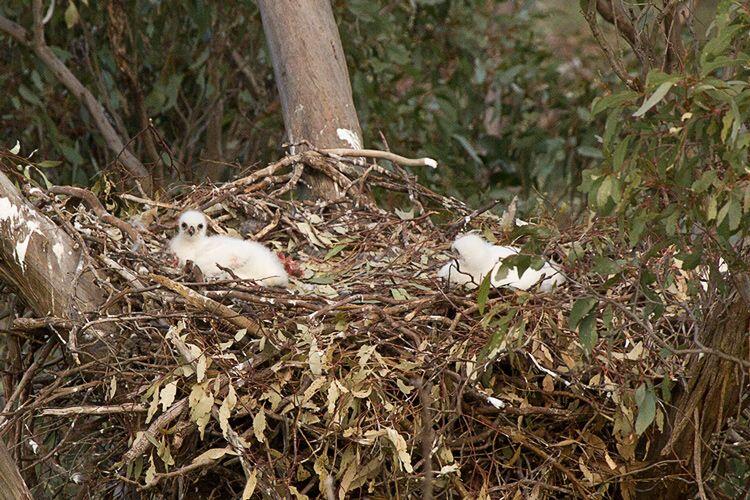
The breeding season occurs from June to October. They are monogamous, mating for life. Both the male and female groom each other during the breeding season. They build the nest together from sticks and leaves in the tallest tree in their area. The nest measures up to two metres wide and three metres deep. They often reuse the same nest year after year. A breeding pair usually only lays one clutch of eggs a year.

The female Wedge-tail lays a clutch of between 1 to 3 eggs over several days. Because of this, the eggs also hatch at different times. The female primarily incubates the eggs, while the male lines the nest daily with fresh leaves. The eggs hatch after 45 days, and chicks emerge covered in white downy feathers. The first chick that hatches is always the largest and sometimes kills the other chicks. The chicks are dependent on their parents for food for the first five weeks. The young Wedge-tail eagle leaves the nest after 12 weeks. However, they are not fully mature for six to eight years.
Threats

Wedge-tail Eagles are very common in Victoria. Sadly, farmers once considered them a menace. Convinced that the eagles carried off lambs, thousands of eagles were shot or poisoned. Subsequent research has found this false, as they rarely attack healthy lambs and never full-grown sheep. Current threats to Wedge-tails are loss of habitat due to clearing land and secondary poisoning from eating animals that have died from pesticides and baits. Road vehicle accidents also account for many deaths, with cars hitting the eagles while they are on the road eating roadkill. Additionally, wind farms also have an impact on their numbers.

Status
Wedge-tail eagles are protected in Victoria. Their status in Victoria is ‘secure’, and fines of up to $8000 apply to anyone found “killing, harassing or disturbing” the eagles.

It was the last morning of our outback road trip as a group. From here, some (like my sister and myself) would start the journey back towards home. Others planned to head further afield and keep travelling for a couple more weeks. A sunrise shoot had been tossed around the night before, but all the days had caught up with us, so the sister and I elected for a bit of a lie-in. Up at 7 am instead of 5.30 am. Naturally, the sunrise we elected to skip was the best one since the trip started. Fortunately, Julie Powell got up early 😉


We packed up our room, loaded the car, then headed over to the dining room for our last breakfast and group photo. Two people are missing as they got the meet time wrong – but otherwise, it’s our happy group.

We headed out of Mungo NP around 9 am and made our way to Balranald. Another 60 kms of dirt road or so. This was made a bit longer by the GPS sending up straight ahead instead of right. We drove 20kms down the dirt road before realising that the GPS had steered us wrong. Another U-turn sent us back the way we came and onto the right road. We would have eventually got to Balranald going that way, but it would have meant an extra 30kms of dirt road. We weren’t the only ones, though – the GPS from two other cars in our group also sent them that way before they turned back also.
Balranald
Reaching Balranald, we headed for the Visitor Information Centre. In search of morning tea, not information. They have an excellent complex with a cafe, visitor centre, toilets and museum grouped around a grassy lawn and kids play area. There are even showers in the toilets for those coming through with RVs or caravans. The cafe is excellent with fine coffee, teas and cakes. We had peppermint tea with apple and rhubarb crumble. Absolutely delicious!

After a quick fuel stop we headed to Hay via the Sturt Hwy.
Hay


Matt Adnate painted the two water towers in Pine Street Hay in December 2020. The art commemorates Lorna Whyte, George Murray, Clifford Farlow, George Cannon and Norman Flack, all local people who joined up to serve in WWII. All endured terrible hardships at the hands of the Japanese in prison camps. You can learn more of their story HERE.
From the water towers, we visited Shear Outback, a sheep shearing museum on the Sturt Hwy. I am always ‘wary’ of country town museums, but Shear Outback was excellent. Museum, shearing shed, cafe, gift shop, toilets – the museum entry is $15, but it’s def worth a stop.


The cafe featured a lot of lamb on the menu, lamb burger, lamb wrap, lamb pie.. but I couldn’t come at it…. after reading what the sheep go through for shearing and then to see there no light at the end of their tunnel (or is there? LOL) I couldn’t eat lamb that week.
Deniliquin
Our days’ destination was Deniquilan, and we were booked into the Settlement Motor Inn. The room was large, carpeted and came with a standard kettle, toaster and microwave. The shower was fantastic – loads of water pressure. After booking into the motel, we went in search of the water tower. Located in Scotts Park, Whitelock st; and painted by Cam Scale, it features two kookaburras resting on gum tree branches in front of a night sky.

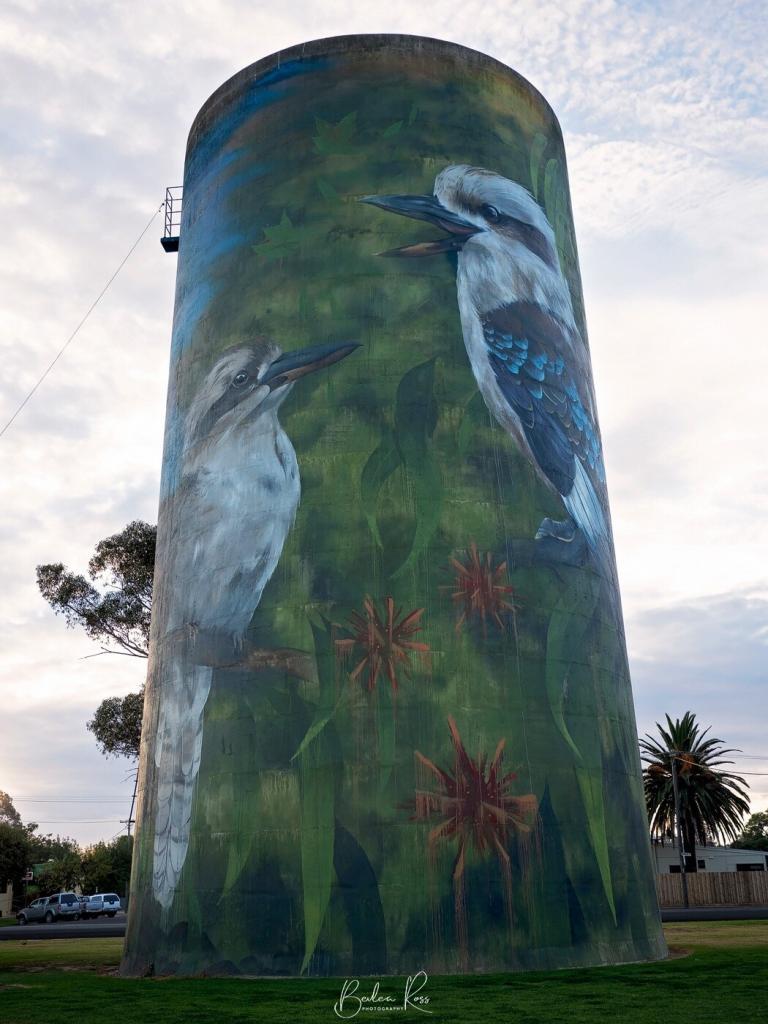
We did try for sunset, but while it started out promising – it turned into a fizzler. We called it a day, picked up Chinese takeaway and headed back to our motel room. Tomorrow would be the last leg of our journey home.

Victoria’s shipwreck coast stretches 172 kilometres from Cape Otway to Port Fairy. Along this spectacular coastline, filled with the history of over 200 shipwrecks, you will find rugged cliffs, impressive limestone rock formations, sandy bays, and raging surf beaches.

The ‘shipwreck coast’ lies within the world famous ‘Great Ocean Road’ snaking along cliffs past stunning surf beaches, Gibsons Steps, Twelve Apostles, London Bridge, Loch Ard Gorge, etc. The Great Ocean Road ultimately spans 400 km. It begins in Torquay and ends at Nelson on the South Australian border.
Shipwrecks
Bass Strait was the major shipping route for ships to Victoria. The early wooden sailing ships, and later the steam-powered metal ships, took the Great Circle Route around Cape Town before heading across the Southern Ocean towards Bass Strait. The most treacherous part of the voyage was the ‘eye of the needle’ at Cape Otway. Over 200 ships sunk between Cape Otway and Port Fairy
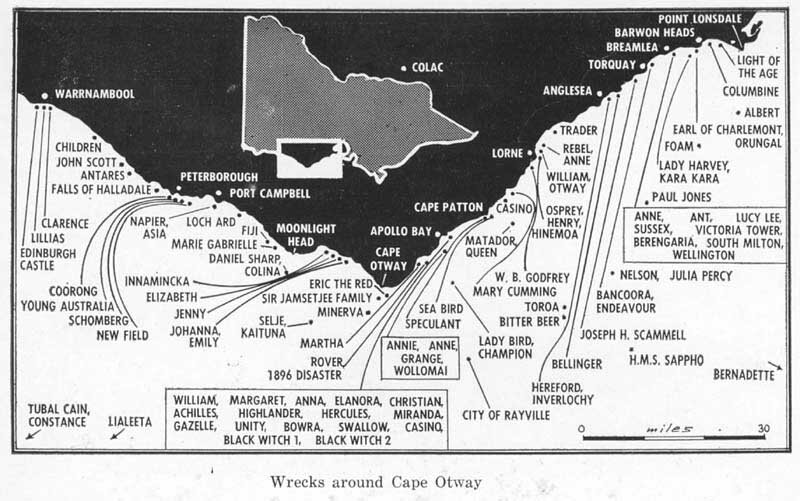
Sinking of the Cataraqui
Australia’s oldest surviving lighthouse, the Cape Otway lighthouse, was built in 1848 in response to the loss, in 1845 of the Cataraqui and 400 deaths off the coast of King Island. The Cataraqui was a 73m long barque that left Liverpool bound for Australia. Aboard were 411 people emigrating from the UK and Ireland.

At 4.30 am, in stormy weather, the ship hit a reef on the west coast of King Island, less than 100 metres from shore. By morning, the 200 surviving passengers and crew still clung to the deck, but the ship broke in two mid-afternoon, flinging survivors into the raging waters. Only nine made it to shore floating on debris. One passenger and eight crew. They sheltered on King Island for five weeks before a passing vessel, the Midge, rescued them and took them to Melbourne. The admiralty then banned ships using Bass Strait until the lighthouse was constructed.
Cape Otway
Known as the ‘Beacon of Hope’, Cape Otway is Australia’s most significant lighthouse. The beacon shines out over the Bass Strait shipping lanes. Constructed of sandstone, it was so well shaped that no cement was required to hold the tower together.

The Lighthouse
The lighthouse was the first sight of land for thousands of 19th-century migrants who had spent months travelling to Australia. The 84km gap between Cape Otway and King Island is known as the ‘eye of the needle’. Ships would hug the victorian coast to avoid being driven, in bad weather, onto reefs around King Island. However, reefs also around Cape Otway led to many ships foundering.
The lighthouse was extraordinarily isolated and received supplies only every 12 months until 1859, at which time they increased to twice a year. The lighthouse lantern was manufactured in London and consisted of 21 polished reflectors and lamps mounted on a frame. Originally running on oil, later converted to electricity, the light has been decommissioned and replaced with solar power.

Wreck Beach
Within the Great Otway National Park lies Wreck Beach. Considered a challenging walk, it’s 350 steps down to the beach where the Marie Gabrielle and the Fiji anchors lie. Both ships foundered at Wreck beach, and it’s not hard to see why. But, unfortunately, it’s only accessible at low tide and subject to large swells.

Gibsons Steps
Continuing westward along the great ocean road and 27 kms from Wreck Beach is Gibsons Steps. Named after Hugh Gibson, manager of Glenample Homestead. Gibson liked to fish and cut steps into the sandstone cliffs to get down to the beach. The 86 steps are steep, safe at low tide, and provide incredible views and the opportunity to walk along the beach beside Gog and Magog.

Twelve Apostles
Just one km further on is the world-famous twelve apostles. The seven towering limestone stacks rise 45-50 metres up from the ocean floor. The eighth stack collapsed in July 2005. The stacks were originally known as The Pinnacles and Sow and Piglets, with Muttonbird Island being the sow and the stacks, the piglets. So the name officially became the Twelve Apostles. However, there were never twelve stacks.


Loch Ard Gorge
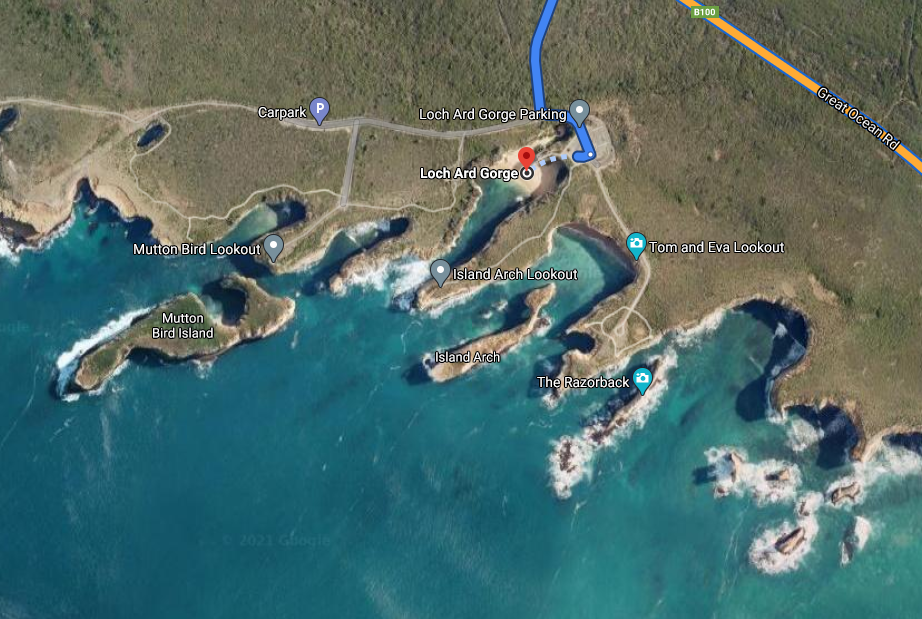
Continuing, we come to the Loch Ard Gorge. Site of the most famous shipwreck along the coast.
The Loch Ard departed England on March 2nd, 1878, bound for Port Phillip Bay, Melbourne. Captained by 29yr old Captain Gibbs, it was packed to capacity with 17 passengers, 37 crew, and a cargo hold full of expensive goods.

Sinking of the Loch Ard
On June 1st, 1878, the ship sailed into dense fog, and when it lifted at 4 am they discovered they were much closer to the cliffs than they thought. The captain ordered as much sail as possible and tried to turn the ship out to sea, but the sails fell limp. Anchors were dropped but failed to hold, and despite all efforts, the ship hit a reef on Mutton Bird Island and sank in fifteen minutes.
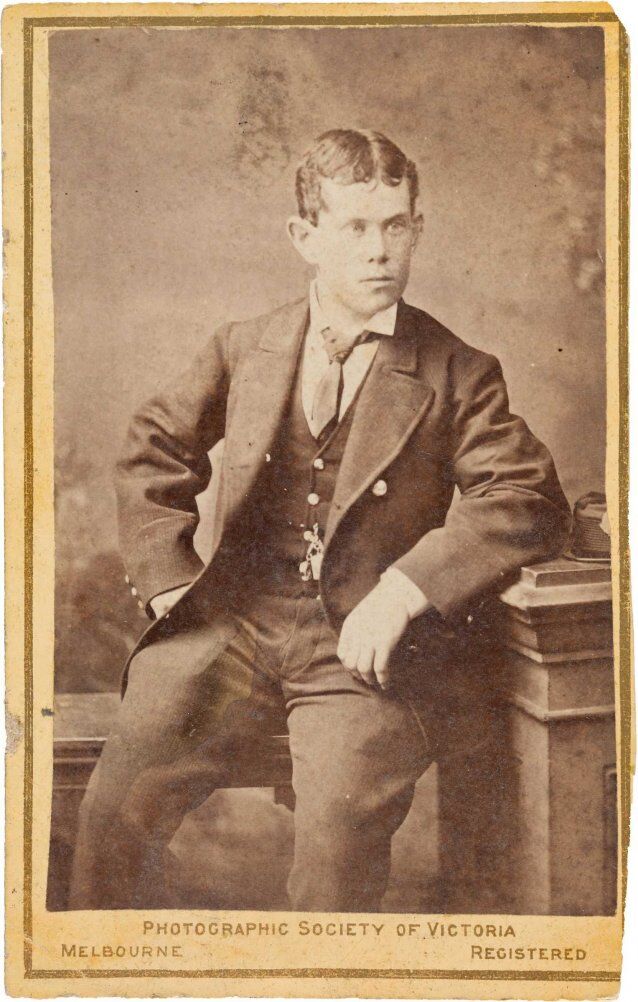

Efforts to launch lifeboats in heavy seas failed, and all crew and passengers drowned save for two. Tom Pearce, a nineteen-year-old ship’s apprentice, clung to an upturned lifeboat and made it into what is now known as the Loch Ard Gorge, where he found shelter in a cave. After five hours in the sea, Eva Carmichael, also nineteen, drifted into the gorge hanging onto a chicken coop to keep her afloat. Tom heard her cries for help and swam back out. Bringing her to safely to the beach.

They sheltered in thunder cave that night, and in the morning, Tom set off for help, climbing the cliffs of the gorge. He came across two men working the farm, and while he returned to Eva, the farmhands went back to the homestead to get help. Eva and Tom spent six weeks recovering with Hugh Gibson and his wife Lavinia at Glenample Homestead (the same Gibson from Gibson’s steps) before Eva returned to Ireland and Tom returned to the sea. In the tragedy, Eva lost her entire family, of mother, father, three sisters, and two brothers. Still, only the bodies of her younger brother and sister were recovered, and are buried in the cemetery overlooking the gorge.

Tom and Eva Lookout
The survivors have named two limestone stacks near the Island Arch and are viewable from the Tom and Eva lookout.


The Arch
Fifteen minutes past the Loch Ard Gorge is the arch. The arch would be spectacular on any other coastline, but it’s underwhelming with the competition it gets from all the other rock formations. Experts believe that with continued erosion, the arch will collapse and create a new pillar. With the viewpoint from the lookout – every image looks the same. It’s nigh on impossible to get a different or unique image of it.

London Bridge
Travelling another 15kms along the great ocean road, past Port Campbell, brings you to London Bridge. Before 1990 the bridge arch was connected to the mainland, and you could walk out onto it. In January 1990, it collapsed and stranded two tourists for three hours on the new island until they were rescued by helicopter.

The Grotto
The grotto is a beautiful rock formation that is a must see as you travel the great ocean road. This incredible, unique rock formation combines a cave, sinkhole and archway all in one. Unfortunately, eons of crashing waves and winds have caused erosion, creating a caved a sink hole in the limestone cliffs.

The grotto is a short walk along a boardwalk to the clifftop. From there, you can see the grotto arch and the stairs leading down to it. Take the stairs to the bottom, and the magical grotto opens up with its smooth rock pools and a view through the arch to the open sea. Unfortunately, there is a low wall cutting access to the pools off for safety reasons. While the wall theoretically prevents access to the pools, no one heeds it, and if you do jump the wall, be mindful that it’s easy to slip on the rocks, and they are quite sharp. Also, if the waves are crashing – you could easily get swept off the rocks.

Port Fairy
The ‘shipwreck coast’ ends at Port Fairy. Around 30 ships were wrecked in and around Port Fairy between 1836 and 1876. In addition, port Fairy is infamous for ships dragging or parting with their anchors when a southerly or southeasterly gale blows.
The Port Fairy lighthouse was built in 1859 at the tip of Griffiths Island to allow ships to locate the bay.


More info: Explore The Great Ocean Road

It’s July 2020, and Covid has created havoc across the world. I live in Victoria. The leper colony of Australia. We are now in stage four lockdown with the harshest restrictions in the world. A Nighttime curfew only allowed 5km from home during the day, shops closed, masks mandatory, businesses closing, and public transport halted. The only option for a holiday is in my imagination.

Photoshop and Luminar
My passport is Adobe Photoshop, and my mode of transport is Luminar 4. This time, luggage wasn’t a problem, nor was choosing what to wear. I made the entire trip in my pyjamas during lockdown 2020.
I gathered together images from previous holidays, fired up Photoshop and Luminar, settled into my desk chair with a coffee, and took off!
Arctic Circle
First stop was the Arctic circle – I had signed on to repatriate three lost polar bears. The boatswain took one look at my pyjamas and handed me a puffy jacket. Then, while he steered, I took photos for posterity.
Leaving the bears safely on a genetically modified ice floe (guaranteed not to melt), we jumped on a plane and headed for Cairns. Queensland. The sunshine state. No lockdown 2020 in Qld. Currently locked tighter than a chastity belt against anyone from Victoria or NSW.
Sunny Cairns

The sun was rising as we arrived and settled in. waving goodbye to Biggles as he flew away from our cuckoo nest. We spent a pleasant and warm few hours in Cairns – then hopped a hot air balloon and headed to New Zealand.

Drifting across the Tasman, we hovered over Melbourne briefly (who would want to land there!?) and watched the space shuttle take off from Princes Pier.

Stonehenge, UK

Our hot air balloon then dropped us at Stonehenge in the UK. We had heard a confluence of druids coming in on Samhain night to attempt a ritual, to drive out the virus. Unfortunately, it was unsuccessful, so the druids headed back to Avalon to report to the lady of the lake.
We bid adieu to our balloon pilot and boarded a flight for Norway. The northern lights were illuminating the skies as we flew over the fjords.

We landed briefly to stretch our legs and had a short visit with Rudolf. He was on holiday from the North Pole – he figures Christmas is cancelled this year, so he was backpacking around Europe.

To be Continued.……..

It was our last full day in Queensland before heading home the next day, and we decided to drive down to Byron Bay, see the lighthouse, and visit the Crystal Castle. Set in the hinterlands above Byron Bay, Crystal Castle and Shambhala Gardens and rainforest with massive crystals brought across South America.
Byron Bay
We woke to beautiful sunshine. At around 5 am again. I had breakfast on the balcony and read for a while before heading off towards Byron Bay at around 8.00 am. It’s only 90 mins from the Gold Coast, and we were there by about 9.30 am. Arriving in Byron Bay, I couldn’t get over how busy it was. There were people out and about and heavy traffic everywhere. Don’t people sleep in Queensland? Heading up to the lighthouse, people out walking, pushing prams, jogging, I have never seen such activity at a lighthouse. It was like it was the central meeting point for everyone in Byron Bay. And it was only 9.30 am!

Byron Bay Lighthouse
The lighthouse has around three car parks, each higher and closer to the lighthouse than the last. We drove up to the top one the parking attendant!? directed us to an empty spot. So we got out, donned hats, grabbed cameras and joined the throng to walk up to the lighthouse. The lighthouse itself is a beautiful little castle-like building at the base with battlements overlooking turquoise and blue sea. We wandered around and down the other side to get shots from the lower vantage point.

Crystal Castle
We stopped for morning tea from the lighthouse, then headed up into the hinterlands. Just 20 mins from Byron Bay is the Crystal Castle and Shambhala Gardens. Entry is $25 and totally worth it. A memorial gate to Tori Johnson is inside the gates, donated by his family. Tori was tragically killed in the Lindt Cafe Siege in 2015.

I would have liked more time here to take in some of the daily events… we missed the music of the plants as by the time we had walked around the gardens, it was quite warm, and we wanted a chair and cold drink 🙂


The Stupa
The gardens are quite large, and to be done properly, and you really need a full day here. We stopped at the Peace Stupa and availed ourselves of the umbrellas dotted around for protection from the rain or sun while we enjoyed the music emanating from the Stupa.


with our walk around finished. We enjoyed a delicious lunch in the cafe before enjoying some retail therapy in the crystal shop. From there, it was back to the car and back to the apartment.


Our last night on the balcony, we finally took some night shots of the city lights. The next morning it was pouring with rain, and all the next week too, but we were home by then 🙂

In 1930, the then Board of Works created a Redwood Forest at Warburton. This one predates the Otways Redwood Forest by about nine years.
They cleared some eucalypt trees and planted Bishop Pine, Douglas Fir, and Californian Redwoods in their place. This was done for “experimental purposes as part of the Board’s hydrology research program”. Over 1476 trees range from 20 metres to the tallest being 55 metres. I don’t know what happened to the program, but the trees are still there for unrestricted access, and the site is just magic. The site is now heritage listed on the Victorian Heritage Database, ensuring survival from logging.

The Yarra River runs along the back of the forest…
and we headed to this first, trekking through a narrow goat track and undergrowth to find the river, and then found a wide path coming back. In the forest, none of us thought to record our Indiana Jones moment 🙁
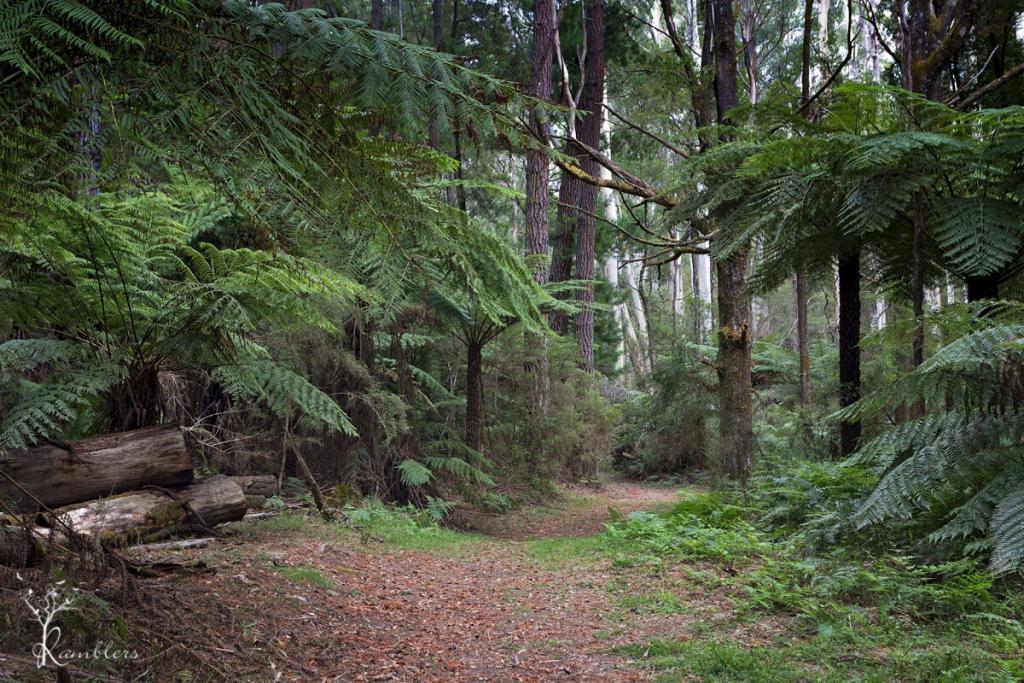
The river is lined with lush green tree ferns, water tumbled and washed over rocks. Not a sound except for running water and the birds. We were only able to get down to the river at one point, with high banks preventing access most of the length, but the spot we found was beautiful, and we spent about an hour there.
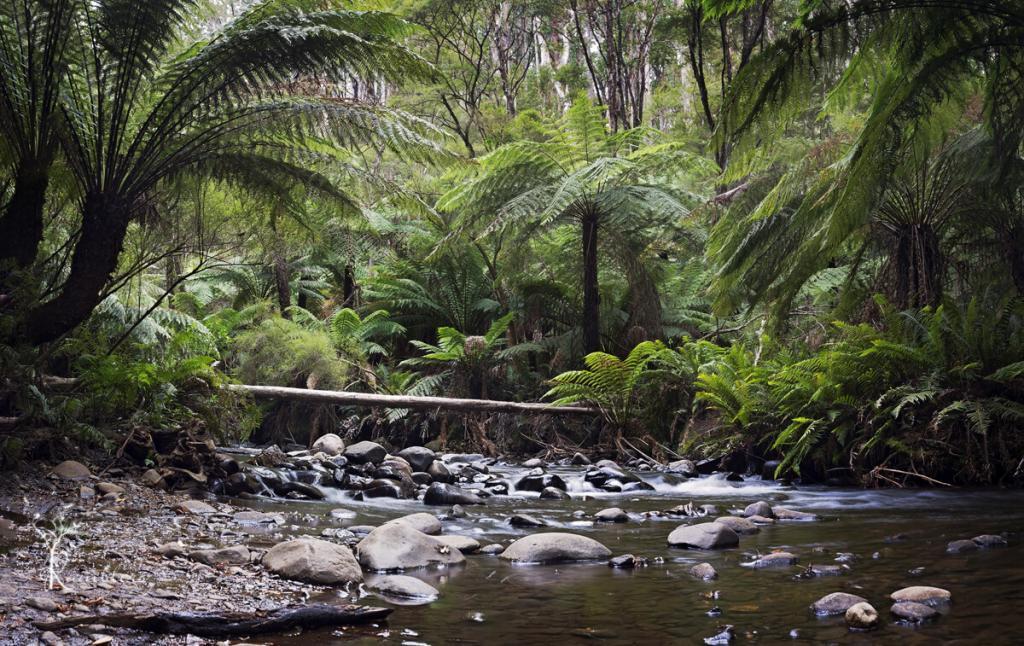
Back in the forest, we found more ‘odd’ evidence on what happens in a Redwood Forest (on a full moon?). Dotted throughout the forest were circles made from twigs and branches and, in one instance, a small shelter. There were dozens of the circles, a couple shaped like large nests, more than a bit ‘Blair Witch’ and no way would I go in there after dark 😉
Getting there:
Drive through Warburton, following the Warburton Highway until it becomes Woods Point Road. After about 7 km, take Cement Creek Road on the left. The road is unsealed and a little rough in places, but 0.7 km along, you will find a small parking area on the right along a fenceline and a small gate barrier. Walk through the gate, and there you are. Walking through the plantation will lead you down to the river, following the walking tracks each way.