
Tag:emu

Nestled in the beautiful Ovens Valley at Eurobin is the Red Stag Deer and Emu farm. The 70-acre property is beside Mt Buffalo National Park and twenty kms from Bright in Victoria’s beautiful high country. The Red Stag Deer and Emu farm began as a tourist farm & coffee shop in 1992. Since then, it has grown into a restaurant, function centre, gift shop and farm stay accommodation.
Visitors at the Red Stag Deer Farm can dine in the a la carte restaurant while enjoying stunning alpine views of the Ovens Valley, including the beautiful Mt Feathertop. And yes, the menu also includes venison, kangaroo and emu meat for customers to try. In addition, to the 200 red deer are emus, ostriches, pigs and goats, all of which visitors can hand feed.

Red deer
Red deer (Cervus elaphus) is a species of deer native to Europe, Asia and North Africa. They are an introduced species in Australia. In 1860, Prince Albert sent six deer from Windsor Great Park in the UK to Thomas Chirnside, who was starting a herd at ‘Werribee Mansion’ in Victoria. Before long, the herd flourished, and Chirnside sent deer to New South Wales, Queensland, South Australia, and Western Australia.

Male red deer are ‘stags’, and female deer are ‘hinds’. The males have impressive antlers which can measure up to a metre wide and weigh up to 15kg. A mature red stag is 120cm tall at the shoulder and weighs between 135 to 160 kg. Females are 90cm tall at the shoulder. Their name ‘red deer’ comes from the rich, russet brown summer coat. In winter, the coats vary between dull brown to grey. They are herbivores, and their primary diet is woody trees and shrubs, as well as grasses. Red deer are social animals and live in herds dominated by a single female. Red stags have a lifespan of around 10-12 years in the wild and up to 20 years in captivity.
Breeding
The breeding period is April, and females will give birth after an 8-9 month gestation period. During the breeding season, male red stags will engage in elaborate displays and battles for mating rights, using their antlers to compete with other males. Males are only territorial during mating season.

Deer Antlers
Deer antlers are the fast-growing, bony outgrowths on the heads of male deer (and some female deer) that are used for display and to compete for mates during the breeding season. Antlers are made of bone and are covered in a soft, velvety skin called velvet, which is rich in blood vessels and helps to nourish the growing antlers. After the breeding season, the velvet dries up and is rubbed off, revealing the hard, bony antlers.

Antlers are also highly valued by hunters, who collect them as trophies, and by some cultures, who believe they have medicinal properties. Antlers are also used in traditional Chinese medicine, and they are used as an ingredient in tonics and other remedies. Additionally, antlers are used to make knife handles, walking sticks, and other decorative items.
Velvet
Red deer produce 10-15 kg of velvet from their antlers annually. After the rut, a drop in testosterone causes the connective tissue to weaken, and the antlers drop off painlessly. They then grow a new set. The antlers become bigger each year as the stag ages. The velvet on the new set is ready to be harvested after approx. 60 days. Specially trained farmers or veterinarians sedate the animal before harvesting the velvet. If left on the antler, it hardens and calcifies into bone with sharp points. Deer Farms are advised against leaving the velvet on the antlers as, during the rut, they can be lethal to humans and other stock.

The Chinese have prized velvet for health-promoting properties for over 2000 years. In western countries, it is now sold as a general tonic and as medication for osteoarthritis and rheumatoid arthritis. Athletes use velvet as it helps heal cartilage and tendon injuries more quickly. In addition, laboratory and animal studies have shown that pilose, a protein found in antler velvet, has an anti-inflammatory effect.
Location
Entry is free to the petting section – The mini golf is $6 pp
Red Stag Deer and Emu Farm is at 324 Hughes Lane, Eurobin, Vic 3739
Open daily from 10 am to 4 pm

We were taking the visiting Scottish cousins away for three days to the Grampians and chose the Northern Grampians. Why the Northern Grampians and not southern, western, eastern, because not only for the abundance of wildlife, but they have most of, the iconic natural attractions found in the Grampians. Boroka Lookout, Reids Lookout, The Balconies, Mackenzie Falls and The Pinnacle can all be found a short drive from Halls Gap, a comfortable 3 hr drive from Melbourne.
We had visited the Northern Grampians in 2016 again basing ourselves in Halls gap. This time around we booked into Halls Gap Log Cabins, nice two bedroom cabin, and very comfy and handy to everything.
Wildlife at Northern Grampians
Every day as the sun went down the ‘roo’s came into the grounds. The owners, as a result, never need to mow their lawn here 😉


Another frequent visitor in the late afternoon were the emu’s. They turned up like clockwork every afternoon around 5pm in the large open paddock behind the cabins, wandering around foraging, only slightly interested in mad tourists.
We made the mistake, on the the first day of feeding a magpie…. I know, I know, I can hear you shaking your head. Within minutes we had a host of cockies joining the maggies.. and they ended up getting the lions share of the twisties!

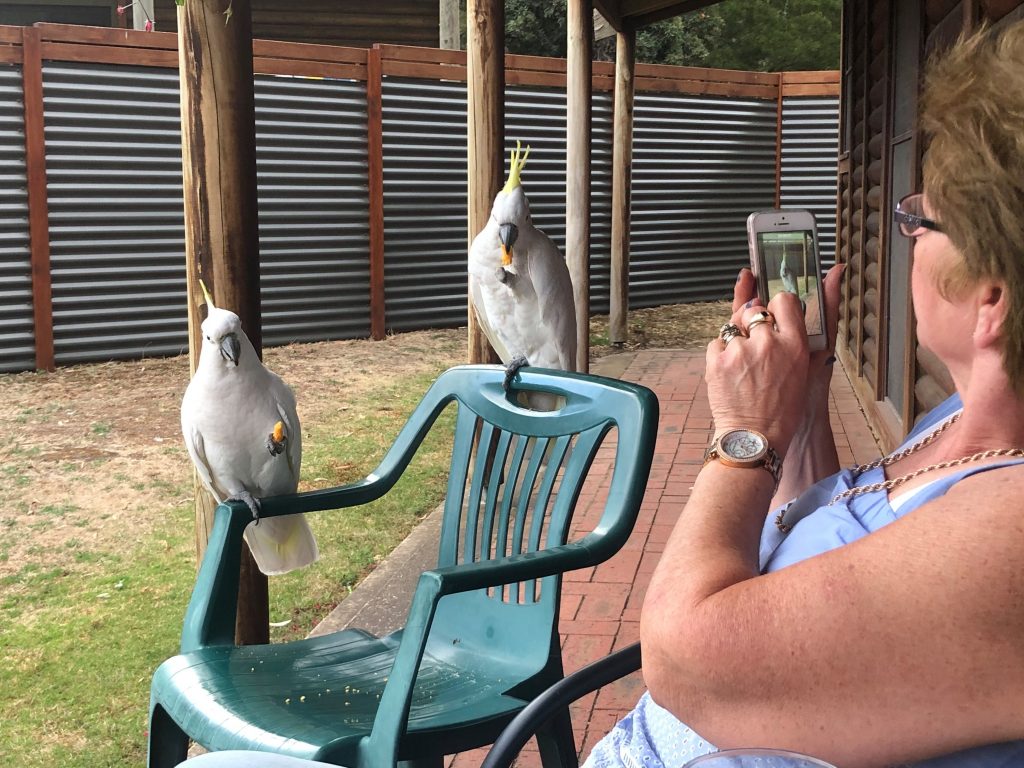
Due to seeing a sign next morning, ‘please dont feed the birds’ we hung our heads and shame and refused to feed them next afternoon when they came calling.
Country Roads
We headed out next morning with plans to visit Boroka Lookout, Mackenzie Falls and Reids Lookout… unfortunately Google Maps on my phone directed us down a poorly signposted dirt road for about 30kms, then told us in the middle of nowhere “you have arrived”. By now, we also had no phone service so we kept following the road for about another 20kms. We came to a sign saying Halls Gap, and took it. Continued on the dirt road, for a few more kms, then came to a fork in the road, with no idea which way to head. Asses Ears Road or Rosebrook-Glenisla Road? Neither sounded a good idea.
Wondering which road to take, and with visions of search and rescue finding our bleached bones in 30 yrs time, I suddenly realised that right at this spot, I had four bars of service! Plugged in Halls Gap and off went again. Back the way we had come. Just a few yards down the road service dropped to one bar then none, but by now, I had the maps loaded. We eventually came back out at Northern Grampians road with a signpost to the lookouts and falls. Cue the applause in the car. We had just done a needless, 50km plus dirt road detour.

On the upside, we saw loads of wildlife, and while they moved way too fast to photograph, or get near, we did spots lots ‘in the wild’. From Kangaroo’s, Wallaby, Emu’s even a deer or two on these rarely travelled (by smart people) tracks.

Back on solid, man made roads we hot footed straight to Mackenzie Falls. Having absolutely no intention of going to the bottom of the falls, we took a couple of walks to view Broken Falls and Mackenzie Falls from the top.
Mackenzie Falls


Boroka Lookout
Leaving Mackenzie Falls behind we drove to Boroka Lookout.

Where both the MOTH and a visiting Scottish cousin ducked through the railing for a photo op


The rest of the day was taken up with non photographic but enjoyable stuff like eating, drinking, watching clouds go by….
Next Morning……..

Waking up next morning, we found the sun had gone.. .light misty rain was coming across the hills. We decided instead to visit Dunkeld in the Northern Grampians sector. Not the best idea. Rain pelted down as we were leaving the and the mountains had heavy cloud hanging over them

Arriving in Dunkeld we headed to the Arboretum. Maintenance was being done on the pier I wanted to shoot and it was completely blocked by fences and workmen. Plan B, we’ll go to the museum in the old railway station. Closed. Only open sundays and public holidays. After 1pm. **heavy sigh** Plan C – lets go to the bakery.

Set back off the main road in a suburban street the bakery is obviously well known as on a wet tuesday it was still busy. The carrot cake and coffee were delicious. No photo. Ate it too quick 😉
The Balconies
Leaving the town that was almost awake we drove back towards Halls Gap. By now the weather was improving so we decided to go to The Balconies on the way back. They are at the same carpark as Reids Lookout, but it had been too warm to do the uphill walk the day before.
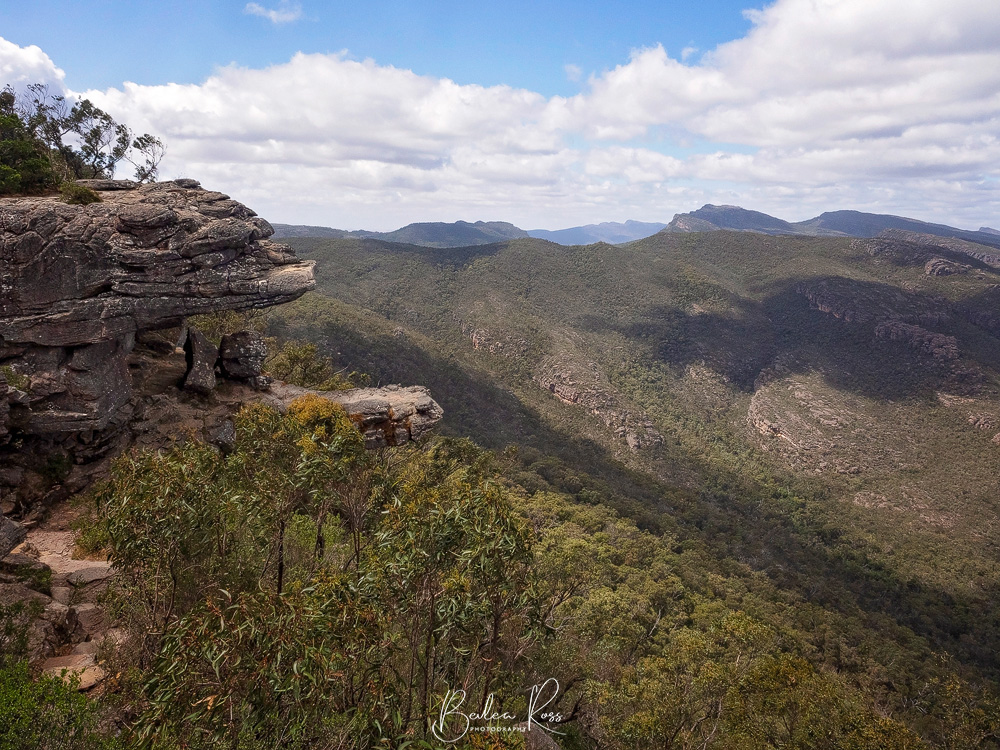
The walk is supposed to be ‘easy’ as its only 1km each way. “Suitable for all ages and fitness”. According the to brochures its a ‘slight incline’. We, however, made use of the chairs on the way up and arrived sounding like asthmatic steam trains. Obviously our level of fitness is considered extinct and not worth mentioning.

This time I didn’t need to encourage the MOTH to climb the barrier and go out on the balcony. Not that I would have suggested it this time – it was blowing a gale up there. But an unknown man who “has done it heaps of times its quite safe” went out there for a friend and we snapped his pic as well.

Next day we headed back home to Melbourne…. had a lovely three nights there with Scottish girls. I thoroughly recommend the Halls Gap Log Cabins. Comfy stay and wildlife at your door, (and the shower was awesome)