
Tag:country

Located in Murchison South, Victoria, Days Mill is a well-preserved steam-driven flour mill with a rich history. It’s also considered the best-preserved flour mill from the 19th century in Victoria. The property spans four hectares of land in the Goulburn Valley, south of Murchison, and includes the mill, a residence, and farm buildings. The mill contains all the original milling machinery in its original setting, just 150 km north of Melbourne.

History
Days Mill was established in the late 1850s by William and Ann Day, migrants from England. William ran the flour mill, a bush sawmill, and a punt on the Goulburn River. Ann also ran the local store. In August 1870, William was thrown against a fence by a cow suffering severe injuries to his legs and arms. He never fully recovered from this accident and died in 1872.
After her husband, William passed away, Anne was left to care for her seven children, aged 5 to 19. Thankfully, William’s estate was worth more than £5,000, which provided Anne with financial security. From 1872 to 1891, she successfully managed the farm and the mill, making it one of the most advanced properties in the area. Through a collection of letters, it’s evident that Anne was a capable and determined woman excelling in the male-dominated Victorian business world. Her letters document her struggles with poor selectors and her endeavours to sell flour in the Melbourne market. They also shine a light on her disputes with tardy agricultural machinery manufacturers and her efforts to sell her farm’s produce at a reasonable price in Melbourne.

By 1870, traditional rural mill stone operations were being displaced by new iron roller technology. This led to the cessation of the mill’s commercial operation in the late 1880s. Anne Day, who had been farming and storekeeping, retired and passed on the reins to her eldest son, Joseph. The property then functioned solely as a farm, with Joseph occasionally grinding chicken feed for his neighbours. In 1910, Joseph extended the size of his farm by acquiring an additional 320 acres. Meanwhile, his younger brother, Henry, acquired 244 acres.

The Buildings
The exact date of the residence’s construction remains unknown. However, the Day family believes the kitchen area was built around 1865, which coincides with the mill’s construction. The two-story house featured a cast iron verandah and was constructed later. The interior walls are adorned with hand-painted stencils and marbling that date back to 1910.

The Mill complex includes a complete collection of farming and flour milling equipment from the nineteenth century. Entering the property, past the gatehouse, down a long driveway lined with peppercorns and pine trees, brings you to a two-story brick house beside the three-story brick mill. In addition, a granary annex with a two-story surrounding veranda was constructed around 1905.
The mill operated using a unique early E T Bellhouse steam engine connected to a Cornish boiler that is still fully functional. There are also several other buildings, such as a stable, chaff shed, blacksmith, butchery, dairy, shearing shed, milking shed, piggery, and chook shed. The original machinery and equipment have been preserved. These include three under-driven millstones, grain and meal elevators, a bolting reel, an air leg aspirator, a sack hoist, and other equipment.

Heritage listed
The Day family owned the Days Mill until 1985, after which the Department of Conservation Forests and Lands acquired it. Since 1996, the Days Flour Mill Complex has been under the management of Parks Victoria. Visiting the mill complex by appointment or during special events held throughout the year is possible.

The Days Flour Mill Complex is a remarkable representation of the milling techniques commonly used in the 19th century. It consequently has earned a spot on the Victorian Heritage Register. The Victorian Government’s Living Heritage Program in 2018/2019 granted it $500,000. This funding allowed significant conservation efforts on the Mill, Gatehouse, and Residence buildings. Reconstruction and repair of the roof, brickwork, windows, chimney, and Pulley House were also made possible by the grant.

Days Mill is located on Day Road, Murchison

Mooroopna, situated in the Goulburn Valley region of Victoria, Australia, boasts a fascinating history. Before European settlement, the Yorta Yorta and Bangerang peoples had occupied the land for several millennia. James Cowper was the first European squatter to establish a residence in the area in 1841. In the 1870s, Mooroopna had already flourished into a thriving agricultural hub. Eventually, in 1865, it was officially surveyed and recognized as a town.

Early History
By 1888 Mooroopna had eight hotels, a flour mill, two banks, four insurance agencies, a State school, a hospital, four churches, and a mechanics institute.

War Years
During World War II, Mooroopna played a vital role in the war effort. The town was home to a training facility for the Australian Army, known as the Mooroopna Recruit Reception and Training Depot. The depot was established in 1940 and provided basic training for new recruits before they were sent to other army camps for further training.
Mooroopna War Memorial
The Mooroopna War Memorial stands at the intersection of McLennan Street and Vaughan Street, situated in the heart of Mooroopna. This monument is a tribute to the brave men and women from the Mooroopna district who selflessly served in the armed forces during World War I, World War II, and other conflicts. Additionally, it bears the names of the 145 enlisted men and 21 serving nurses who received their training at Mooroopna Hospital.

Amidst a landscaped park, pathways lead to a war memorial featuring a stone obelisk within a rotunda. The names of the brave soldiers who lost their lives are inscribed on the sides of the obelisk. Surrounding the rotunda is a circular garden bed with a tall flagpole at the centre. Notably, the memorial was unveiled on ANZAC Day, April 25th, 1928, by Lieutenant General Sir John Monash, and a large crowd of locals, many of whom had lost family members in the war, were in attendance to pay their respects. Trees and benches can also be found in the area, offering a peaceful retreat for those who wish to reflect and remember.

In 2020 the Greater Shepparton City Council allocated $320,000 to upgrade the war memorial. Funding also came from the Mooroopna Rotary Club, the Victorian and Federal governments, and private donors. Significantly the upgrade included new flagpoles and memorial panels. New concrete paths, lighting, a rose garden and irrigation were also added.
Mooroopna Hospital
The Mooroopna Hospital was built in 1876. At first, it began as a small timber hut on the Goulburn River. The hospital treated injuries and accidents as the nearest doctor was forty-two kms away in Rushworth. From 1910 to the 1930s, the hospital underwent a significant rebuild and was the main hospital in the region until the Shepparton Base Hospital opened. This eventually saw the closure of the Mooroopna Hospital in 1974.

Unfortunately, on January 9th 2011, the abandoned hospital was gutted by fire. It had been slated to be converted into a nursing home then. After the fire, the developer applied to demolish the laundry and main entrance. He submitted an engineering assessment that repairing the damage was “probably not feasible”.

The Heritage advisor opposed demolishing the hospital due to its “historical, social, aesthetic and architectural significance”. Independent engineers also determined that 70% of the building was undamaged and heritage elements could be included in any development. Since then, it has sat empty and at the mercy of vandals and graffiti taggers.
Mooroopna Museum
The museum and gallery are located at the back of the old Mooroopna Hospital in a former nursing home. It boasts the biggest historical medical collection in regional Victoria, comprising fifteen rooms and hallways filled with remarkable artefacts. The archaic operating theatre and patient rooms are the museum’s prime attractions. Visitors will also find nurses’ uniforms, medical apparatus, and a dentist’s chair serving as a reminder of how much medicine has progressed since its early days.


Cows and Statues

The main street has a spacious median strip dotted with part of the unique ‘Moooving Art’ herd. Additionally, there is a statue of Jack Findlay, a well-respected local figure. Born in Mooroopna in 1935, Jack Findlay was a skilled Australian Grand Prix motorcycle racer. Findlay is one of only four riders who have achieved a twenty-year Grand Prix racing career. He is recognized for his exceptionally long racing career in Grand Prix history, and his achievements are celebrated through the monument dedicated to him.


The Blue Mountains, situated in New South Wales, Australia, is a stunning mountain range that has been designated a World Heritage site. Only 80 kilometres west of Sydney, they boast a variety of hiking trails, rock-climbing paths, and awe-inspiring scenic views. The Blue Mountains at Katoomba are also home to the famous Three Sisters, a popular tourist spot that draws visitors to the area.
Early History
The Blue Mountains and the Great Dividing Range presented a formidable obstacle to the early European pioneers who sought to settle and explore Sydney and its surrounding areas. These settlers viewed the range as an intimidating wall of sandstone cliffs, deep gorges, and thick vegetation. Due to the challenging terrain, settlements were limited to coastal areas, and the seemingly impenetrable mountains made it difficult if not impossible for pioneers to venture beyond these areas. Consequently, the Blue Mountains remained largely unexplored for many years.

This all changed, however, when in 1813, Gregory Blaxland, William Charles Wentworth, and William Lawson set out to cross the Blue Mountains to find a way into the unknown interior of Australia. Unlike many before them, they successfully crossed the mountains, completely the journey in only three weeks and reached the western plains. Thus becoming the first Europeans to do so. Previous explorers had looked for a route through the valleys. Unlike previous explorers, Blaxland, Wentworth and Lawson’s expedition crossed the mountains by traversing the ridges rather than the valleys. Their journey opened the interior to further exploration and settlement, eventually leading to the development of new towns and communities beyond the mountains.
World Heritage Listing
The Blue Mountains was added to the World Heritage Register in 2000 due to it’s exceptional natural beauty, biodiversity and outstanding examples of global geological processes. The site also includes the Blue Mountains National Park and several adjacent conservation reserves, covering approximately 1.03 million hectares.

The region is well-known for its rugged sandstone cliffs, deep canyons, and eucalyptus forests. It boasts a rich biodiversity with diverse plant and animal species. The Blue Mountains is also home to numerous Indigenous cultural sites, such as rock art, ceremonial grounds, and scarred trees, which hold significant cultural value for the area.
The Three Sisters
The iconic Three Sisters at Echo Point are three sandstone peaks that rise from the Jamison Valley below. The peaks are named Meehni, Wimlah, and Gunnedoo and are said to be named after three Indigenous sisters. According to local legend, the sisters were turned to stone by a witch doctor to protect them from an unwanted marriage. The Three Sisters is a significant Indigenous cultural site, and the local Indigenous community consider it a sacred site. It is also a popular spot for hiking and rock climbing, and visitors can take a scenic walk to the base of the formation.

The Jenolan Caves
The caves are a complex system of twenty-two limestone caves and are over 340 million years old. Apart from being considered one of the most spectacular cave systems in the world, they are also the oldest caves in Australia. Within Jenolan Caves are an extensive network of underground passageways and limestone formations, including stalactites, stalagmites, and helictites.

The caves were first discovered by Europeans in the early 1800s, and before long, became a popular tourist destination. Today, the Jenolan Caves are one of the most popular tourist attractions in the Blue Mountains. Visitors can take various guided tours and activities, including self-guided, adventure-caving, and lantern-lit tours. The caves are also a significant site for speleology and have been the subject of much scientific study.
Lennox Bridge
The Lennox Bridge is a historic sandstone arch in the Blue Mountains, New South Wales, Australia. It was designed and built by Scottish stonemason David Lennox between 1833 and 1837. Significantly, the bridge is the oldest surviving stone bridge on mainland Australia and spans the historic Mitchell’s Pass over the Coxs River. It is a particularly popular spot for tourists and photographers. The bridge is also listed on the New South Wales State Heritage Register.

The Hydro Majestic Hotel
The Hydro Majestic Hotel is an iconic hotel situated in Medlow Bath. Constructed by Mark Foy, a prosperous Australian businessman and theatrical impresario, in 1904. The hotel boasts an Edwardian style of architecture with a blend of Art Nouveau and Federation designs. It’s grandeur and unique architecture make it a significant landmark. The United States Department of Defence occupied the Hydro for a brief period during WWII, and it served as a hospital for American casualties from battles in the Coral Sea and South Pacific.
The hotel underwent several renovations over the years. Today it continues to operate as a hotel, offering accommodation, dining, and spa services. The Hydro Majestic Hotel is listed on the New South Wales State Heritage Register for its architectural and historical significance. It is undoubtedly considered one of the Blue Mountains’ most iconic heritage buildings.
The Katoomba Scenic Railway
The scenic railway is a historic railway forming part of the Blue Mountains Line, connecting Katoomba to the Jamison Valley below. Known for its 52° steep gradient, it descends over 300 meters (984 feet) through a cliff-side tunnel. It is one of the steepest railways in the world.

The railway was constructed in the early 1900s for the transportation of passengers and goods. As of now, it still functions as a tourist attraction, providing visitors with a picturesque journey through the Blue Mountains.
Govetts Leap
Govetts Leap is a scenic lookout in the Blue Mountains’ Blackheath area. The lookout offers a panoramic view of the Grose Valley, a deep gorge carved by the Grose River, named after William Romaine Govett, a surveyor who was the first European to discover the viewpoint in 1831. Govetts Leap lookout is a popular spot for tourists and hikers, offering a range of short and long walks.

Govetts Leap also offers breathtaking views of the Bridal Veil waterfall, a popular photography spot. The view of the valley is considered one of the most spectacular in the Blue Mountains. It’s a must-visit destination for anyone visiting the area.
Waterfalls
Within the Blue Mountains are several beautiful waterfalls. Some of the most popular waterfalls in the area are the following:


Best time to visit
The best time to visit the Blue Mountains in New South Wales, Australia, depends on your personal preferences and the activities you plan to do.
- Spring (September-November): The weather is mild, and the wildflowers bloom. It is also an excellent time for bushwalking and enjoying the area’s natural beauty.
- Summer (December-February): The weather is warm, and the days are long, making it the perfect time for swimming and picnicking.
- Autumn (March-May) – The weather is mild, and the trees are changing colours. It’s an excellent time for photography and scenic drives (and also a perfect time to pop over to Mount Wilson)
- Winter (June-August): The weather can be cold, but the crowds are minimal. However, it is an excellent time for those cosy fireside and log cabin holidays and winter sports like skiing and snowboarding.
The Blue Mountains provide a diverse range of experiences throughout the year, with each season offering something special. It is essential to remember that peak season can get quite busy, so it’s wise to consider this when organising your trip.

In 1999, the marketing committee of Shepparton Show Me introduced Merry Moos for a Christmas campaign. The Merry Moos was so successful it evolved into Moooving Art. The Shepparton cows all sport whimsical artwork and are forever moooving around Shepparton and the Goulburn Valley.

Moooving Art Shepparton is a tribute to the strength of the dairy industry in Greater Shepparton. The region produces a large percentage of Australia’s dairy exports, evidenced by the number of grazing cows driving through the Goulburn Valley. Therefore, cows were an obvious choice for public art. Moooving Art is both a unique and innovative way to increase the dairy profile while also increasing public art in the region.

Moooving herd
There are ninety cows in the herd, scattered around towns in the Greater Shepparton area. However, not all are on display at one time. Shepparton Council publishes a list of locations; however, as the herd is always on the move due to events or repairs – it’s not always up to date. As of January 2023, thirty-seven cows are out to pasture Due to sun damage and wear and tear, some are waiting to be repaired, and others are having a makeover.

Certificate of Excellence
The three-dimensional, life-sized cows are the canvas for emerging artists to paint and decorate. In 2018 Moooving Art was awarded a Certificate of Excellence by Trip Advisor


Just over two hours from Melbourne, nestled in the beautiful tableland of Strathbogie in Victoria’s northeast, is Sunnymeade Cottage Garden, Kithbrook (not to be confused with Sunnymeade at Anglesea). In days past, the area was previously home to infamous bushranger Ned Kelly, gold miners and tree loggers. Today it’s a quiet rural area, home to vineyards, farms, farm stays, and our destination – Sunnymeade Cottage Garden for a rare open day.

Garden Plan
Craig Irving started Sunnymeade Cottage Garden in 1986. In 2017 Sunnymeade won the Melbourne Cup Tour and VRC Australian Garden competition. The garden is laid out along the lines of interconnecting rooms. An Incan wall garden and a circular lawn are enclosed by towering hornbeam hedges from Europe. A Persian garden invites you into the tiled pavilion.

Further along, is the Yellow Garden boasting an iron arbour with wisteria. A rose garden with old-fashioned roses with a Victorian-era gazebo to sit in. Additionally, there is a medieval garden, a walled garden with a moon gate, a rose walk, a sunken garden, a fruit garden and an Egyptian garden.

Unhelpful weather gods
The day before our visit was in the high 30s, and we had everything crossed that our day wouldn’t be so hot. Unfortunately, the weather gods granted our wishes but went a little overboard with the cool change, giving us bland white skies and no sun. We even had a quick rain shower as we walked around (taking refuge in the gazebo).


Topiary Trees
I love Topiary, and Craig has undoubtedly mastered the skill. His immaculate hedges and spiral trees were a delight. However, while I thoroughly enjoyed our visit, I wished we had sunshine and blue skies. Maybe, fingers crossed, it will be open again in spring.


The Yea Wetlands is a 32-hectare flood plain adjacent to the Goulburn Valley Highway and a short walk from High Street. Home to many Australian marsupials, birds and aquatic creatures, the wetlands are a haven of peace and tranquillity encompassing natural bush and riverine floodplains. The Discovery Centre opened in August 2014 due to the dedication of the community and volunteers. Also added were the suspension bridge and raised boardwalks.

A neighbouring property owner graciously agreed to relinquish a crown land license. This enabled the construction of a track between the Centre and the suspension bridge. Native trees, endemic to the area, replaced the willow trees and noxious weeds that were choking the waterway.
Walking trails
Wetlands are areas of land that are saturated with water, either permanently or seasonally. They are characterized by unique hydrological, chemical, and biological characteristics and are typically classified as marshes, swamps, bogs, or fens. Wetlands can be found in various environments, including coastal areas, river deltas, and the edges of lakes and ponds. Accordingly, they provide essential habitats for many plant and animal species and play critical roles in water management and carbon sequestration. They also provide various ecosystem services, such as water purification, flood control, and shoreline stabilization.
Grade 2: Distance: 2 Km. The walk begins at the Franklin Track and crosses the Yea River via a suspension bridge. Keep a lookout as you cross the bridge; Platypus and Rakali (native water rat) regularly forage along the river bed. The walk features information boards along the route and a bird hide overlooking a pond. A leisurely 45-60 min stroll allows you to come across Koalas and Sugar Gliders as well as Azure and Sacred kingfishers, spoonbills, Platypus and Rakali.

Discovery Centre
The Yea Water Discovery Centre is a multi-purpose facility incorporating an accredited Visitor Information Centre and an Interpretive & Educational Centre. They offer visitor information in the form of maps and brochures as well as accommodation and travel guides. There is also a gift shop, free wi-fi, public toilets and meeting room hire.

Upgrades to the Wetlands
In July this year, the Yea wetlands successfully received a grant of $375,000 from the Victorian Government’s Regional Tourism Fund. The funding will go towards an upgrade of the precinct. The upgrade will include a 700m extension of the existing walk, named Yea River Kayigai Trail. In addition, the Cummins Lagoon will be extended to include a Riparian Zone.
A new bird hide and a sculpture trail will be added, focusing on the Taungurung people and their connection to the Country, and the exhibits in the Discovery Centre will be refurbished. Works are expected to be completed by mid-2024.
Preserving wetlands is essential for maintaining the ecological, economic, and societal benefits they provide. Some preservation strategies include:
- Protecting existing wetlands through regulations and laws such as Environment Protection and Biodiversity Conservation Act 1999.
- Restoring degraded or destroyed wetlands through reforestation, re-vegetation, and other management practices.
- Creating new wetlands by constructing artificial ponds, marshes, and swamps.
- Implementing conservation programs and policies to protect wetlands and their associated species and educating the public about their importance
- Collaborating with local, state and federal government and other organizations to protect and implement conservation plans.


It’s important to note that preserving wetlands requires an integrated approach involving different stakeholders and a long-term commitment to ensure the sustainable use and protection of wetland resources.

Sunflowers are known as ‘happy’ flowers due to their association with the sun. While not as plentiful in Victoria as the spring canola fields (the primary location of sunflower fields in Australia is NSW and Qld), there are still a few sunflower fields in Victoria to satisfy photographers. Western Australia also has an emerging sunflower industry.
Sunflowers are giant, bright, beautiful flowers popular with photographers worldwide. In Australia, they bloom from January to March. The meanings of sunflowers include happiness, optimism, honesty, longevity, peace, admiration, and devotion. No other flower exceeds it for its ability to make people smile. Popular with nature photographers and photographic enthusiasts, sunflowers look great, either as a single flower or in their thousands in fields.

Ethical Sunflower Photography
Photographing sunflower fields full of blossoms has become popular in recent years due to social media posts. However, that popularity has also brought out thoughtless photographers who ruin it for the rest of us. Like Canola fields, the critical rule when photographing sunflower fields is remembering the Do Nots.

Sunflower fields are farms on private land. However, some sunflower farmers will allow visitors into portions of their fields while protecting other fields. Visitors can take photos and pick the flowers for a per stem cost.

Grow Your Own
Many Sunflowers can be successfully grown in suburban backyards, from giant to dwarf types, such as Dwarf Sensation. For those who suffer hayfever or bee problems, you can even get pollen-free varieties such as ‘Teddy Bear’, though they look more like chrysanthemums than sunflowers.

Plant the seeds in late spring or early summer when the ground is starting to warm up—plant in well-drained soil enriched with some compost. Place them where they get six to eight hours of sun daily. They can even be grown indoors if you place them near a north-facing window!
Plant each seed 60cm apart and 2cm deep and give them deep regular watering in the mornings. They will flower in 8-10 weeks. Companion planting works well for sunflowers next to cucumbers, melons, sweetcorn or squash. However, keep them well away from potatoes and beans because sunflowers release toxins that will inhibit the potatoes and beans.

Fun Facts
- The tallest sunflower recorded was 9.17m tall (30 whopping feet!)
- sunflowers are the national flower of Russia and Ukraine
- the seeds are full of calcium
- each sunflower can produce 1000-2000 seeds
Where to find them
I know of three Sunflower Fields in Victoria that allow the public and photographers to visit. In no particular order, they are:
*Pick Your Own Sunflowers*
One of the largest fields in Victoria is Pick Your Own Sunflowers at Dunnstown. Entry is $5 per person, and kids under five are free. Pack your camera, bring your scissors or secateurs, have cash on you to pay for your sunflowers, and you are set for a great day. Leave your drone home as they are not allowed. Booking online is highly recommended, though you can sometimes pay at the gate.

*Sunflowers of Timmering*
Another great field was Sunflowers of Timmering, corner of Thornton Road and Webb Road, Timmering. However, they recently announced there would be no sunflowers this year. Due to the impact of floods across the region, they lost most of their crops, and to feed the livestock, they have had to replant on all available land. Unfortunately, this left no room for sunflowers. However, mother nature notwithstanding, they plan to be back in 2024

*Greendale Sunflowers*
Set in the rolling hills of Greendale near Ballarat, you will find Greendale Sunflowers at the corner of Lidgett’s Lane and Ballan-Greendale Road in Greendale Vic. The latest news is they expect to open in mid-February 2023. Usual hours are open Thursday and Friday from 11 am to 5 pm, Saturday from 10 am to 6 pm, and Sunday from 10 am to 5 pm. Admission is $5 per person, with children under five free. Sunflowers are available for sale at $2 each. Bring your own secateurs or hire for $2 a pair. Cash only.
Update: Greendale Sunflowers closed permanently in March 2023
Note: all pricing is at 2022 prices and is subject to change. It’s also a good idea to take gardening gloves or a bucket or roll of newspaper for your sunflowers. The sunflowers are pretty hairy and can be prickly and uncomfortable on your hands.

Photography tips and ideas
Sunflowers always turn their faces to the sun throughout the day, so it helps to consider the sun’s position when deciding on the background of your image.
- Close’ fill the frame’ images will bring out the detail of the flowers
- Use a macro to photograph just the very centre of the flower
- Don’t forget the back of the sunflower – they are just as interesting as the front
- Look for sunflowers that haven’t bloomed yet – they also make a great image
- Take a portrait or selfie against or in field of sunflowers (if permitted)
Safety First
When heading out to shoot in Victoria sunflower fields, be mindful that you are entering a working farm. Wear closed-toe sturdy shoes, a hat and sunscreen. Being summer, snakes are possible. Keep a watch out for wriggly sticks! Bees love sunflowers, as the sunflower provides nectar and pollen. Be careful not to disturb the bees. But then, it’s also a great way to get Bee images.


The Welcome swallow is the most widespread swallow in Australia. They are so named because they can even be found at sea, and their name, welcome swallow, was given by sailors who knew that seeing the bird meant the sight of land was not far away. In Australia, they are a self-introduced species that is believed to have flown over from New Zealand in the early 1900s.

Appearance
The Welcome swallow is a small bird that only weighs 10 grams when fully grown. Their plumage is metallic blue-black on the upper back, light grey on the breast and belly, and russet on the forehead, throat and upper breast. Their long forked tail has a row of white spots on the individual feathers. The outer tail feathers (streamers) are slightly shorter in the female. Young Welcome Swallows have buffy white, instead of rust, on the forehead and throat and shorter tail streamers.

Habitat
While welcome swallows are widespread across Australia, they are more common in the south than in the north. They can be found across various habitats, from city buildings, farmland paddocks, wetlands, deserts, forests and grasslands. However, they are not commonly found in heavily forested or dry inland areas. At night they gather in flocks of up to 100 birds.
Diet
The diet of the Welcome Swallows consists of a wide variety of insects. They catch prey in flight, using their impressive acrobatic flying skills. The short bristles bordering their beak guide their prey into the swallow’s wide, open mouth. These bristles also help protect their eye. When insects are plentiful, Welcome Swallows feed in large flocks.

Breeding
Welcome swallows are monogamous, and the breeding season lasts from August until March. Their nest is an open cup of mud and grass built by both sexes. When complete, the female lays three to five eggs, often raising two broods in a season. The nesting sites cover various areas, from cities to rural regions attaching the nest to vertical walls, buildings, boats, tree hollows, caves, cliffs and mine tunnels. Their cup-shaped nests are situated to avoid sunlight. Building the nest takes an average of 8–23 days and is often re-used for consecutive years of breeding.

When breeding, they usually work in pairs. However, they often form small groups to protect their nest and territory against predatory birds. Eggs are sized from 18 mm long and 13mm wide, pink in colour with brown speckles. Male welcome swallows do not participate in incubating the eggs, as they forage while the female incubates. However, while the female forages, they take turns watching the nest for a short period or accompanying the female in foraging. Both parents feed the fledglings when the eggs hatch after 14 and 21 days. The fledglings remain in the nest for 18 to 23 days and are entirely independent at around 35 days.
Predators
Hawks, snakes, and feral cats are the main predators that hunt welcome swallows, with snakes their most dangerous predator. Snakes climb the trees to reach the nests and eat the eggs or the chicks. Another threat is the swallows’ excreta which contains various bacteria and parasites. These breed in the nest and cause severe diseases such as histoplasmosis, encephalitis, salmonella, meningitis and toxoplasmosis.

Cactus Country at Strathmerton is a Victorian Tourism Awards Gold Winner. It is an Australian desert landscape with more than 4000 cacti and succulents, and it abounds with photo opportunities when the cactus is flowering.
History
Cactus Country started as a collection of Cactus plants owned by Jim Hall’s Father. In 1979, when Jim’s father decided to sell, Jim and his fiancé Julie purchased the collection, tended the plants for the following four years, and propagated new seeds. They also planted mature specimens allowing the cactus to grow faster.

In 1983, Jim and Julie purchased the peach orchard that has become Cactus Country. They bulldozed the trees and began creating gardens. In 1984 they bought a second collection from the estate of Mr Ed Kroemer. Kroemer was a bachelor from Loxton, SA, who had travelled the world collecting cactus plants. Kroemer wanted his collection to stay together, and his family approached Jim and Julie. Since then, the gardens have grown from ½ an acre to over 8 acres.

With the growth, the name has been changed to Cactus Country, and Jim and Julie continue to expand the garden.
Cacti Vs Succulents
All cacti are succulents, but not all succulents are cacti. Cacti have needle-like spines and fleshy stems. They also store water and are capable of photosynthesis – the process whereby plants utilise sunlight, water, and carbon dioxide to create oxygen and energy in the form of sugar.

On the other hand, succulents store water and nutrients in their fleshy leaves. Outdoors, cacti can live for hundreds of years. However, indoors their lifespan is reduced to 10 years or more. As they don’t drop leaves like a typical plant, the damage remains visible for the life of the plant every time they sustain damage from knocks or scratches.

Cactus Blooms
All cacti flower, with some creating large and impressive blooms. Cacti only flower on new growth. Many cacti won’t flower until they reach maturity and grow at least two metres tall. In Mexican culture, cactus blooms signify love. They believe that when a person sees a blooming cactus, someone close to them will get married soon.

In Native American culture, it is believed that the cactus represents warmth, protection, and motherly love. This is because cactus plants survive in harsh conditions; thus, they’ve become a symbol of unconditional, enduring maternal love.
The Garden
Laid out with mostly circular paths, it is easy to cover the entire garden in an hour. Spring is the best time for photographers as the cactus is flowering.


The café
While the garden is worth a visit, unfortunately (and this is solely my opinion and experience), the same cannot be said for the café. The coffee and cactus cake (made from prickly pear) was delicious, but the margaritas (way too tart) and slushies (over-the-top sweet) were not. In fact, if you are looking for lunch, the only menu item is nachos. Another group near us ordered coffee and had it with the food they had brought along from home — they had evidently been there before and were aware of the limited options.


Cactus Country – Location and pricing
4986 Murray Valley Hwy, Strathmerton VIC 3641
Entry is $20 for adults, $17.50 for seniors and $10 per child
Open Wednesday to Sunday from 10 am to 5 pm
4986 Murray Valley Highway, Strathmerton 3641

The rainbow bee-eater is an impressively beautiful bird. Their plumage is green, blue, chestnut and yellow; they have slim bodies with slender curved bills and distinctive streamers extending from their tail.
Appearance
Rainbow bee-eaters are medium-sized birds measuring 9-24 cm in length to the tail tip and weighing around 27 grams. They have a long curved bill, a long tail and streamers. They have a golden crown on their head, and their red eye is set in a wide black stripe running from their ears to the base of the bill, which is edged in a narrow blue line. Their yellow-orange throat has a broad black band separating it from their green breast.

While the upper parts are green, they have copper flight feathers tipped in black and bright orange and underwings with a black edge. The bee-eater’s lower abdomen is blue. Female rainbow bee-eaters are similar to males but have shorter, thicker tail streamers. Juveniles are duller and greener and lack the black chest band and long tail streamers.
Habitat
The Rainbow Bee-eater is widespread throughout Australia, except in desert areas. They can be found in woodlands, open forests and cleared areas, often near water and farms with remnant vegetation, in orchards and vineyards. They will also use quarries, river banks, cuttings and mines to build their nesting tunnels.

Diet
Rainbow Bee-eaters eat all insects, such as dragonflies, beetles, butterflies and moths; however, they mainly eat bees and wasps. They have excellent eyesight and can spot a potential meal up to 150 feet away. Once they have spotted their prey, they swoop down from a high perch, snatching the insect on the wing in its long, slender bill. The bee-eater then carries their meal to a perch, where they beat the insect against the perch before swallowing them.

While immune to bee and wasp stings, they still rub them against the perch to remove the stings and venom glands before eating them. Rainbow bee-eaters can consume 700 bees daily, making them an apiarist’s enemy. Conversely, they also keep locusts, hornets and wasps under control.

Breeding
Rainbow Bee-eaters are migratory birds and move north, forming small flocks over winter. However, in spring, they return to breeding their areas. Rainbow bee-eaters are monogamous and mate for life. Once they have selected a nesting site in a sandy bank, they dig a long tunnel leading to the nesting chamber and line it with grass. The tunnel can be up to 90cm long. The female will lay 3 to 7 glossy white eggs, and both parents share the 24-day incubation period and will feed the young.
Threats
Hatchlings are at risk from cane toads, dogs and foxes.

While WWII and the battlegrounds of Europe seemed a world away from Australian shores, for some regional Victorians, it was right on their doorstep. The Graytown POW camp was one of eight POW camps established in the Tatura district, holding between 4,000 to 8,000 prisoners of war. Camps 1 and 2 were located at Tatura, camps 3 and 4 at Rushworth, Dhurringile Mansion, camp 13 at Murchison, camp 5 at Myrtleford and camp 6 at Graytown. Camps 1 and 2 were for single males, mostly German and Italian. Camp 3 was for mostly German family groups
Camp 6 near Graytown and Camp 5 near Myrtleford housed enemy servicemen who had been captured from around the world and then transported to Australia. The remaining camps near Tatura held migrants deemed a security risk to Australia by virtue of their nationality.

taken December 1stst, 1943
Graytown
The town was surveyed in 1869 and named ‘Moormbool’ before being renamed Graytown after Moses William Gray, a parliamentarian for the local Rodney electorate between 1860-1864. Graytown is a gold mining ghost town between Heathcote and Nagambie. At its peak in 1868, it had an estimated population of 20,000 Graytown and was known as Spring Creek when gold was discovered in September 1868. Over the next few months, over 30,000 people arrived, drawn by the lure of striking it rich.
The businesses and public houses followed. Tents and rough shanties made way for wooden buildings and by June 1869, there were two hundred and sixteen beer houses! The town also sported thirty-six butchers, fourteen bakeries, seventeen general stores, five banks, four chemists, six doctors, two newspapers, five soft drink manufacturers, ten drapers, eight restaurants, six tobacconists, ten boot makers, six timber yards, eighteen blacksmiths, two watchmakers, three ironmongers, two tin smiths and seventy-two unknown stores.
A Cobb & Co Station and nineteen Police Officers also serviced the town. Life was hard, and illegal mining was a problem, along with larrikinism. Families often had their children sleep on the floor to avoid stray revolver shots. However, the alluvial gold was soon exhausted; by 1870, the population had dropped to around 150. In 1870 a flood inundated the mines and destroyed several buildings. By the 1960s, most of the local population had moved on and the buildings relocated to other towns.
The Kormoran
The German merchant raider Kormoran held 393 officers and men. Of these, 315 officers and men and three of the four Chinese (taken captive when the Kormoran sank the Eurylochus 10 months earlier) were saved when the Kormoran was sunk. Unfortunately, approximately 20 of the crew were killed during the battle, with the remainder drowning when their overloaded raft capsized. The Aquitania picked some up on her way to Sydney; the Trocas recovered others on her way to Fremantle.

Once on the land, nineteen were hospitalised while the remainder were distributed between barracks. Following the interrogations, they were then transferred to Victoria’s internment camps. The officers came to Victoria on the liner Duntroon on December 13th, while the sailors were transported by train in two groups. Two prisoners deemed too ill to travel stayed behind in Fremantle. One of them, Erich Meyer, died three months later of lung cancer. He became the only crew member to die on Australian soil.
Dhurringile

Arriving in Melbourne, the prisoners were transferred to Murchison POW camp, where they were joined by those whom the Aquitania had rescued. The officers were then transferred to Dhurringile, a 65-room mansion about ten miles from the Murchison camp. The military had leased Dhurringile as accommodation for prisoners of war. One of the most successful POW escapes happened at Dhurringile in 1945 when 17 officers and three batmen tunnelled 14 feet down from a large crockery room and under a perimeter fence. The heritage-listed mansion is now a working dairy farm, minimum security prison, and part of Corrections Victoria.

Camp #6
The Graytown POW camp held captured sailors and was designated Camp 6. Approximately 250 Italian and German POWs were detained at Camp 6 Graytown POW Camp. The German POWs mainly were crew members from the German raider ship “Kormoran”, which had sunk the HMAS Sydney off the Western Australian coast. Additionally, some Finnish seamen were also held at Camp 6 Graytown.
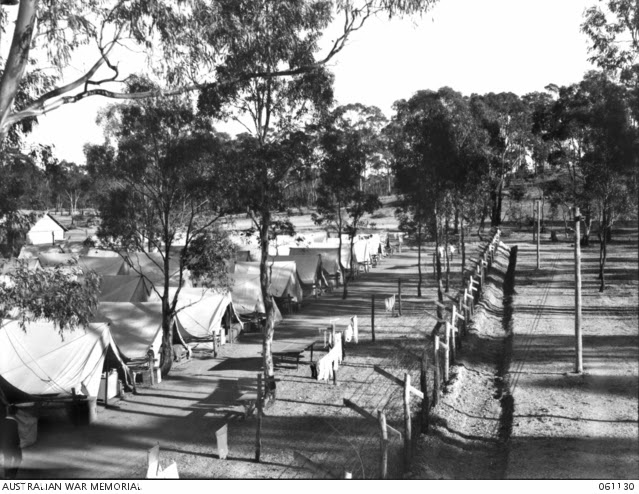
Each compound was enclosed by a double row of wire fencing 2 metres high with coiled barbed wire in between. Guard towers stood at each corner, with the perimeter lit at night. Each of the timber-framed barracks held twenty men. Kitchens, mess huts, shower blocks, laundries and latrines were all located within each compound.

The surrounding forest had been cut for firewood since Graytowns settlement, and POWs were put to work cutting firewood in the forest. The area now forms Graytown State Forest, and timber cutting has been illegal since 2002.

All the players are German POWs.
Repatriation
By 1943 the Kormoran men had been transferred from Murchison to Camp 6 (a timber felling camp) at Graytown. Others were transferred to Tatura. Finally, the prisoners returned to Europe on the Orontes in 1947.


Globally there are 250 species of owls; of this, 11 species are found in Australia. They are the Barn Owl, Barking Owl, Powerful Owl, Rufous Owl, Masked Owl, Morepork, Greater Sooty Owl, Lesser Sooty Owl, Eastern Grass Owl, Southern Boobook and Christmas Island Boobook.
Owls have long sparked our imaginations; their haunting night calls, silent flight, extraordinary hearing and deadly eyesight has seen them embedded in different cultures as symbols for magic, wisdom and mystery.
Bush Heritage

Characteristics
Owls are masters at silent flight. Their soft, uniquely structured feathers are serrated, affecting the movement of air over the wings. Additionally, the velvety surface of the feathers absorbs any sound made by flapping wings. Their silent flight allows them to pounce on prey with no warning. Owls have incredibly superior eyesight and hearing, and their forward-facing eyes grant them excellent depth perception, which is necessary for low-light hunting.

They can rotate their head 270 degrees, a vital asset when their eyes are fixed and cannot move within their sockets. In addition, their ears are asymmetrical on their head (at different heights on the side of their face), so the sounds reach each ear at different times, aiding them in identifying the exact location of their prey. Owls also have a facial disk around their eyes; this helps focus sounds to their ears, so they hear even the quietest sounds.

Behaviour
Owls are nocturnal (hunting only at night) though some are active at dawn and dusk. They are found in every state of Australia and vary significantly in size; they range from the smallest (Southern Boobook at 36cm tall and around 175g) to the largest (Powerful Owl at 60cm tall and 1.5kg). They live in various habitats, from snowy mountainous areas to deserts, from open wet forests to woodlands and grasslands. The Powerful Owl is territorial and has been known to attack humans, though most are solitary and shy.

Diet
Owls live on a diet of small to medium-sized mammals, birds and insects. Like most birds, they cannot chew and eat their prey whole or will tear off pieces with their powerful, sharp beaks if unable to do so. Some owls, such as the Sooty Owl, eat mainly tree-dwelling mammals such as sugar gliders and small possums. Others prefer land-dwelling lizards or mammals. Like other raptors, owls regurgitate the non-nutritious party of their prey. Several hours after eating, they will produce a pellet from their gizzards of fur and bone. They will then be ready to eat again.

Threats
Habit loss is the biggest threat to Australian owls as they rely on old-growth trees with hollows for nesting and breeding. These hollows take hundreds of years to form. Sadly, land clearing and bushfires are wiping out the hollows at an alarming rate. Another significant threat is secondary poisoning from eating prey such as foxes, feral cats, rabbits and rodents that have taken the bait. Poachers are also a concern, both as live specimens and eggs.

Status
No Australian owl species is on the national threatened species list. Some populations, however, such as the Powerful Owl in Victoria, are vulnerable, and the Masked owl is endangered in SA, Tasman and Victoria.