
Tag:photography

Ever wonder how photographers capture images that seem to leap off the screen, drawing you into their captivating depths? The secret lies in depth and perspective, two crucial elements that work together to create a sense of three-dimensionality and realism in photographs. By understanding and utilising these techniques, you can transform your photos from flat snapshots into captivating scenes that transport viewers into the heart of the image. Today, we explore how mastering depth and perspective can elevate your photography and add an artistic edge to your storytelling through the lens.
Understanding Perspective

Depth gives an image a three-dimensional feel. It provides a sense of distance between elements and can draw the viewer’s eye deeper into the scene. Techniques for adding depth include using a shallow depth of field, incorporating layers in your composition, and using leading lines to guide the viewer’s eye through the image. A shallow depth of field, often achieved by using a wide aperture, keeps the photo’s subject in sharp focus while blurring the background or foreground. This technique adds depth and helps isolate the subject and draw the viewer’s attention to it.
There are many types of perspective that you can use to create a sense of depth in your compositions; however, the basic ones are linear perspective, atmospheric perspective, and size perspective.
Linear (Geometric) perspective creates the illusion of depth by making lines converge as they recede into the distance. It relies on two key components: parallel lines and a vanishing point. The vanishing point is usually situated on the horizon but can also be positioned anywhere within the image.
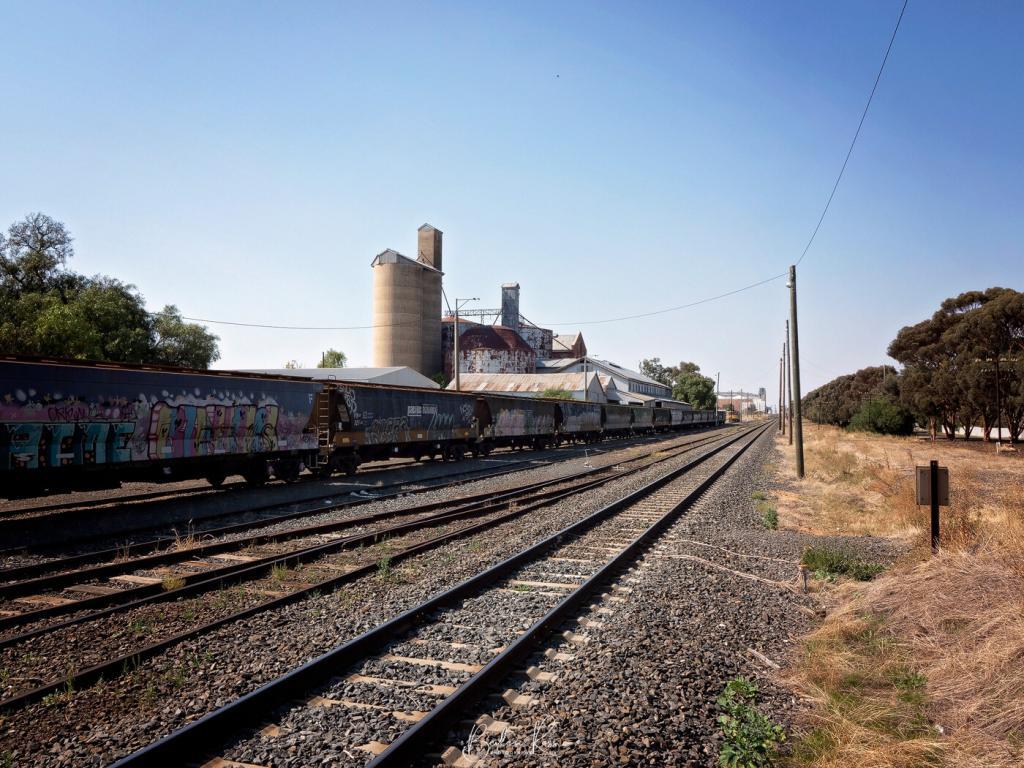
Atmospheric Perspective: This technique depicts distance by making distant objects appear lighter, less saturated, and hazier than closer ones. To use this technique effectively, you can include background elements such as mountains or trees to enhance the feeling of depth.

Size (diminishing scale) Perspective: With this technique, objects closer to the camera appear larger, while those farther away appear smaller. One popular method is to place a figure in a landscape shot to give a sense of scale. You can also emphasise height, length, colour, texture, contrast, highlights and shadow. You can use this to your advantage by juxtaposing different-sized objects in your composition to create a sense of depth.

Framing and Composition
Regarding framing and composition, there are a few things to remember to make your images more visually engaging:
- Try to include interesting foreground elements in your shot. This will help to create a sense of depth and immersion in the scene.
- Consider positioning objects so that they overlap. This technique provides a visual cue of depth and layers within the frame.
- Experiment with diagonal compositions.
- Diagonal lines can add dynamism and depth to your images, making them more visually appealing.

Aperture and Depth of Field
For a shallow depth of field, which isolates your subject from the background and emphasises depth, use a wide aperture with a low f-number. However, for landscapes, choose a narrow aperture with a high f-number to keep more of the scene in focus, which enhances the perception of depth.

Light and Shadows:
Side lighting can create shadows, highlight textures and add depth to your subjects. Backlit subjects can create a sense of depth by emphasising the silhouette and creating a halo effect.
Lens Choice:
- Wide-angle Lenses: These lenses exaggerate perspective, making objects appear farther apart and enhancing depth.
- Telephoto Lenses: Compress the scene, bringing distant elements closer together. This can create a unique sense of perspective and intimacy.
Looking up or down
An interesting way to add perspective to your photos is by changing the angle of your camera. Instead of looking straight ahead, shoot from above or below your subject. This technique can help you create unique and captivating images that stand out in your portfolio. For example, taking photos from above of a cityscape or a beautiful landscape can emphasise the scale and depth of the scene.

On the other hand, shooting from below can add a sense of drama and power to your photos, especially when capturing buildings, bridges, or other architectural structures. Including recognisable elements such as people or objects in your composition is also helpful, as they provide a reference point for the viewer and help them understand the scale and depth of the scene.
Post Processing
If you take pictures of buildings or other objects with straight lines, you may notice that they appear distorted. Fortunately, there are tools in Adobe Photoshop and Lightroom that can help you fix this issue. In Photoshop, you can use the Perspective Warp tool to restore parallel lines, while in Lightroom, you can use the Geometry panel to correct perspective automatically. Additionally, you can enhance the depth of your images by adjusting contrast, sharpness, and clarity. Consider using selective focus or vignetting to direct the viewer’s attention.

Mastering perspective and depth in photography is an ongoing process that involves experimenting and refining your skills. To create captivating images that transport viewers into the scenes you capture, it’s crucial to understand the principles of perspective, use compositional techniques, and utilise your equipment effectively. Remember to practice consistently, analyse your results, and stay open to new creative possibilities.

Have you ever looked at a photograph and wondered how the photographer captured such an engaging image? The answer often lies in the art of photography composition. It’s the secret ingredient that transforms a simple snapshot into a captivating masterpiece, guiding the viewer’s gaze and telling a story without any words. Whether you’re a professional photographer or just beginning your journey with a camera, mastering the fundamentals of composition can take your photos from ordinary to extraordinary. So, let’s explore the world of composition and learn techniques like the rule of thirds, leading lines, and negative space to help you create stunning visuals that will leave a lasting impression.
Photography is not just about capturing a moment; it goes beyond that by telling a story, conveying emotions, and creating visually striking images that leave a lasting impression. One of the crucial elements that can elevate your photography to new heights is mastering composition. Understanding and applying composition guidelines can transform an ordinary image into a work of art. This article will explore the essential photography composition guidelines to help you create compelling and visually appealing photographs.
Rule of Thirds
The Rule of Thirds is a fundamental guideline for composing images. To apply this rule, you need to divide the frame into a 3×3 grid, both horizontally and vertically. This creates nine equal parts that you can use to position your critical elements. Imagine a tic-tac-toe board overlaying your image. When you place your subject or focal point at the intersections or along the lines of this grid, you create a more balanced and visually exciting composition. This technique can help you achieve a dynamic or pleasing composition for your images.

Leading Lines
Leading lines are an effective way to direct the viewer’s eyes through a photograph. They can be straight or curved and guide the viewer’s gaze towards the main subject or points of interest.

Examples of leading lines include roads, rivers, fences, and architectural elements. Use these lines to create a sense of depth and draw attention to specific areas of your image.

Framing
Framing is a technique that involves using elements within the photograph to encircle and highlight the main subject. These elements can be naturally occurring, such as trees, archways, windows, or man-made structures, such as doors or bridges. By framing your subject, you can draw attention to it and add depth to the composition. To create unique and visually engaging images, experiment with different framing elements.

Symmetry and Patterns
Symmetry and patterns can enhance the visual appeal of your photographs by creating a sense of balance and harmony. Look for naturally occurring symmetrical scenes or patterns, or create them deliberately to improve your composition. To achieve symmetry, try placing the main subject in the centre of the frame, while patterns can be captured by repeating shapes or elements throughout the composition.

Perspective and Depth
Experimenting with perspective and depth adds dimension to your photographs. Use foreground elements to create a sense of depth and draw the viewer into the image. Different perspectives, such as low-angle or high-angle shots, can also alter how a scene is perceived. Playing with depth of field by adjusting your aperture settings can emphasize the main subject while blurring the background.

Rule of Odds
The Rule of Odds is a visual principle that suggests an odd number of subjects in a photograph is more appealing than an even number. This is because having an odd number of elements creates a natural focal point, making the image more balanced and exciting. This principle is beneficial when taking group shots or capturing multiple subjects in a scene.

Negative Space
Negative space in photography refers to the empty or unoccupied areas surrounding the main subject. By incorporating negative space into your composition, you can draw attention to the subject, create a sense of minimalism, and evoke emotions in the viewer. Don’t hesitate to leave room around your subject, giving it some breathing space within the frame.

Mastering the guidelines of photography composition is a continuous process that requires practice, experimentation, and an acute attention to detail. By integrating these guidelines into your photography, you can produce images that captivate viewers and withstand the test of time. It’s important to remember that these guidelines are not strict rules but tools that can be tailored and merged to fulfil your artistic vision.

Do you ever feel like your photos and videos lack vibrancy and appear lifeless on other devices, even though they look great on your own screen? This could be due to inaccurate screen calibration! Just like tuning an instrument, calibrating your screens ensures that they display colours and details precisely. Whether you are capturing stunning travel memories or editing professional graphics, proper calibration unlocks the full potential of your display, allowing you to see and share your visual creations exactly as intended.
In our increasingly digital world, visuals are crucial in communication and entertainment. Therefore, it is of utmost importance to have accurate and vibrant displays. Whether you are a professional photographer, graphic designer, or casual consumer, screen calibration is vital to ensure that the colours and tones you see on your screen are true to life. In this article, we will delve into the art and science of screen calibration. We’ll explore why it matters and how to achieve optimal results.
Why Screen Calibration Matters

Have you ever spent hours editing a photograph or designing a graphic on your computer, only to realize that the colours appear entirely different when viewed on another device? Or, send an image off for printing, which comes back unusable? A few years ago, I had a landscape image printed, and it came out far too dark, even though it looked fine on my monitor. This experience led me to purchase a Datacolor Spyder X, and I have not faced any similar issues since then.
This issue is common due to variations in display settings across different monitors. However, there is a solution called screen calibration, which involves adjusting your monitor’s settings to achieve consistent and accurate colour representation.
Colour Accuracy:
Screen calibration is essential to ensure that the colours displayed on your device are accurate. When colours are represented correctly, you can rely on the images or designs you see on your screen to match the actual colours. This is especially important for professionals or those who require precise colour reproduction.
Consistency Across Devices:
In today’s world, your work may be viewed on various devices, including laptops, tablets and smartphones. Calibrating your screen ensures that colours are accurately reproduced across different devices. This maintains consistency and ensuring that your creative vision remains intact, regardless of the viewing platform.

How to Calibrate Your Screen
- Use Calibration Hardware:
- Although some basic calibration can be performed manually via your computer’s settings, utilizing specialized hardware, such as a Datacolor Spyder X, colourimeter or spectrophotometer, yields more precise and accurate outcomes. These devices measure the colours on your screen and generate a personalized profile to rectify any inconsistencies.
- Software Calibration:
- It’s common for monitors to have built-in calibration tools or allow you to use third-party calibration software. These tools help you calibrate your monitor by adjusting brightness, contrast, and colour balance.

To get the most accurate calibration, ensure your workspace has consistent lighting. The ambient light can affect the way you perceive on-screen colours. It’s best to calibrate your monitor in your work environment to account for any lighting differences.
Regular Maintenance:
Screens may drift over time, so it’s vital to recalibrate your monitor periodically. This is especially true for professional projects where colour accuracy is essential.
Screen calibration is a crucial aspect of digital work that is often ignored. However, it significantly impacts the quality and consistency of visual output. Whether you’re a creative professional or a casual user, taking the time to calibrate your screen can enhance your viewing experience and ensure that your digital creations are presented in their most accurate form. Embrace the art of precision, and let your creativity shine with the confidence that comes from accurate and vibrant displays.

Infrared photography is a captivating form of capturing images that can reveal a hidden world that is invisible to the human eye. Infrared was initially developed for scientific and military purposes. However, this unique photographic technique has evolved into a creative medium that photographers and artists worldwide are embracing.
By using light beyond the visible spectrum, photographers can create surreal and dreamlike images, which offer a new perspective on the world. This post will explore the fascinating world of infrared photography, including its history, techniques, equipment, and the breathtaking results it can produce.

History of Infrared Photography
Infrared photography has its origins in the early 20th century when scientists discovered the existence of infrared light beyond the visible spectrum. An English physicist named Robert W. Wood (1868-1955) conducted experiments with infrared-sensitive photographic plates in 1910, which furthered research in this area. In the same year, he captured the first infrared and ultraviolet photographs, which were of subjects around his summer home in East Hampton, N.Y., as well as the Moon. During World War II, infrared film proved to be useful for aerial surveillance, enabling the military to detect camouflage and hidden enemy targets.
Photographers started using infrared film in the 1930s. Infrared film allowed them to capture stunning landscapes and portraits with an ethereal feel. With digital photography, infrared imaging is now more accessible, allowing photographers to explore this unique artistic expression. Two decades later, recording artists like Jimi Hendrix and the Grateful Dead further popularised the technique. They released album covers with infrared images that were popular due to their multicolored look.

Understanding Infrared Light
Infrared photography captures light beyond the visible spectrum, usually in the near-infrared (NIR) or shortwave infrared (SWIR) ranges. Unlike traditional photographic films, which are not sensitive to infrared light, specialised equipment or modifications are required to achieve the desired results. Dedicated infrared cameras or modified DSLRs equipped with infrared-passing filters can capture infrared imagery in digital photography.
Converting a Camera for Infrared Photography
There are two popular methods to capture infrared images. One way is to modify a digital camera by removing the infrared-blocking filter and replacing it with a filter that blocks visible light. This modification makes the camera sensitive to infrared light. Another way is to attach an infrared filter to the lens of a standard digital camera. This filter allows only infrared light to pass through, enabling the camera to capture infrared images.

Finding the Right Subjects
Landscapes
Infrared photography can turn ordinary landscapes into scenes from a fantasy world, with vegetation appearing in striking shades of white and pink and skies taking on a deep, dramatic hue.
Plants and trees reflect infrared light, which makes them appear bright and luminous. This contrasts sharply with darker elements such as water, rocks or skies. Infrared photography can also enhance the appearance of clouds, making them appear more dramatic and fluffy against a deep black sky. Since water absorbs infrared light, it seems darker in photographs. This allows for exciting contrasts between water and the surrounding scenery.

Architecture
Old buildings, such as those made of stone and brick, have unique textures and appearances when captured in infrared. Similarly, modern buildings with sleek designs and large glass panels create a fascinating futuristic look in infrared photography. You can also experiment with contrasts by capturing older and newer structures or juxtaposing natural elements, such as trees and skies, with architectural subjects.
Portraits
Unique Skin Textures: When captured using infrared light, imperfections on the skin become highlighted, and the skin appears smoother, resulting in surreal and ethereal portraits.

Dramatic Eyes: Infrared photography often captures the irises of the eyes as much lighter or almost white, resulting in intense and captivating portraits.
Black and White: Infrared portraits translate exceptionally well in black and white, which enhances their timeless and dramatic quality.”
Other Compelling Subjects
Cemeteries offer a unique opportunity to capture evocative and haunting imagery with the weathered textures of tombstones and the starkness of the IR aesthetic. Similarly, automotive photography can be transformed by using Infrared techniques, resulting in a fascinating, vintage appearance. Additionally, ruins and abandoned buildings become even more captivating and moody when photographed with an IR look. IR enhances the eeriness of decay and desolation.

Ideal Shooting Conditions
Traditional photography steers clear of harsh shadows or sunny days. Infrared photography runs toward it. Not only does more light give the photographer more infrared for imaging, but it also makes shutter speeds more manageable and raises the intensity of the refracted IR light within the scene. This can deliver stunning effects. Sunlight and clear skies are optimal for infrared photography, as infrared light is abundant under these conditions.
- Midday sun can create intense contrasts and dynamic images, while overcast skies produce softer, more subdued results.

Post-Processing Techniques
- Post-processing is essential to infrared photography, as raw infrared images may appear reddish or magenta.
- Adjusting white balance, swapping colour channels, and fine-tuning contrast can reveal infrared photographs’ surreal, otherworldly appearance.

Equipment for Infrared Photography
Infrared Filters
- Infrared filters are essential for photographers who opt not to convert their cameras. The filters block visible light and allow only infrared light to pass through.
Converted Infrared Cameras
- For photographers dedicated to infrared imaging, converting a digital camera to be sensitive to infrared light is a popular choice.
- Converted cameras are permanently modified to capture infrared light without external filters, providing convenience and flexibility in shooting.

Infrared photography is a fascinating technique that reveals a hidden and surreal perspective of the world around us. By using specialised equipment and techniques, photographers can create beautiful and extraordinary images that capture the unique qualities of infrared light. Whether taking photos of breathtaking landscapes, striking portraits, or architectural wonders, infrared photography inspires and captivates photographers and viewers.
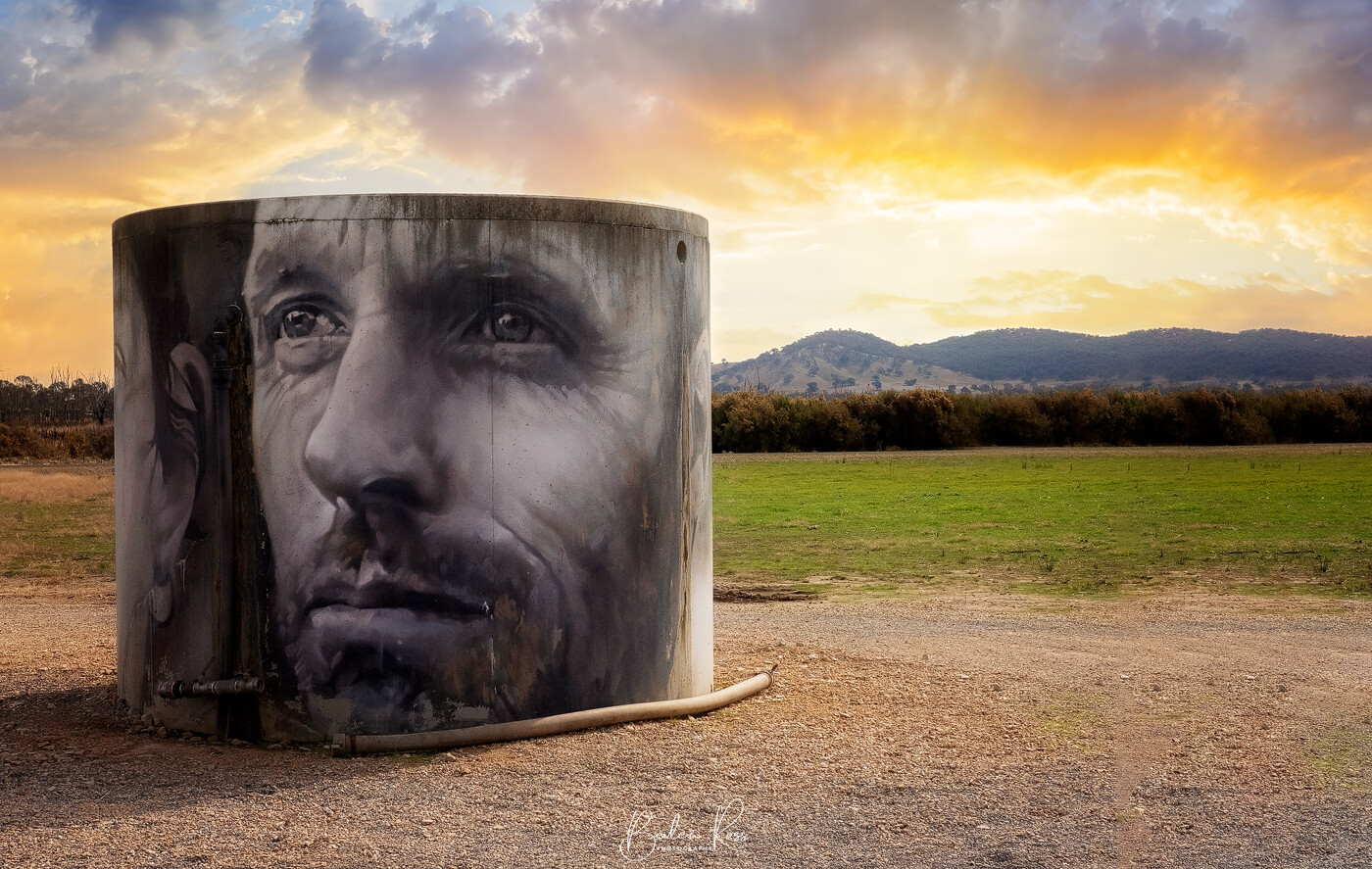
Victoria, a beautiful state in Australia, is famous for its natural beauty, cultural heritage, and lively art scene. In this captivating landscape, the painted water tanks have become an unexpected canvas that has captured the attention of locals and visitors, primarily due to the popularity of painted silos. Once considered mundane, these structures have been transformed into stunning works of art, creating open-air galleries that enhance the rural and urban landscapes.
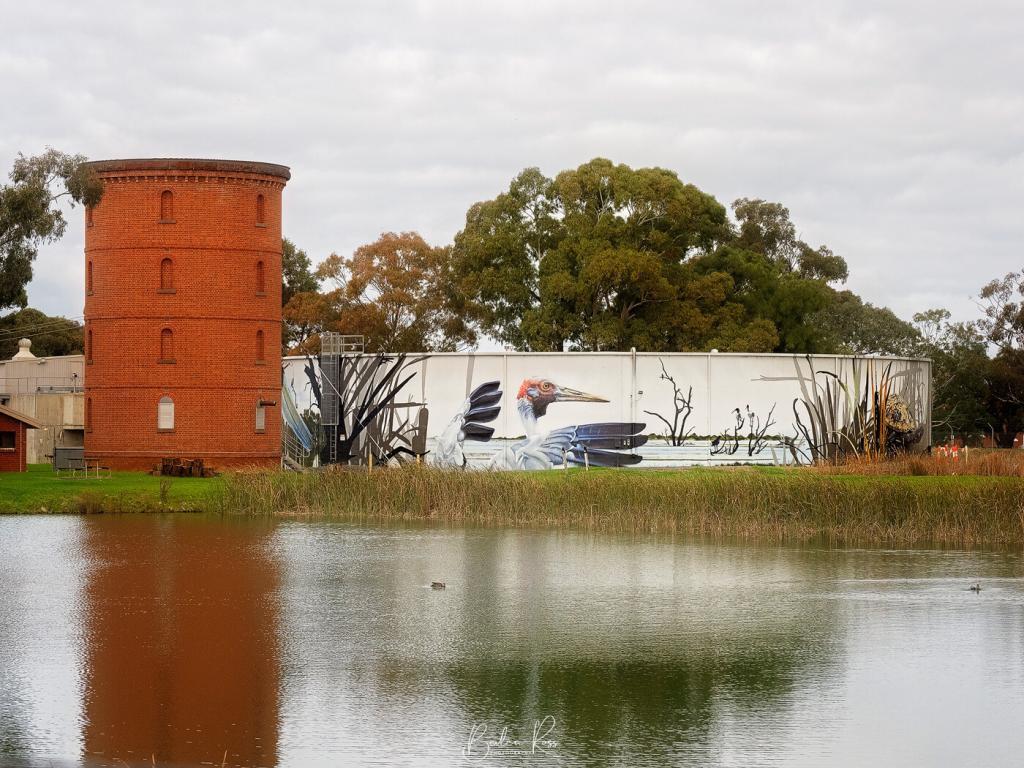
The Artistic Transformation
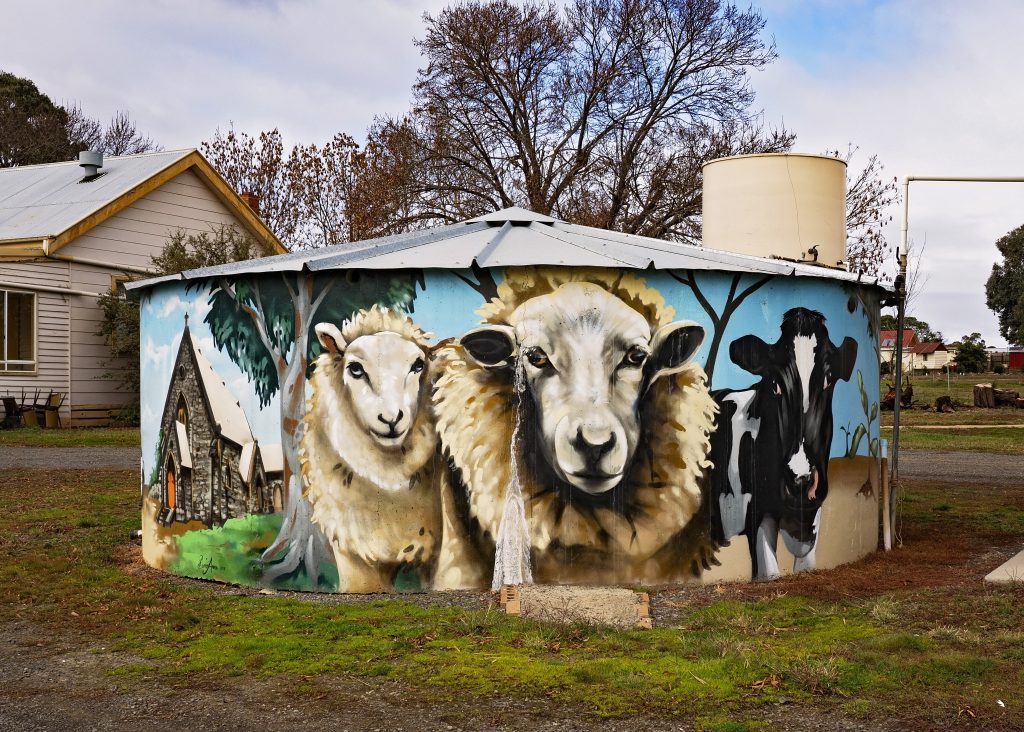
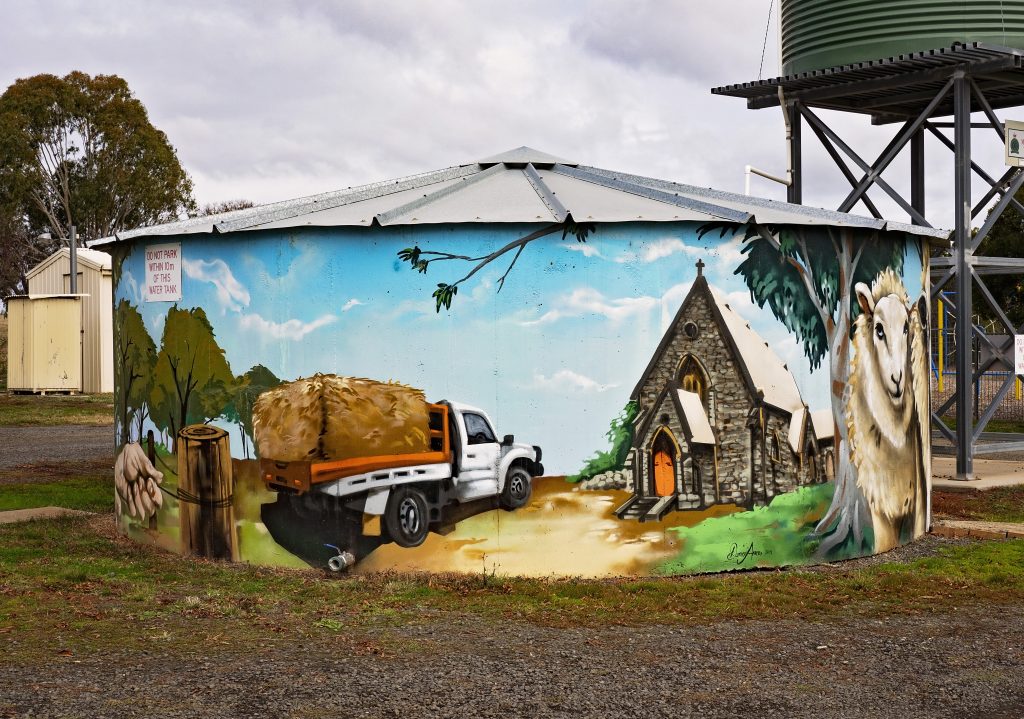
In recent years, people in Victoria have been encouraging local artists to collaborate with communities to transform ordinary water tanks into captivating works of art. Street artists and more traditional muralists have joined forces to create visually stunning pieces on these cylindrical canvases. The designs typically reflect the local culture, history, and environment. Each painted water tank tells a unique story, from depictions of native wildlife and plant life to indigenous artwork honouring the land’s original caretakers to contemporary designs that celebrate city life.
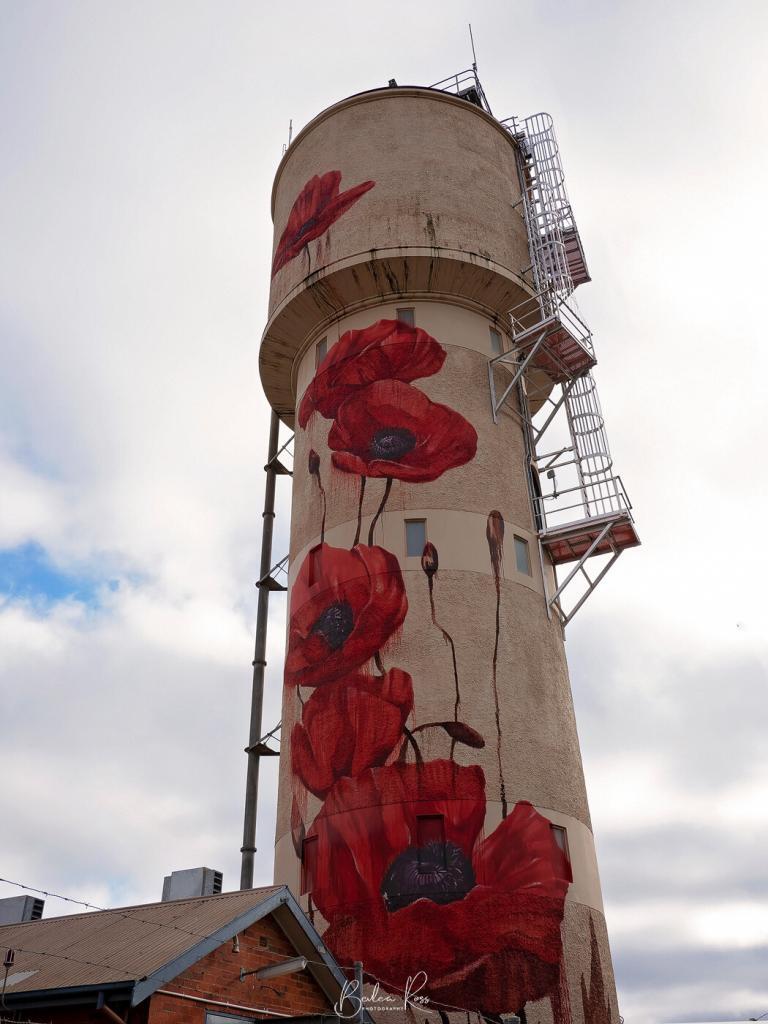
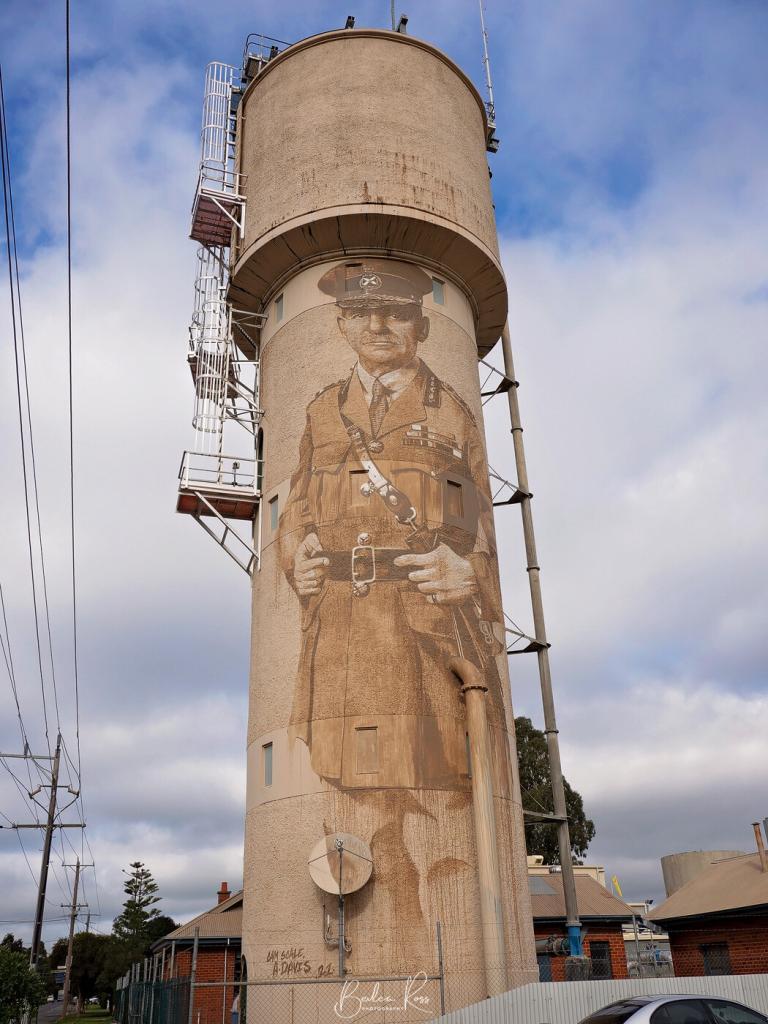
The Tatura water tower has remembrance poppies on one side and a portrait of Sir John Monash on the other. Cam Scale and Andrew Davis are the talented artists who created this beautiful artwork on the tower. The tower was built in 1912 and was designed by Monash, who was not only an engineer but also a renowned Australian military commander during WWI. The Tatura Water Tower is also the earliest surviving example of a reinforced concrete tower of its type in Victoria.
Connecting with Communities
The painted water tanks are beautiful not only because of how they look but also because of the sense of community they create. Making these artworks involves working with the locals, who help choose the themes and colours and even share stories to inspire the artists. This collaboration helps strengthen the community’s pride and ownership, transforming the water tanks from ignored structures into cherished symbols of identity.
Promoting Tourism
The painted water tanks have made quite a name for themselves, attracting tourists who crave a unique artistic experience. People now venture beyond the usual tourist spots to discover the hidden treasures of Victoria’s countryside and towns. The tanks have undeniably boosted tourism, increasing local economic revenue.
Challenges and Future Prospects
Painted water tanks have received much positive attention, but some difficulties come with this movement. Obtaining funding for significant projects and acquiring the necessary permits can prove challenging. Moreover, certain heritage-listed water tanks are not permitted to be altered. Additionally, artists must deal with logistical issues such as working at heights and ensuring the artwork can withstand weathering.
Despite these obstacles, the outlook for Victoria’s painted water tanks is bright. As the movement gains popularity, more potential sponsors and supporters are expressing their interest. The state’s commitment to promoting arts and culture further solidifies the importance of these water tank masterpieces as a crucial part of Victoria’s artistic heritage.
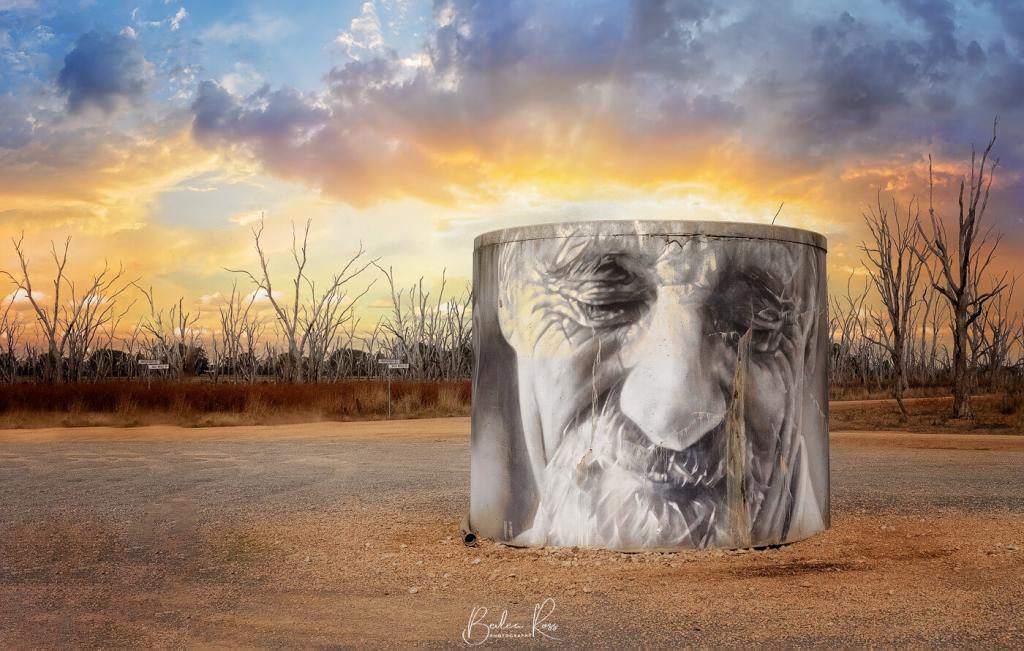
The painted water tanks in Victoria showcase the remarkable impact of art in elevating ordinary structures into extraordinary works of art. These structures, which were once ignored, have now become vibrant symbols of artistic expression, environmental awareness, and community collaboration.
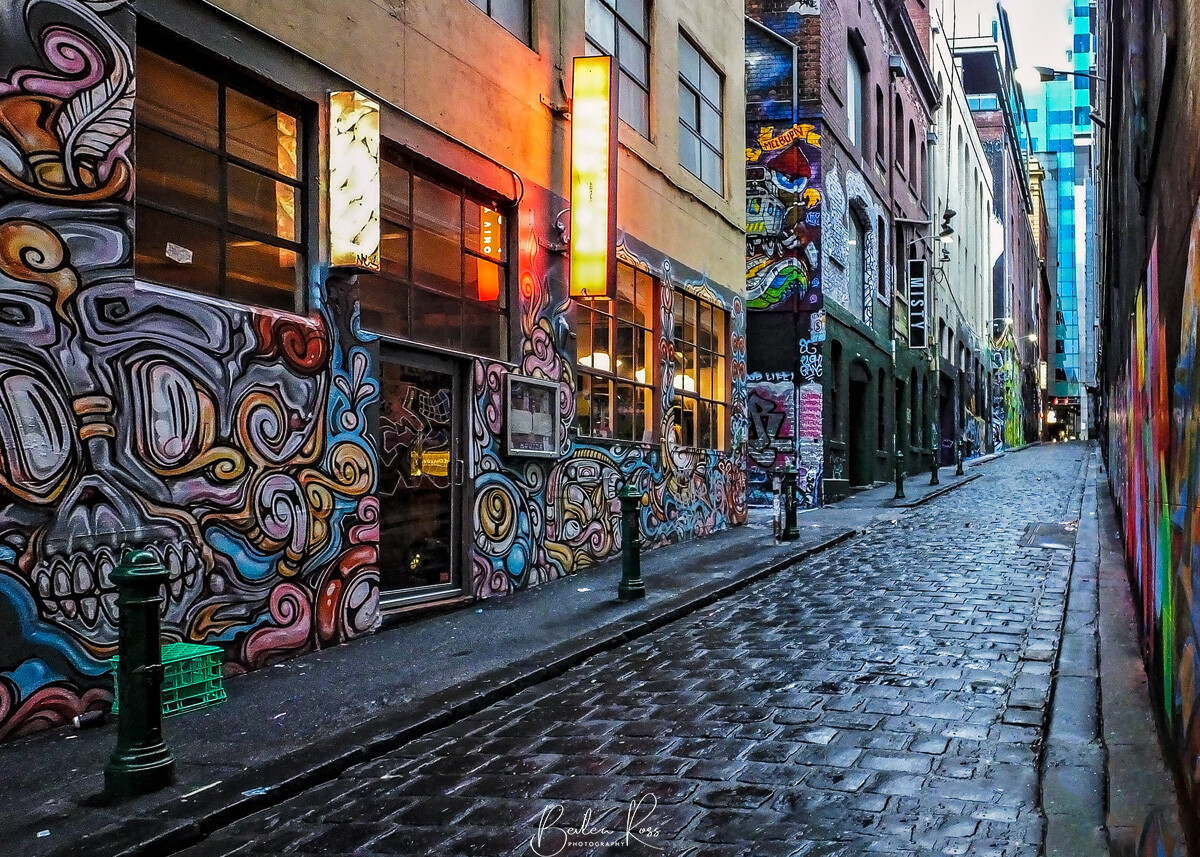
Victoria’s street art scene is a lively showcase of creativity and self-expression. Urban walls have been transformed into stunning works of art, making it a highly respected art form. Street art constantly evolves, capturing the essence of culture, identity, and social commentary. Artists are continually creating new pieces, and new art may replace or cover older ones.
The Evolution of Street Art in Victoria
Victoria’s street Art had humble beginnings as an act of rebellion; however, it has transitioned into a legitimate art form.
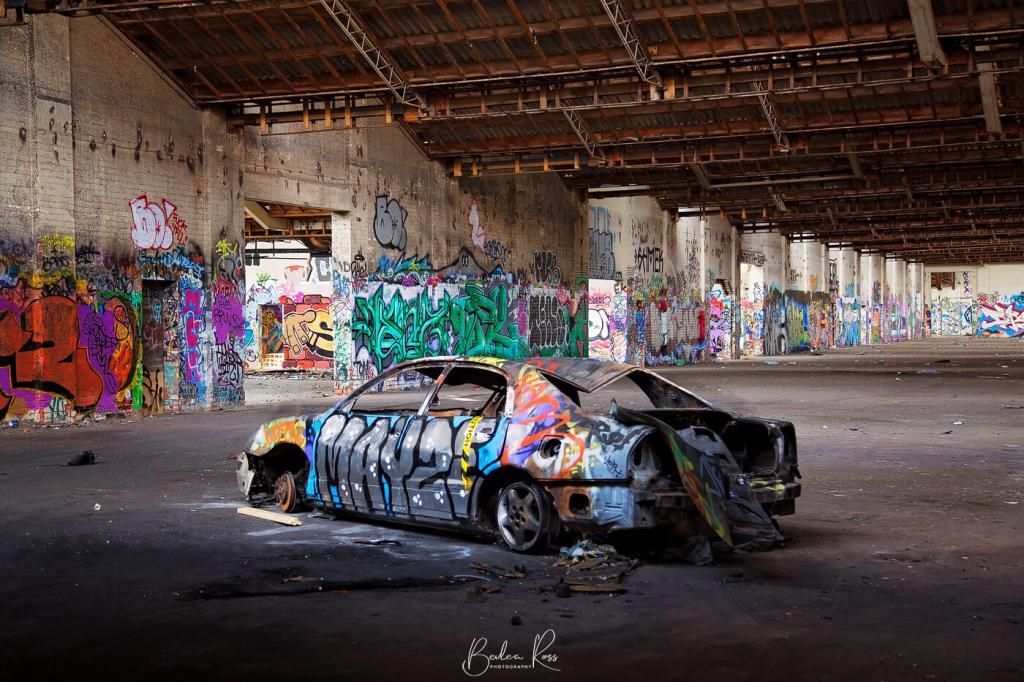
Victoria’s street art scene emerged during the 1970s and 1980s, with graffiti artists leaving their marks on public spaces. Initially regarded as vandalism, attitudes changed in the 1990s as artists created more complex and imaginative works. Debates arose about how to distinguish between art and vandalism.
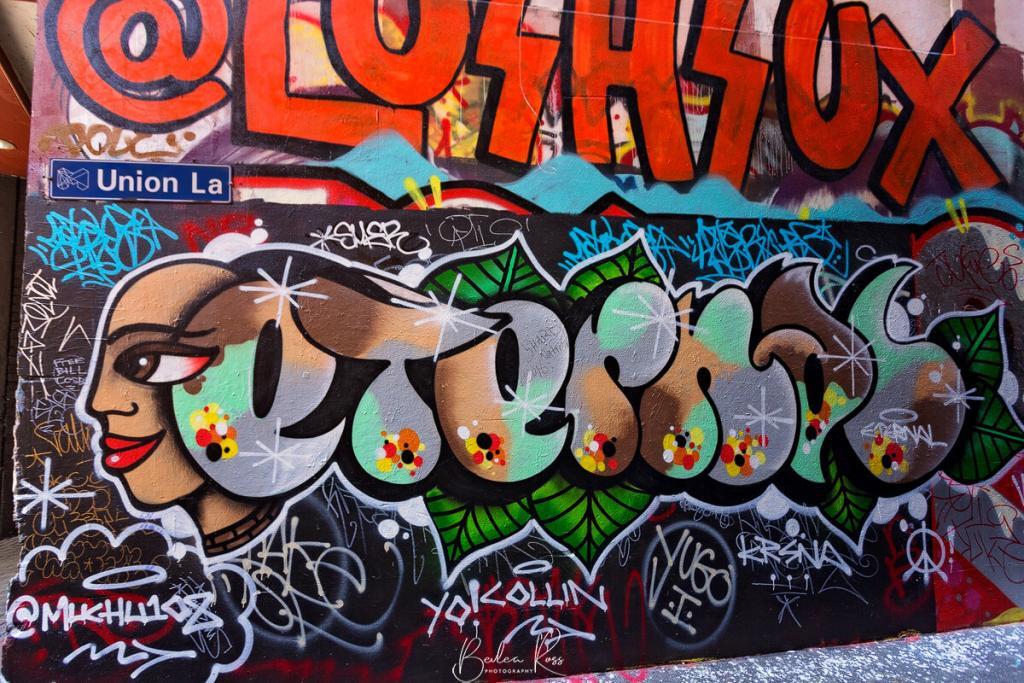
Street art festivals in Victoria during the early 2000s provided legal spaces for artists to express themselves through murals and graffiti. Notable events like the Stencil Festival and Melbourne International Street Art Festival were crucial in legitimising street art as a recognised art form. As street art gained acceptance, many councils and property owners commissioned artists for larger, socially significant murals celebrating local culture and history.
Art and Artworks
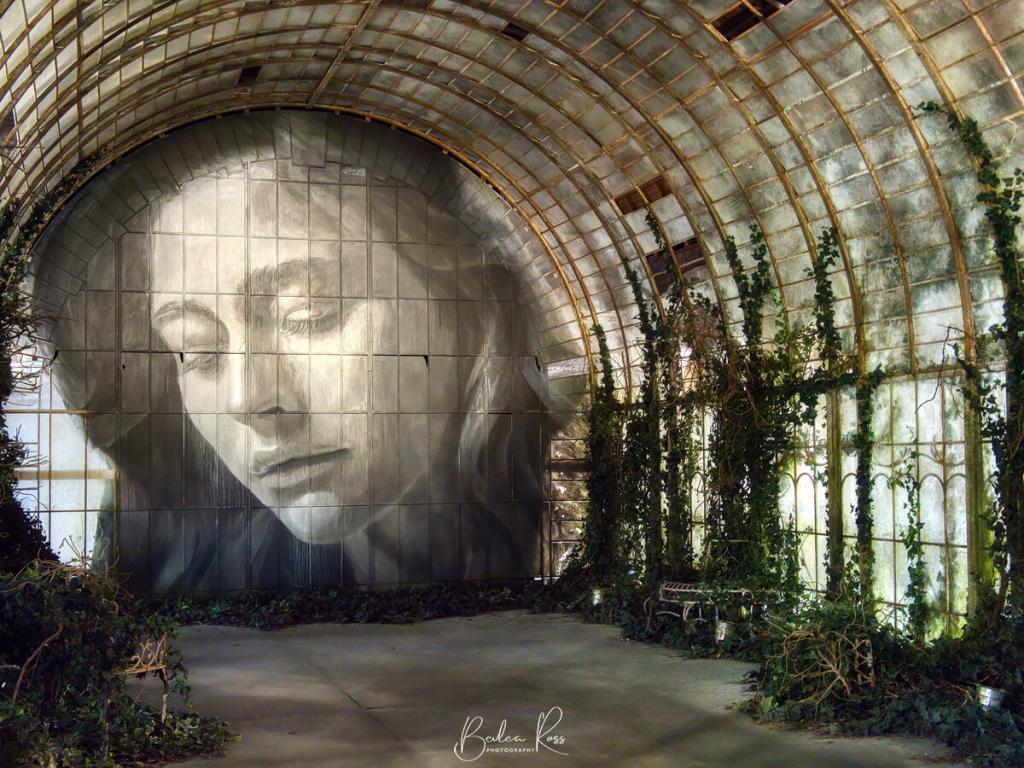
As street art gained popularity and commercial appeal, more and more artists entered the traditional art world. For example, exhibitions like Rone’s Time or Empire have showcased his creative skill, earning recognition from collectors and enthusiasts alike. This blending of street and traditional art highlights the incredible talent and versatility of Victoria’s street art scene.
Street Art with a Purpose
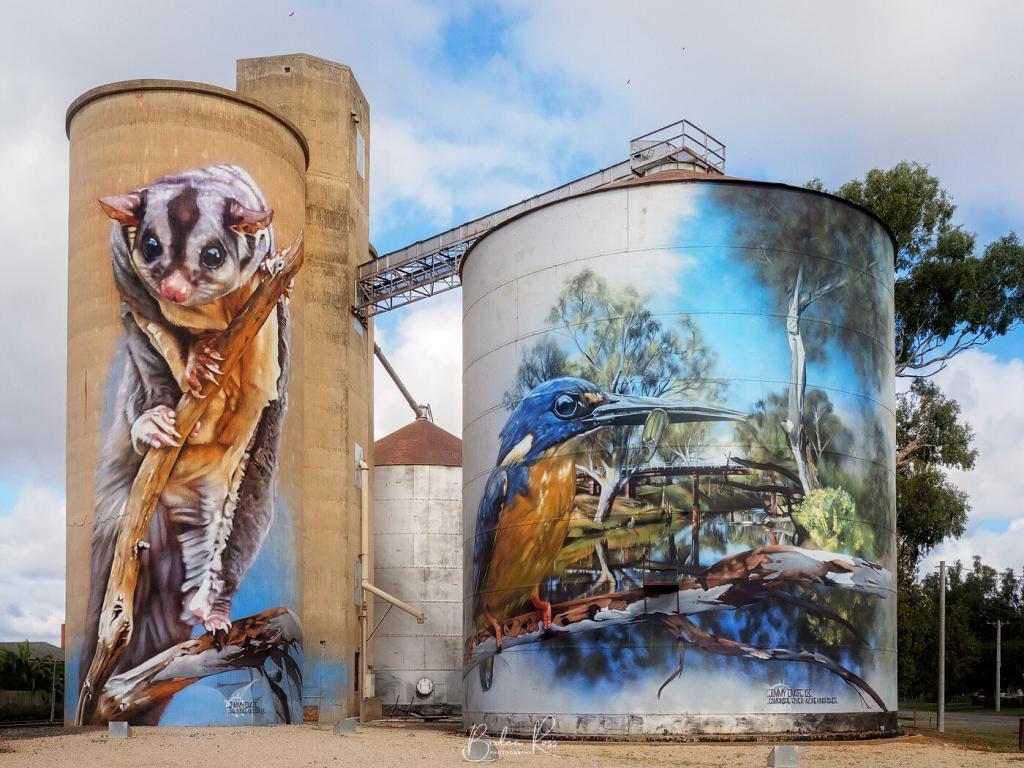
Street art has become a crucial part of urban development in recent years. It revitalises and activates urban areas, beautifies spaces, and promotes a sense of community. Victoria encourages street art, which increasingly incorporates cultural and social commentary. Artists use their work to raise awareness about important societal issues and engage the public in meaningful discussions.
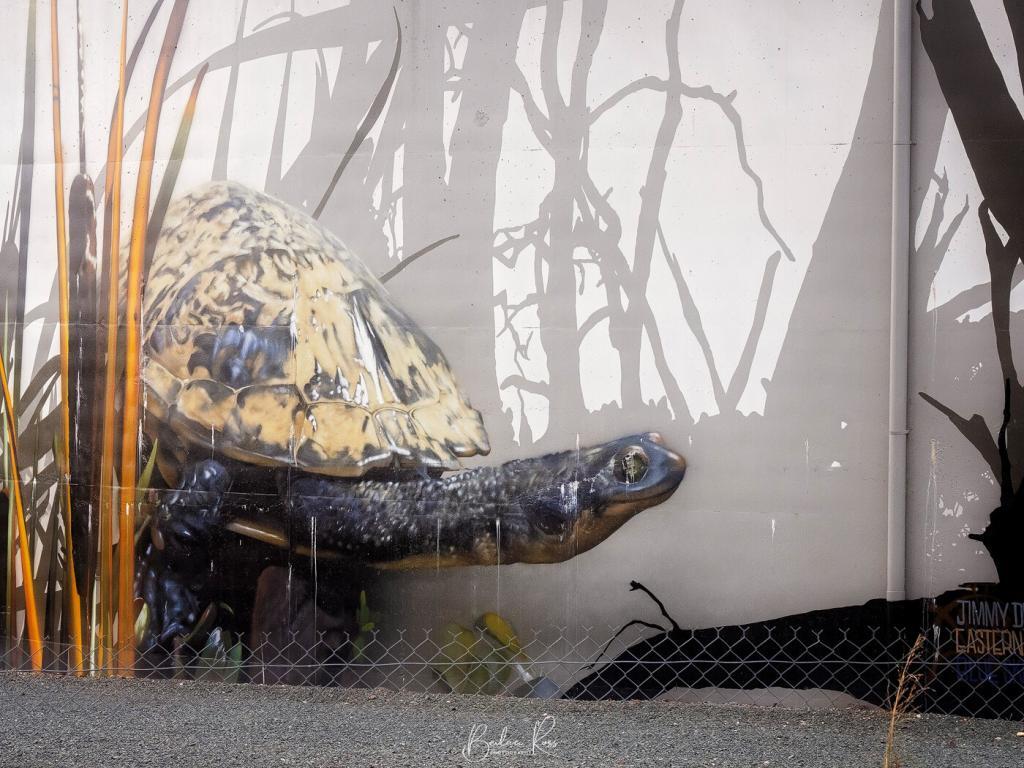
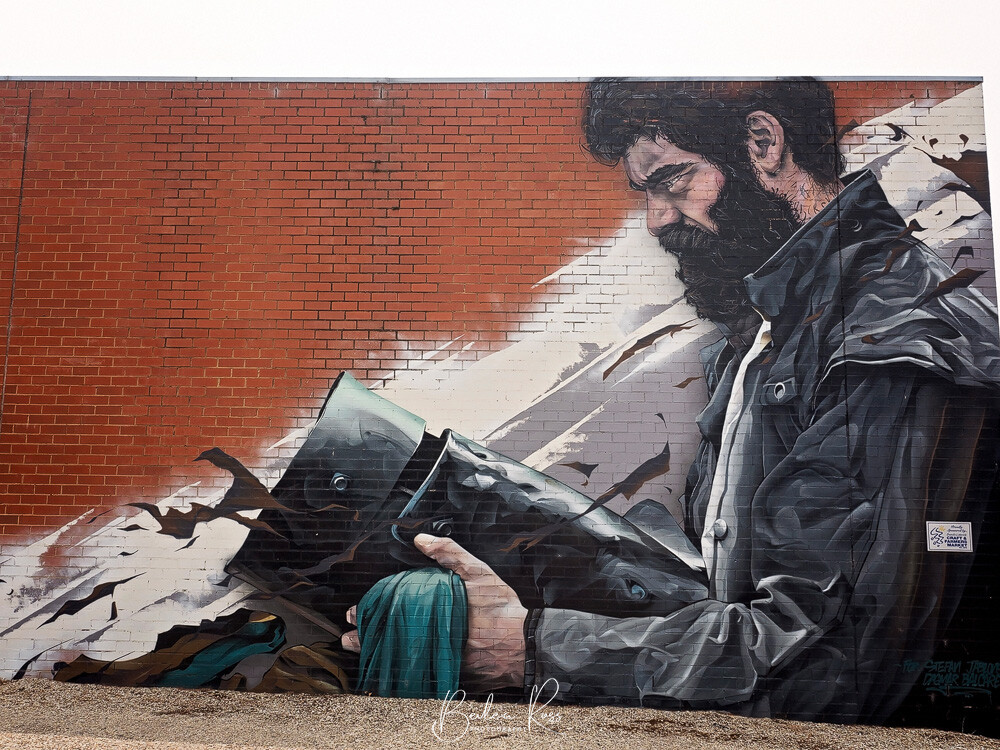
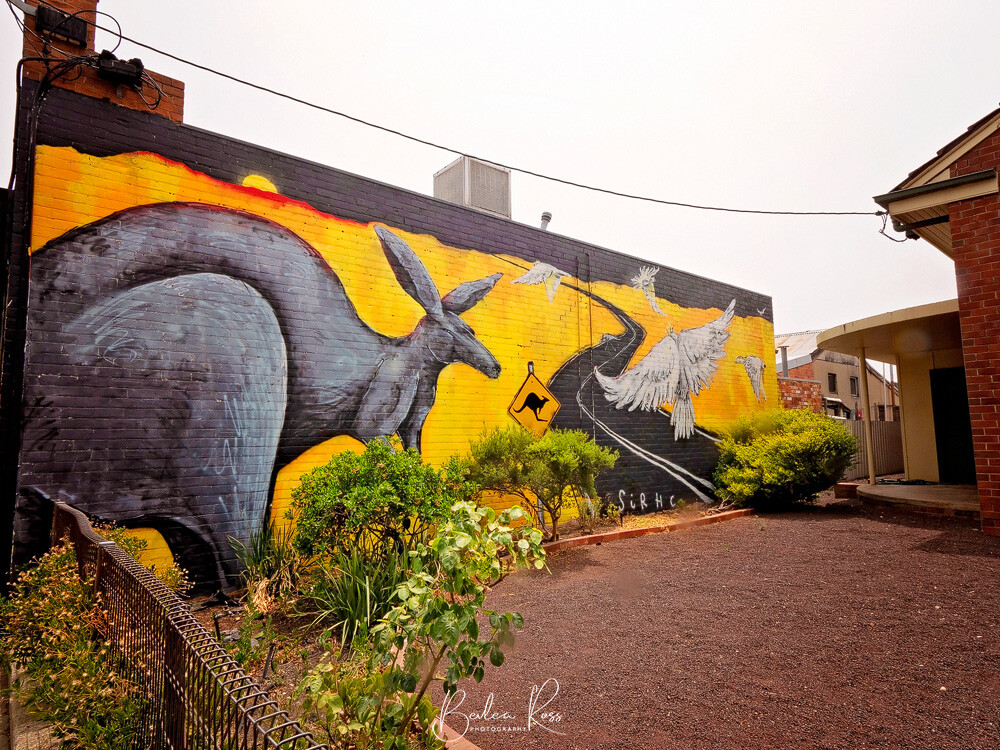
In Victoria, street artists create visually appealing works and use their art to bring attention to social issues and promote various causes. Their murals and graffiti often convey compelling messages about environmental conservation, mental health, inclusivity, and social justice. In rural areas of Victoria, murals and silos frequently feature local wildlife. Street art, therefore, acts as a platform for activism and encourages positive change.
Inner city Hotspots
While street art can be found throughout Victoria, some areas have become well-known as important hubs for street art.
Brunswick
This suburb in Melbourne is a hub of street art. Stroll along Lygon Street and Sydney Road to uncover an array of vibrant and meaningful murals and graffiti. All highlight the artistic and cultural richness of the area.
Fitzroy and Collingwood
These urban areas are hubs for dynamic street art culture. Stroll through the streets, alleys, and laneways, and you’ll come across numerous murals, stencils, paste-ups, and graffiti pieces. Johnston Street, Brunswick Street, and Smith Street are especially abundant with street art.
Hosier Lane
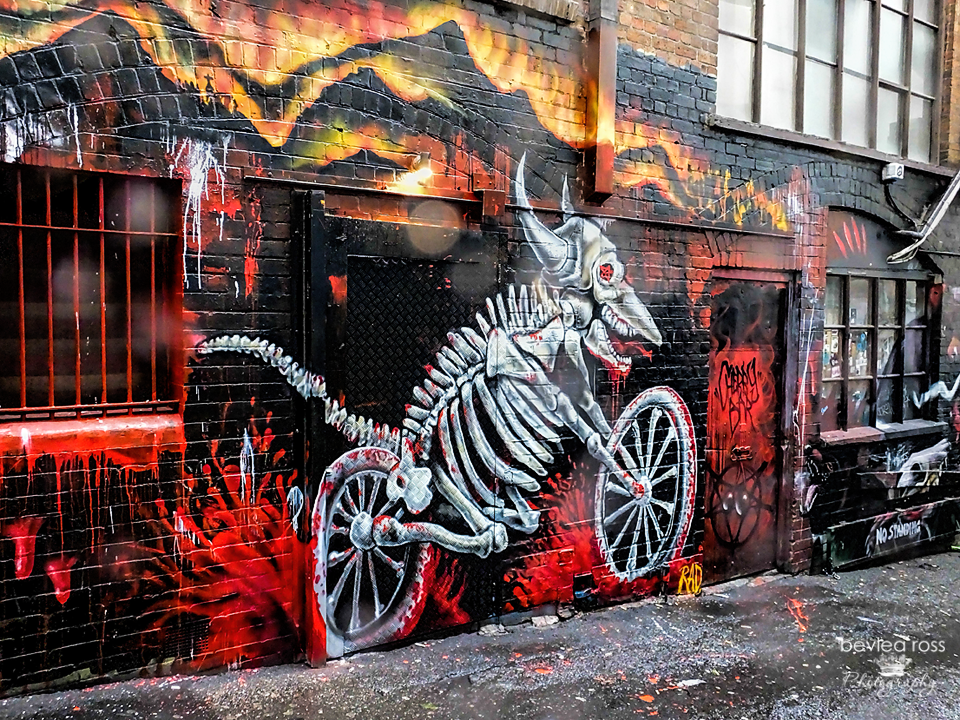
A quaint cobblestoned alleyway near Flinders St. Station has become a dynamic, ever-changing outdoor gallery.
Street Art Towns
Benalla Wall to Wall Festival
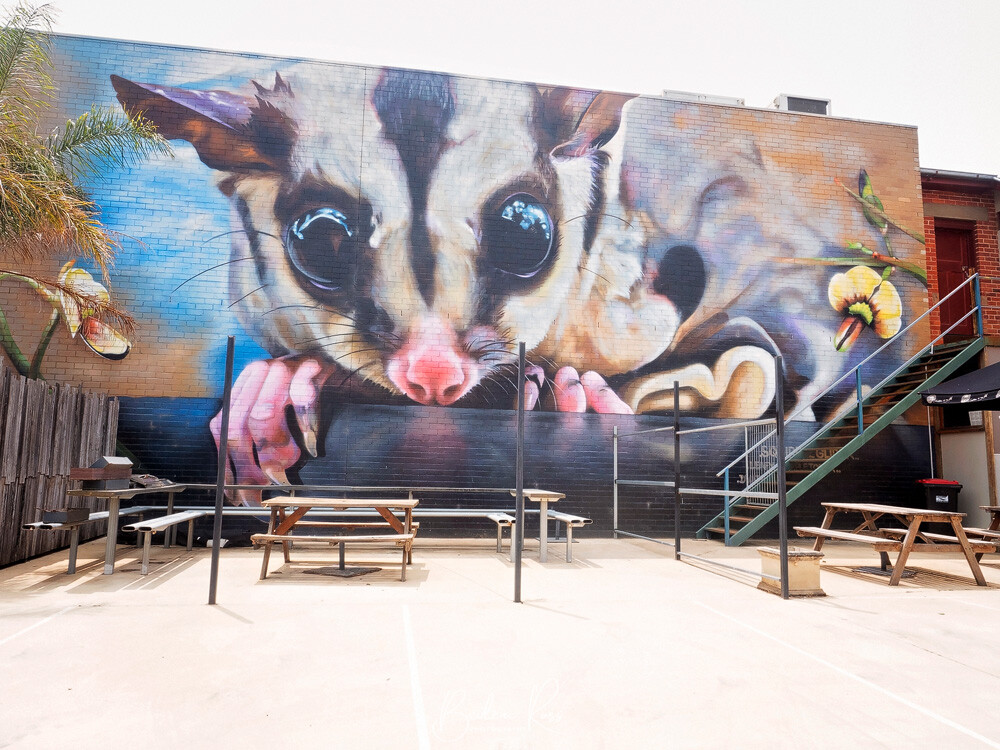
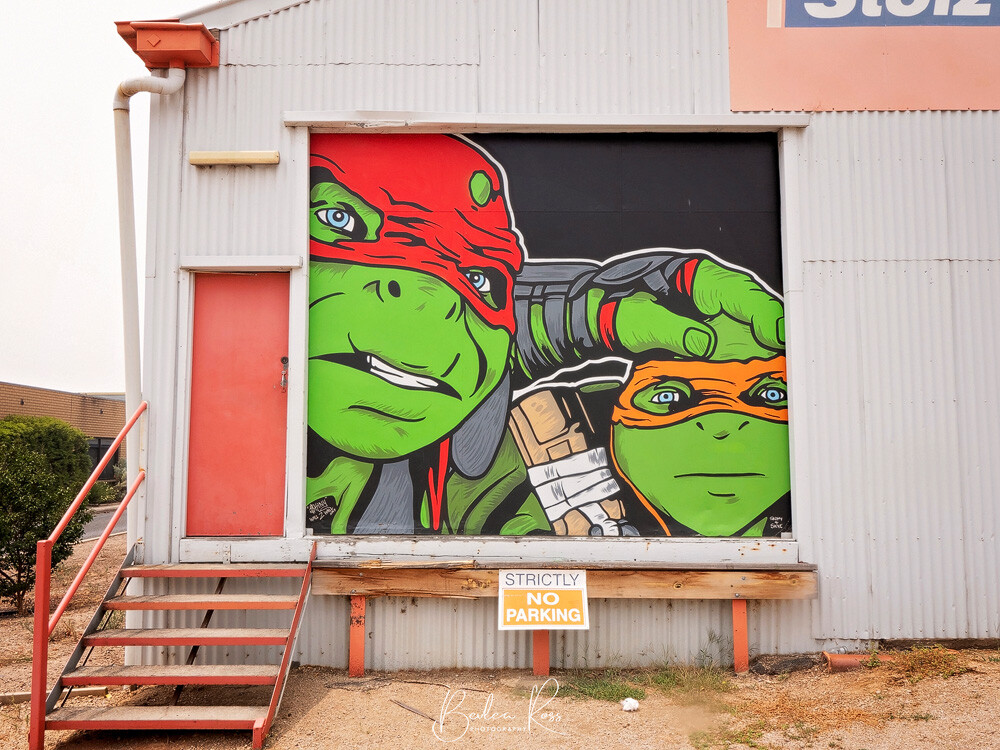
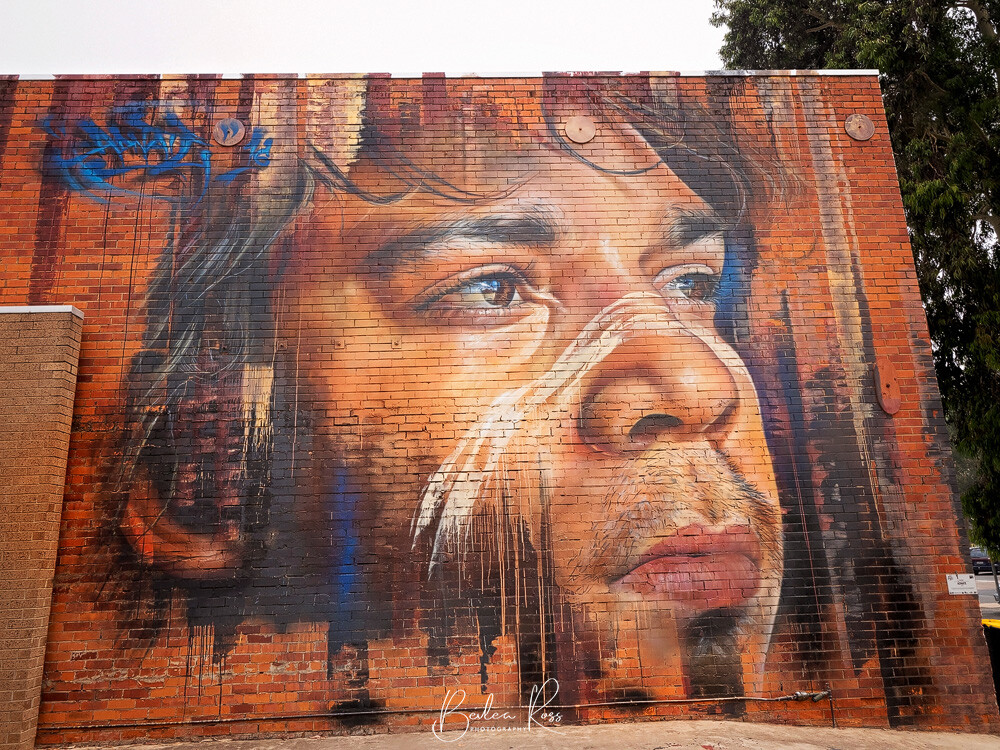
Benalla is considered the street art capital of regional Victoria. Every year, they hold the Wall to Wall Festival of street art, which features incredibly talented and well-known street artists from all over the country and the world. They create breathtaking murals and street art on the walls of buildings around the town. If you’re looking to explore the 65 murals on the art-filled streets of Benalla, you can take a self-guided walk and make the most of your experience by using the Storytowns-Benalla Street Art app. Don’t forget to grab a street art walking map from the Visitor Centre!
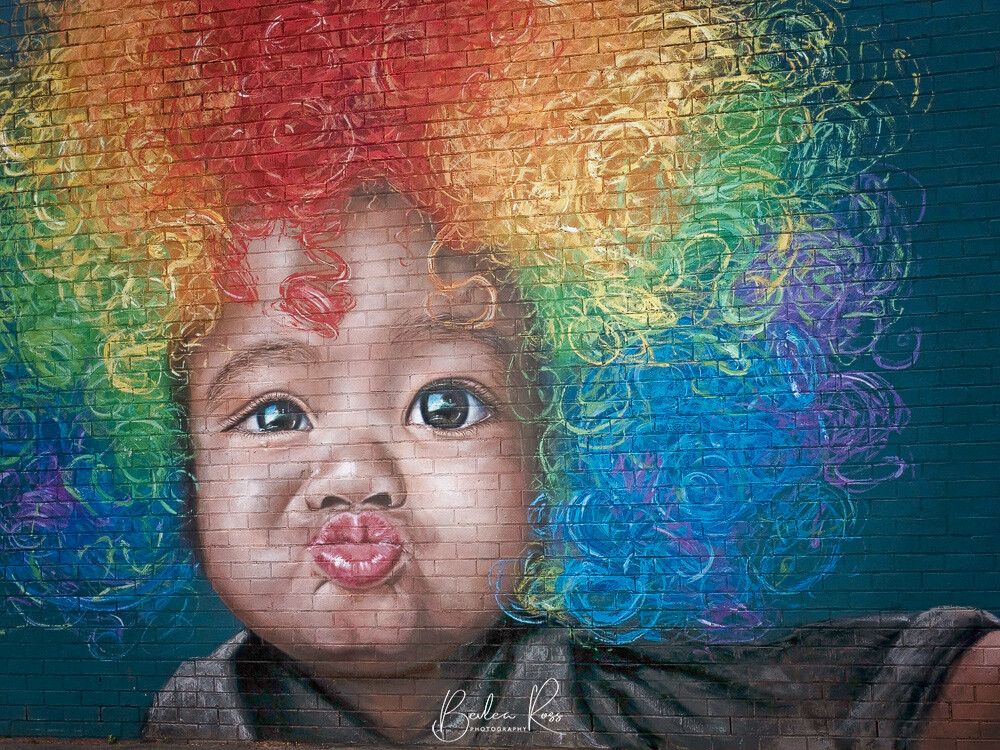
Bendigo
Another regional centre located in Victoria has incorporated street art into its cultural landscape. The Bendigo Street Art project has brought stunning murals to various locations around the city.
Geelong
Geelong, a city in the southwest of Melbourne, has a thriving street art culture. The lively alleys and walls near Little Malop Street have become attractive outdoor galleries, giving the urban landscape character and creativity.
Rochester
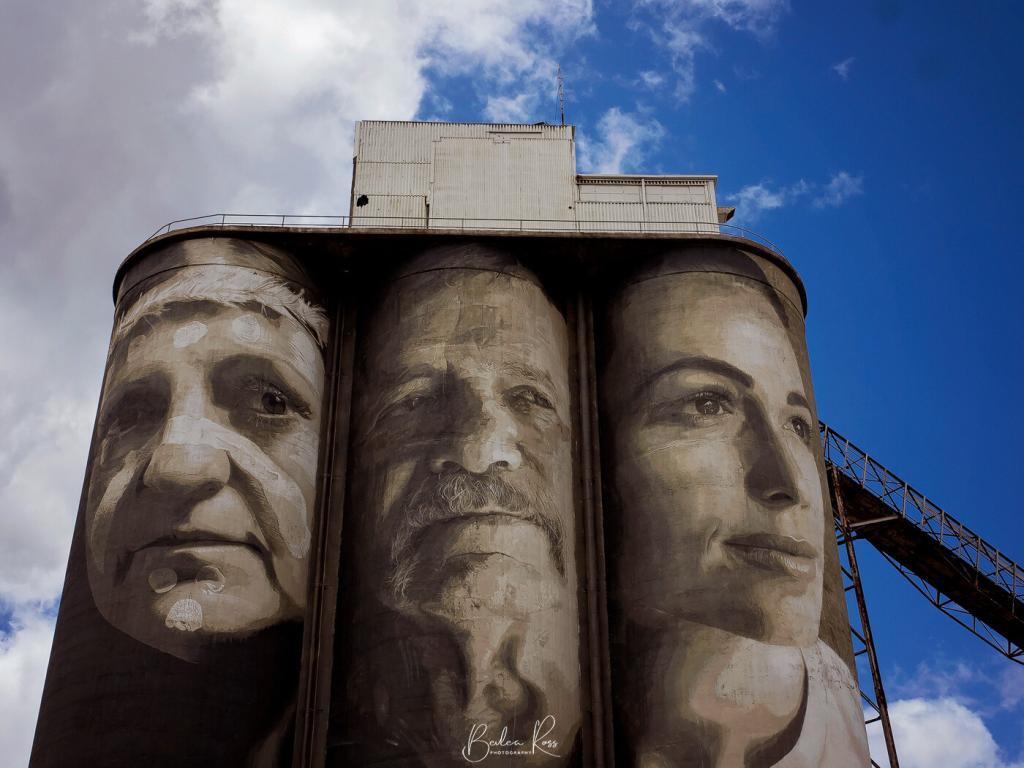
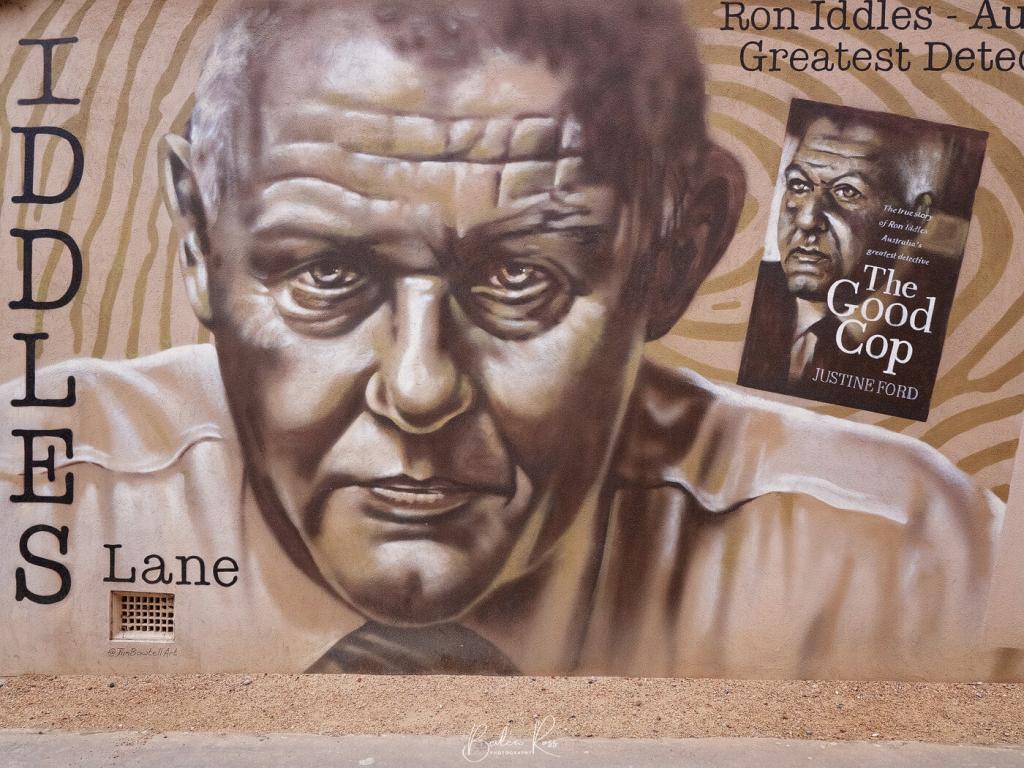
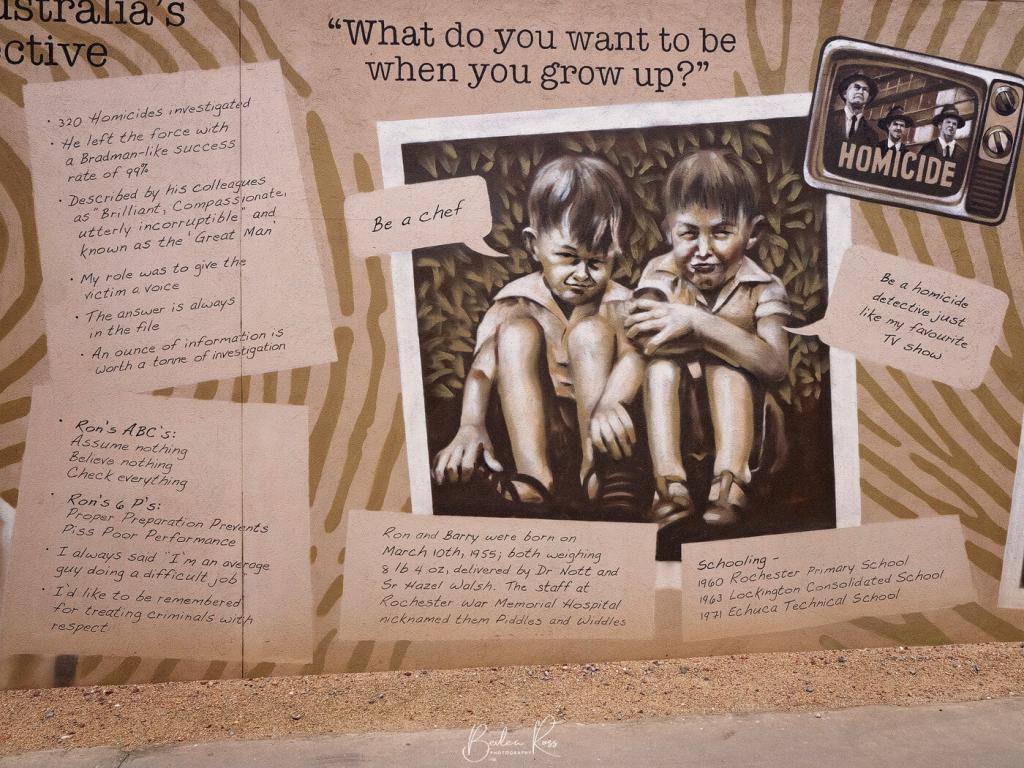
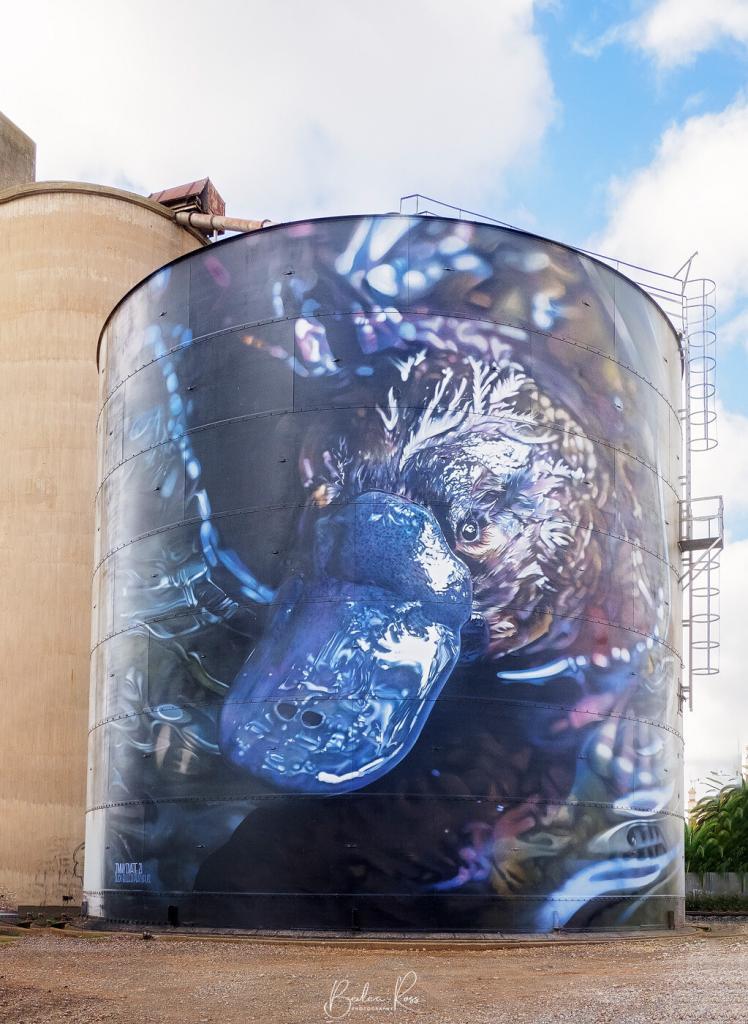
Rochester is a town in the Campaspe shire that boasts impressive art installations. In this area, there are two silos that Jimmy Dvate has painted. Additionally, there is a laneway that features the artwork of Tim Bowtell on both walls. This laneway has been recently named Iddles Lane in honour of Ron Iddles OAM APM, an accomplished Australian police detective who had a remarkable conviction rate of 99%. His exceptional performance earned him the title of “Australia’s greatest detective.”
St Arnaud
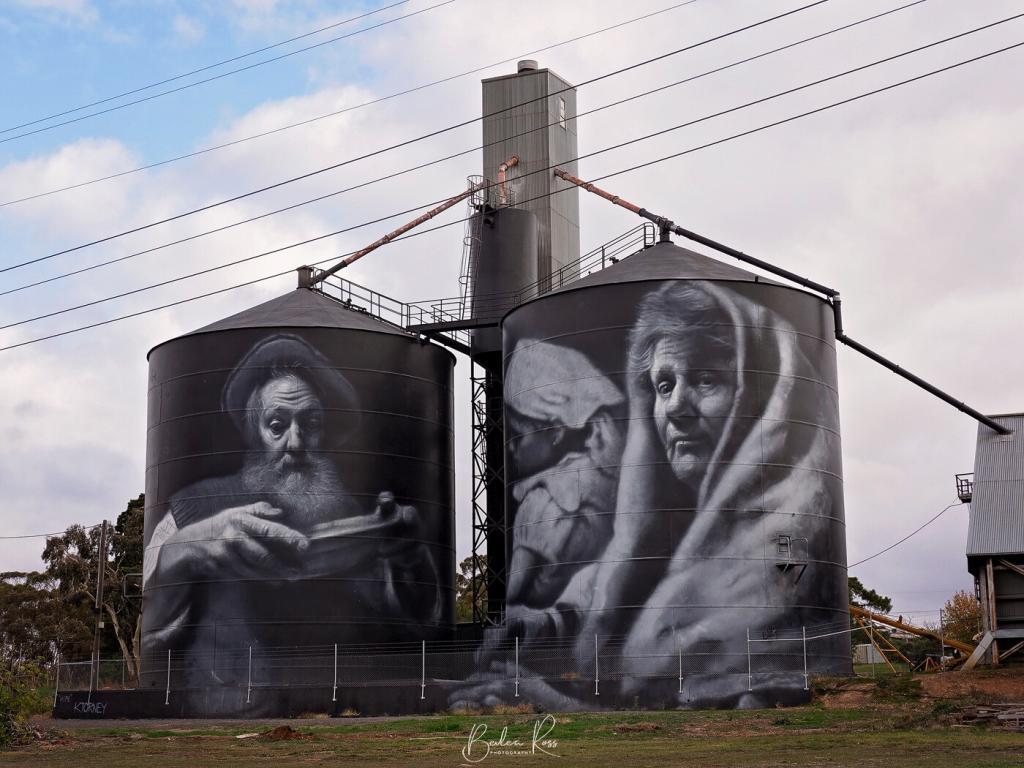
St. Arnaud is a town between Avoca and Donald and was once a central place for gold mining. Kyle Torney, a skilled muralist and oil painter, is a resident of St. Arnaud and has gained recognition in the street art community for his Renaissance-style artwork. His pieces showcase local stories with great attention to detail. Coincidently, St. Arnaud is the region’s starting point of the Silo Art Trail and is a great place to stay overnight before you start the Trail the following day.
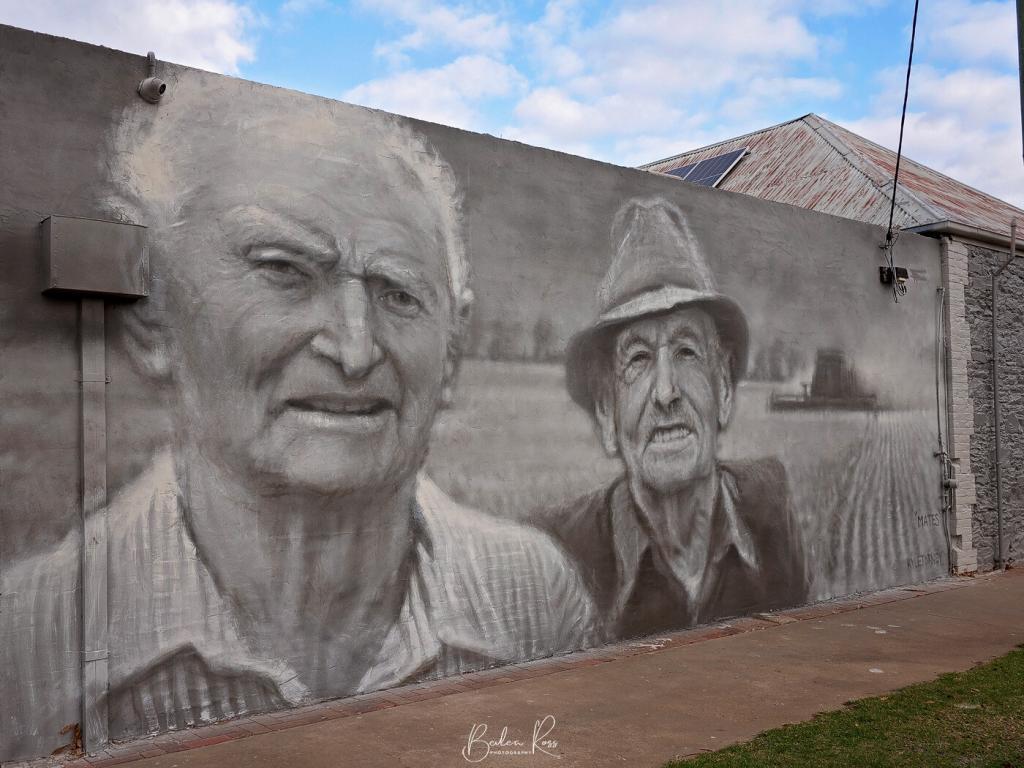
Warrnambool
Impressive murals and street art collections can be found in the coastal town of Warrnambool. The CBD and laneways feature colourful artworks that reflect the town’s beauty and local themes.
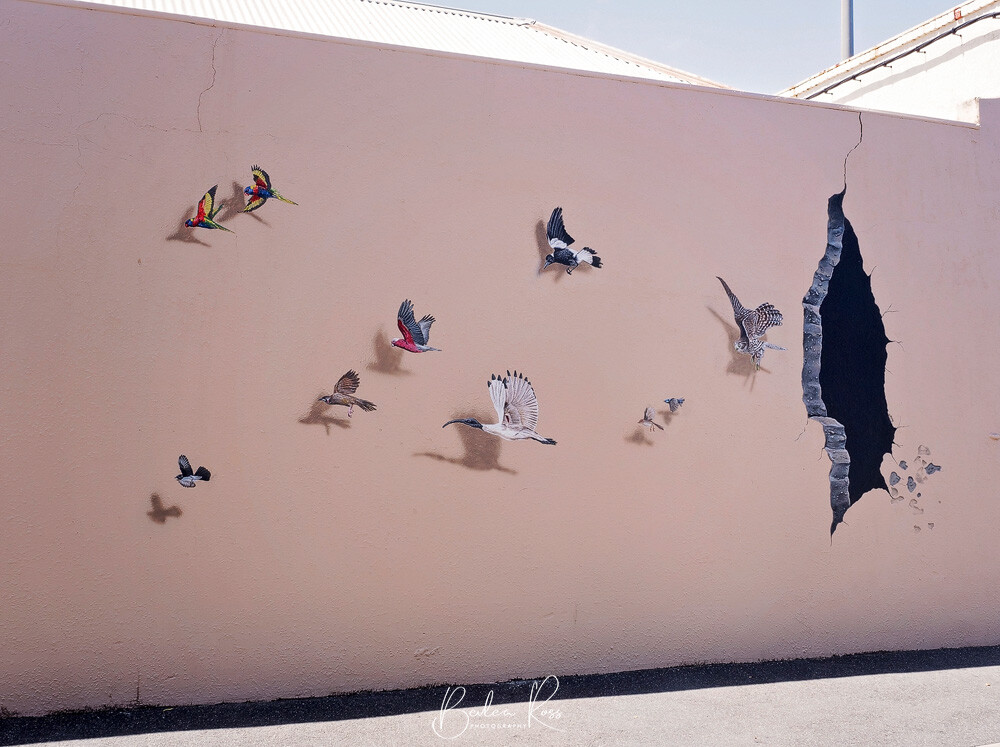
Shepparton
Shepparton has approximately ten street art spots and its award-winning Moooving Art herd. The locals have named ‘Dana Djirrungana Dunguludja Yenbena-l’ to the Aboriginal Street Art Project, which translates to ‘Proud, Strong, Aboriginal People’ in the Yorta Yorta language. The project aims to honour the area’s Aboriginal heritage and traditions while connecting the newly constructed SAM (Shepparton Art Museum) with Shepparton CBD.
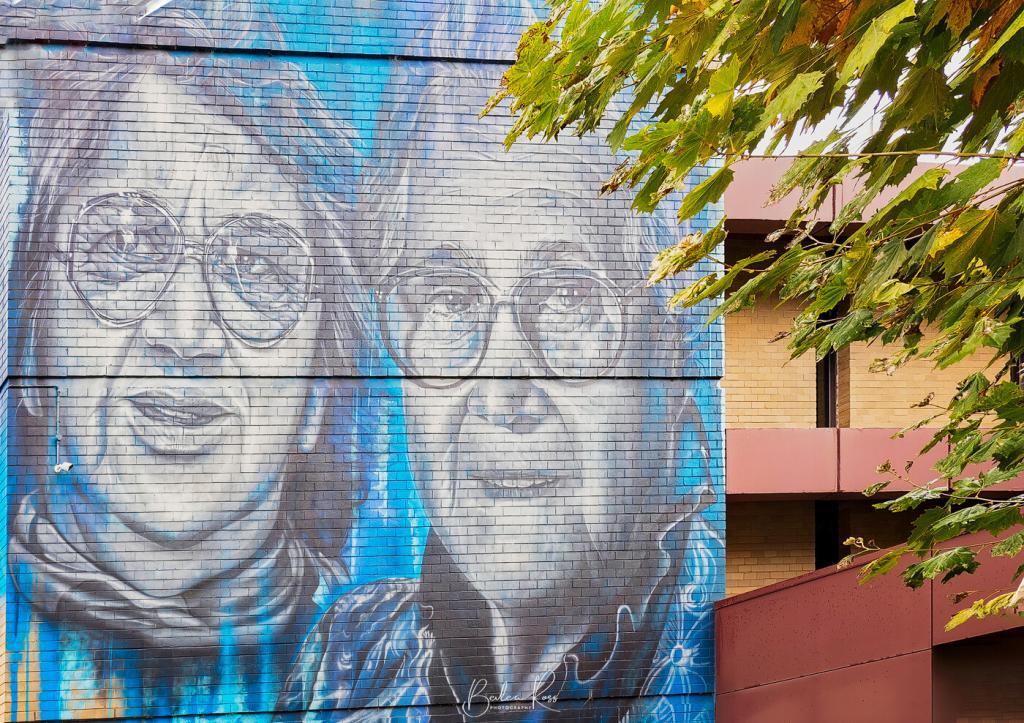
Yarram
The small township of Yarram is in southeast Gippsland, 221 kilometres east of Melbourne. It’s a two-and-a-half-hour drive down the Princes Highway car.
Yarram boasts impressive artwork by Heesco, a well-known artist from Ulaanbaatar, Mongolia. Heesco relocated to Australia in 2010 and settled in Melbourne, where he has been busy painting walls across the country, including some silos in New South Wales. Yarram has ten outdoor murals and five indoor murals to enjoy. Yarram was also the Gold winner of the 2020 Street Art Awards.

Digital photography, digital composition and artificial intelligence (AI) are three separate but interconnected areas of creativity that have sparked an ongoing debate about the changing landscape of artistic expression. In the intersection of these domains, creators find themselves navigating a dynamic space where human ingenuity and machine intelligence meet, creating new opportunities and challenges.
Digital Composition: The Human Touch
Using software tools and digital platforms, such as Photoshop, has changed how artists create their works. Digital technologies have made artistic tools more accessible to a broader range of people, allowing them to participate in the creative process.


With digital tools, artists can easily mix different mediums, experiment with colours and manipulate elements with great accuracy, surpassing the limitations of traditional artistic methods.
Supporters of digital composition believe that the creative process involves a human touch that AI cannot replace. They stress the significance of an artist’s intuition, subjective interpretation, and unique perspective. According to this perspective, technology can enhance the artist’s abilities rather than replace them. Emotional depth and personal experiences are integral to the creative process that machines cannot replicate.

Algorithms in Art: The Rise of AI:
Ai has brought a significant change to the creative world. Image generators such as Photosonic, Dall-e, Midjourney, Nightcafe or Adobe Firefly utilise machines that combine datasets, algorithms, and neural networks. AI can analyse extensive datasets, identify patterns, and create content independently. This has resulted in the rise of AI-generated art, which has raised concerns about the role of machines in the creative process and questioned traditional concepts of authorship and originality.

On the other hand, some people argue that AI-generated art has a unique and unpredictable aspect that traditional art forms cannot match. Machine learning algorithms can produce novel and unexpected results that challenge conventional artistic boundaries. Additionally, the ability of AI to analyse vast datasets allows it to incorporate diverse influences, resulting in art that transcends individual styles or cultural limitations.

The intersection of Digital Composition and AI:
One of the key differences between digital composition and AI is the source of creativity. In digital composition, creativity comes from the artist’s ideas, emotions, and skills, which are then translated into a digital format with the help of tools. It is a collaborative process between the creator and the tools they are using. On the other hand, AI relies on algorithms and data inputs (prompts) to generate outputs. Those against AI argue that it may resemble human creativity but lack the emotional and experiential nuances inherent in human artistry.

Challenges and Ethical Considerations:
The conversation surrounding digital composition versus AI is becoming more complex as time goes on. It is essential to consider this debate’s ethical implications and societal impact. Questions about copyright, ownership, and whether machines will replace human artists raise ethical concerns. Striking a balance between embracing technological advancements and preserving the authenticity of human creativity becomes crucial in navigating this complex terrain. Ultimately, the relationship between digital composition and AI is not one of opposition but of collaboration and co-evolution.

The Future of Artistic Expression
Integrating art and technology presents exciting opportunities for artists to push the boundaries of their creativity and expand their skills. Artists can break down traditional boundaries and create new and innovative works by utilising digital tools and exploring the vast possibilities of AI-generated art. This merging of human ingenuity and machine intelligence promises a dynamic and diverse future for the art world.

AI-powered image creation is an exciting avenue for creativity and exploration. It allows you to generate surreal landscapes, craft whimsical characters, experiment with colours and textures, and experience joy and wonder. The journey of harnessing AI for image creation is educational, inspiring, and undeniably fun.

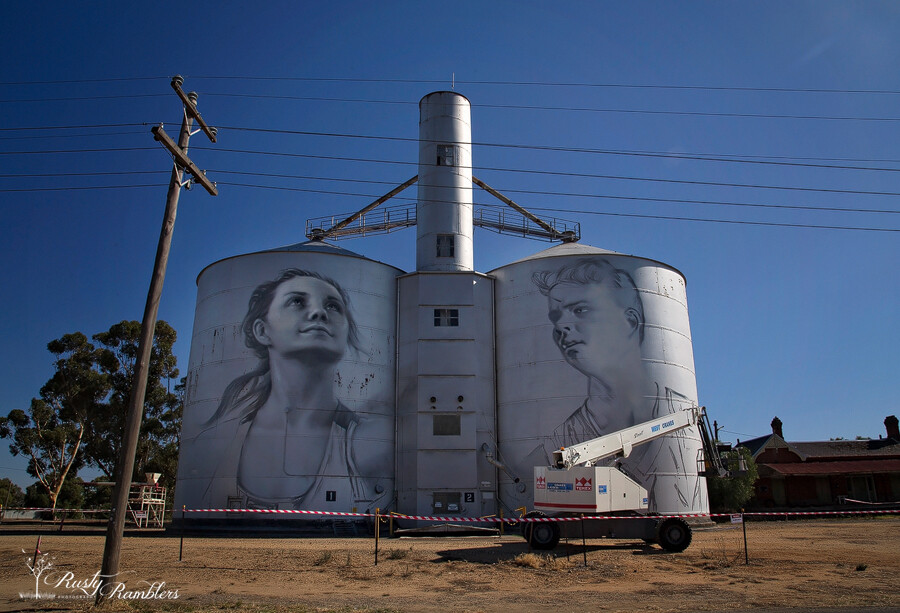
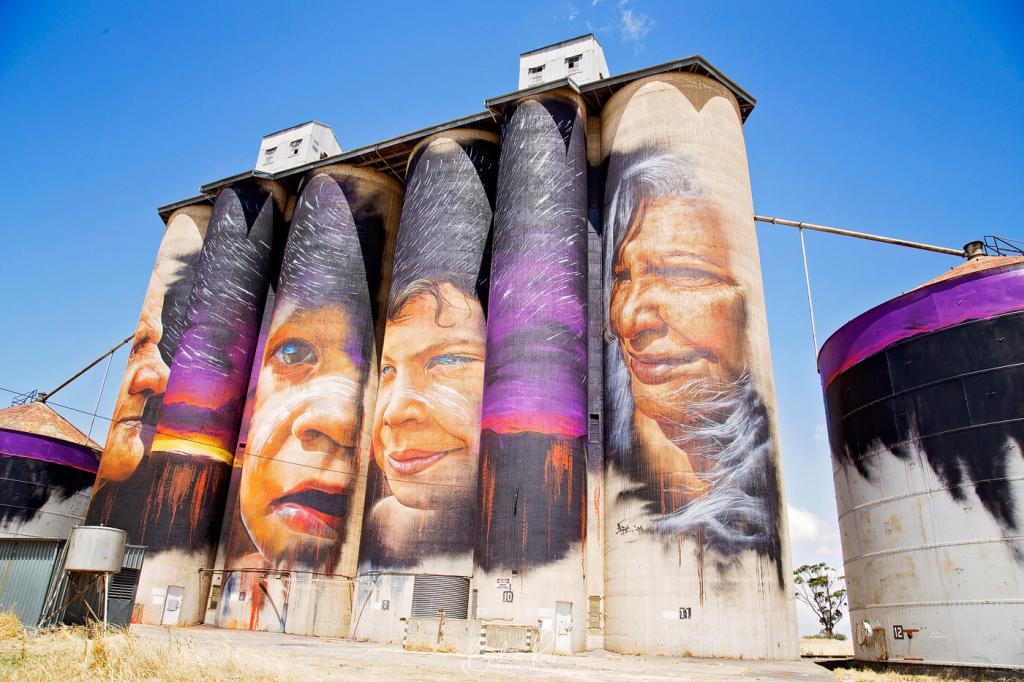
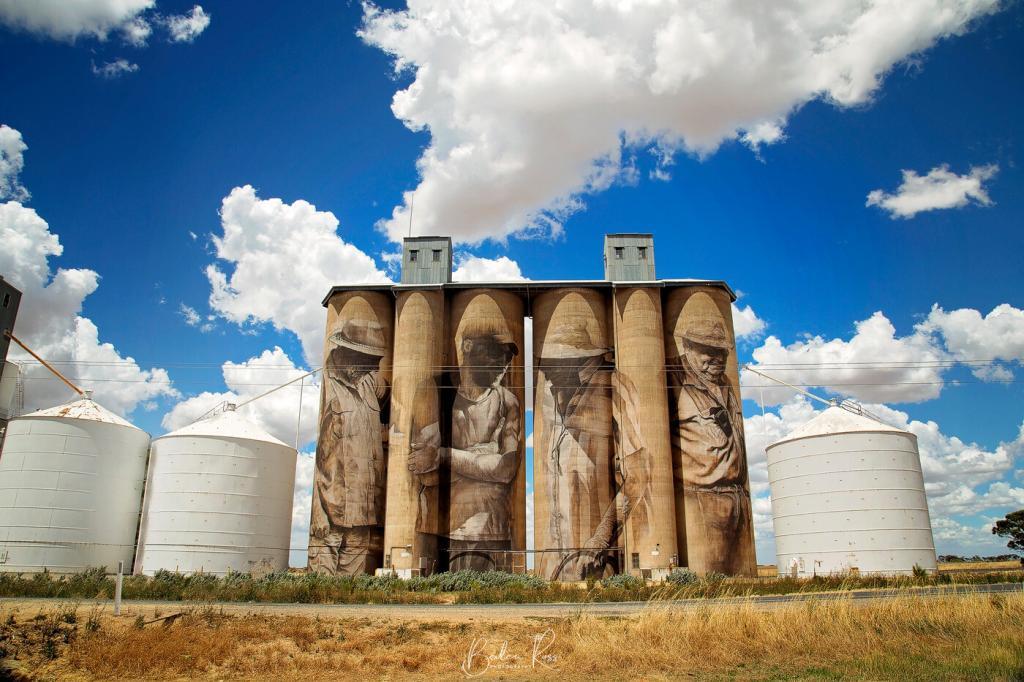
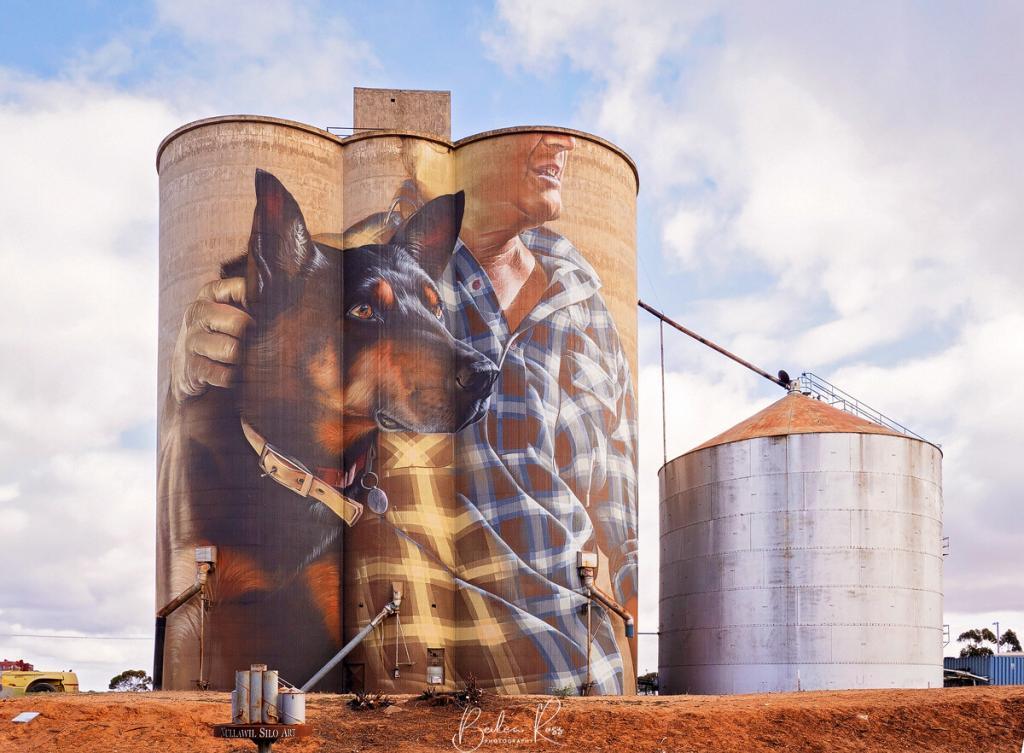
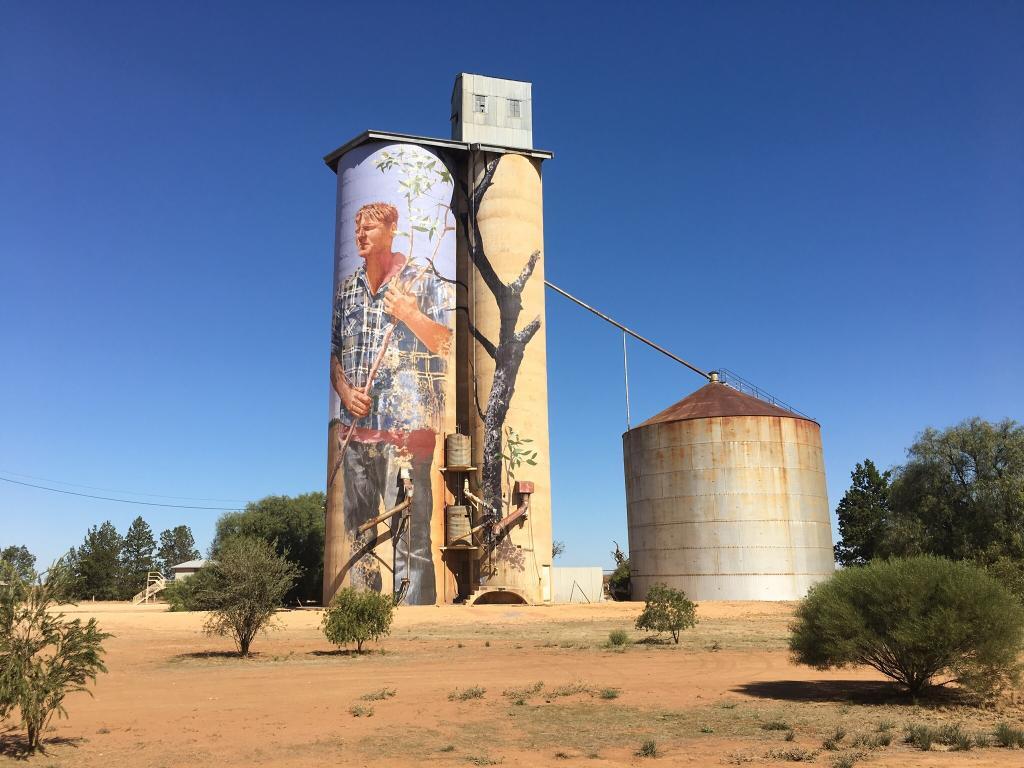
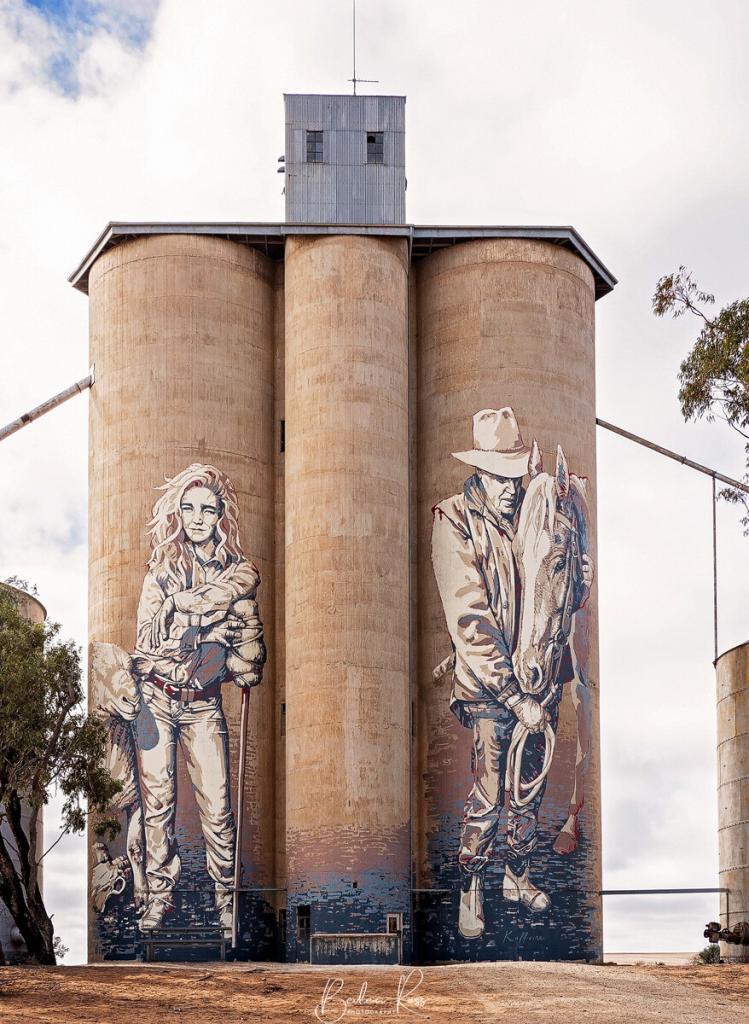
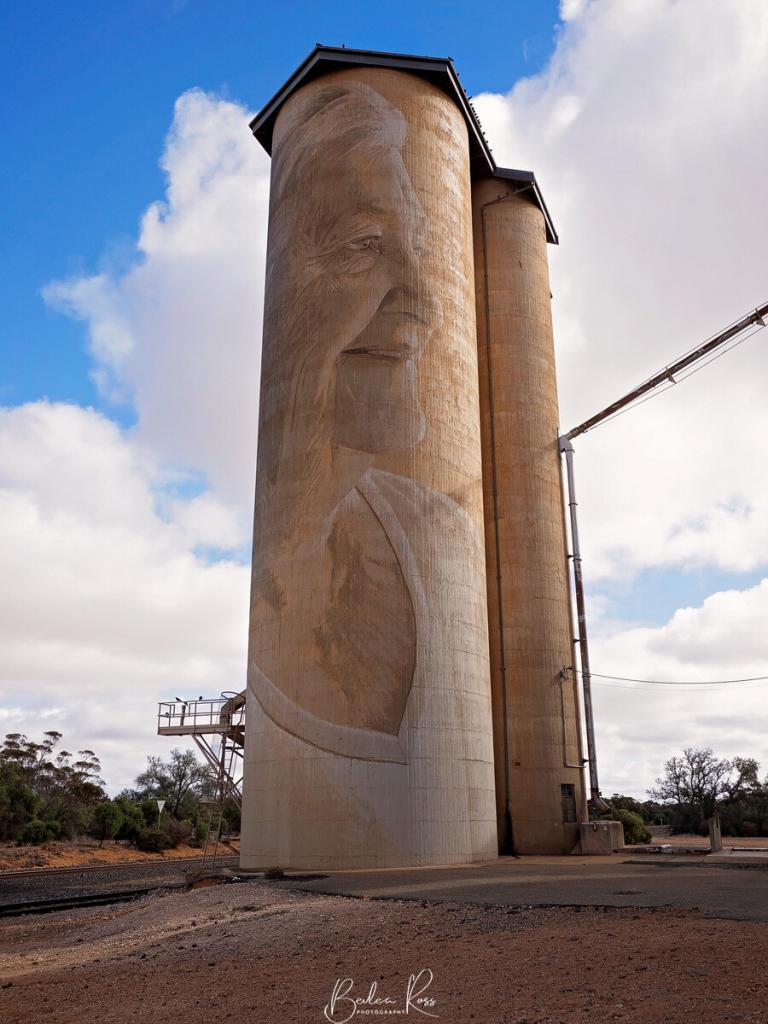
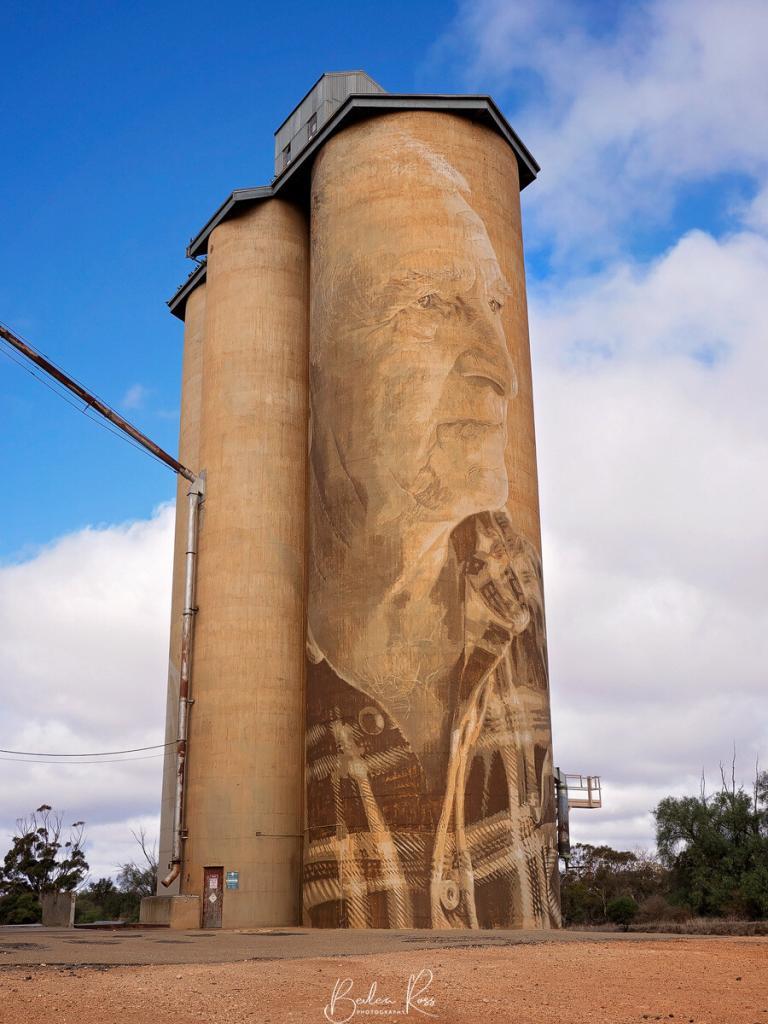
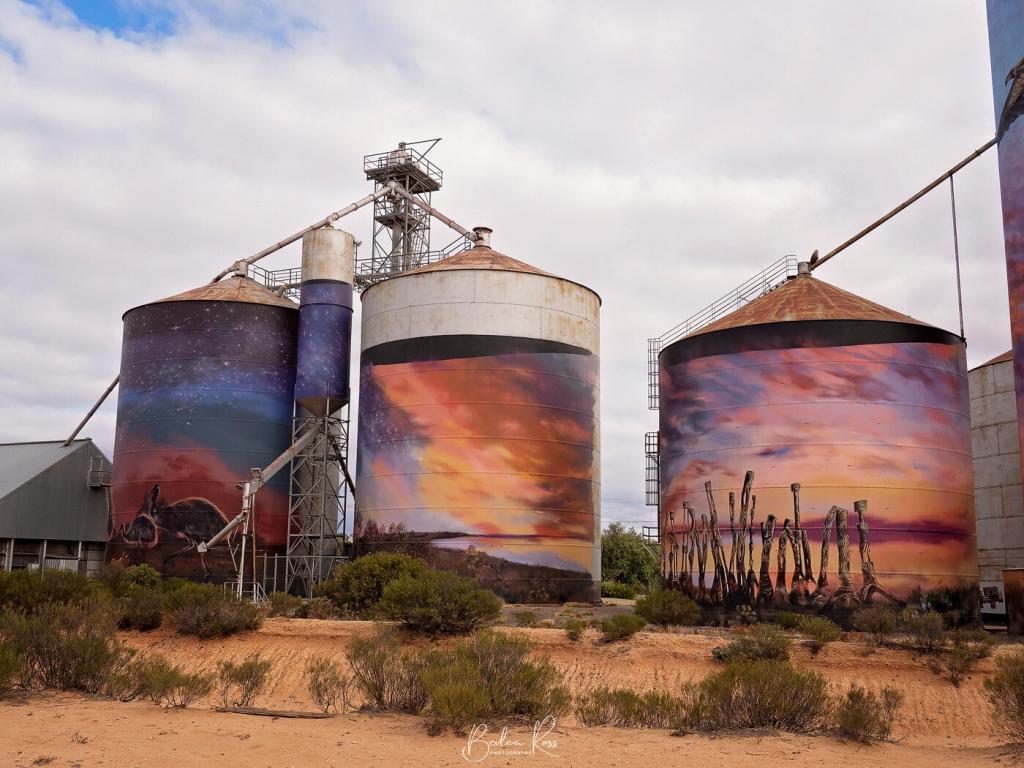
While other states also have painted silos, Victoria has the most painted silos standing at 26, as of July 2023. Only Victoria has a drivable trail with only 50-60 km between each silo. And Victoria has three separate Trails at that! The Silo Arts Trail and the Northeast Silo Trail are in regional areas. These trails are a one-of-a-kind public art project in regional Victoria, Australia, that’s truly amazing.
Silos as a canvas
This unique project aims to turn rural landscapes into an open-air art gallery. Northam, Western Australia, was the first official silo artwork in 2015, created by Phlegm and HENSE. However, the Silo Trail concept was initially launched by the Yarriambiack Shire Council in 2016. Since then, talented artists from Australia and all over the globe have been invited to paint these silos with their artistic interpretations.
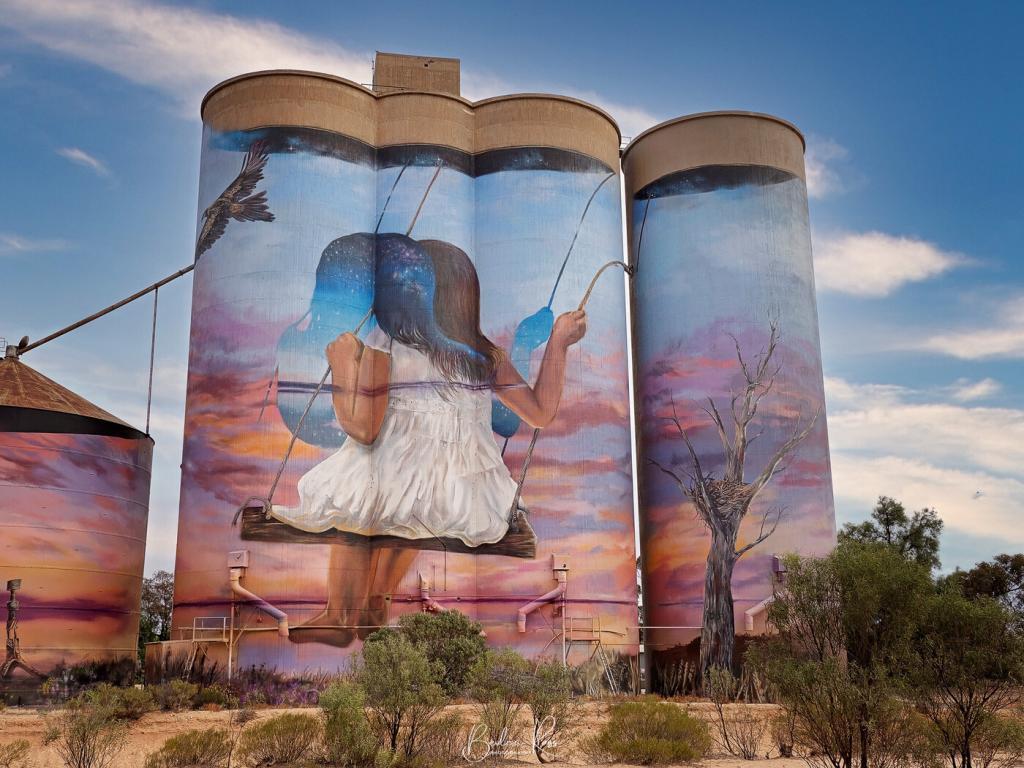
The painted silo artwork is by famous street artists such as Rone, Adnate, Dvate, Guido Van Helton, Kaff-eine and others, who use these towering silos as their canvases to create impressive artworks that celebrate the local communities, culture, and history.
The Silo Art Trail
The original Silo Art Trail in Northwest Victoria started in 2016 and stretches 350km across regional Victoria, where the silos are strategically located in small towns along the trail. The artwork celebrates the people and culture of the region and adds an artistic touch to the picturesque countryside. Towns that feature painted silos (in driving order) are:- St Arnaud, Rapanyup, Murtoa, Horsham, Sheep Hills, Brim, Lascelles, Walepeup, Sea Lake and Nullawil, with more being added all the time.

North East Silo Trail
The North East Victoria Silo Art Trail began in 2018 and spans 132km. It starts just outside Benalla and takes approximately two hours to complete. Talented artists, including Guido Van Helten, Sobrane, Cam Scale, Adnate, Dvate, and Tim Bowtell, a local artist from Benalla, created the silos along this trail. The first town, Goorambat, has four works of art, including the interior wall of the Uniting Church.
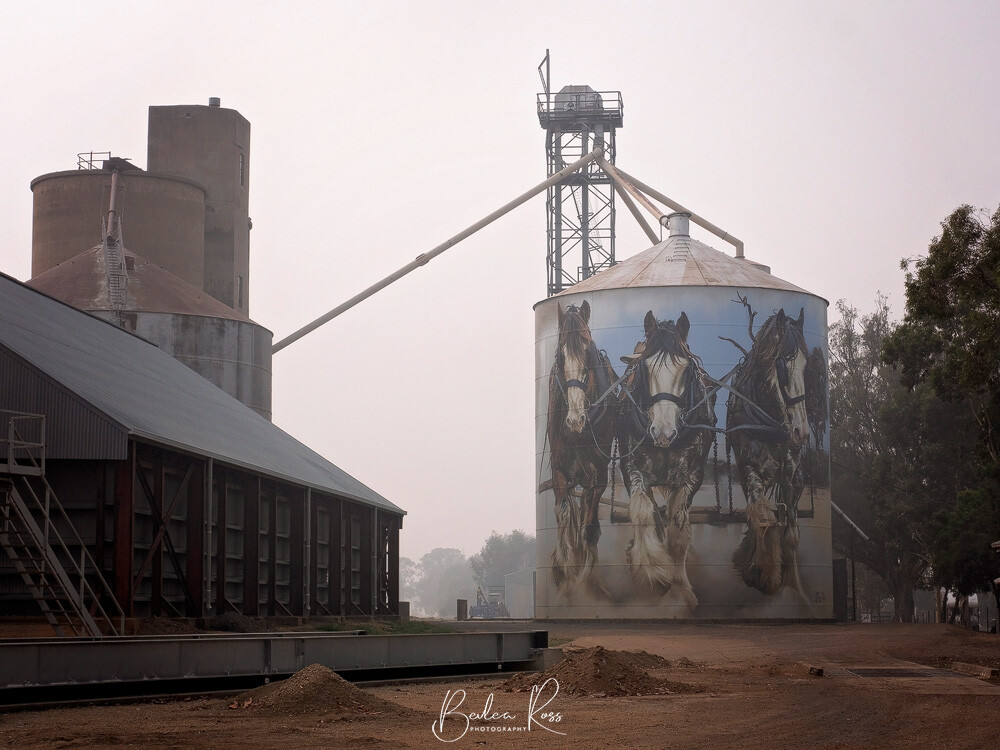
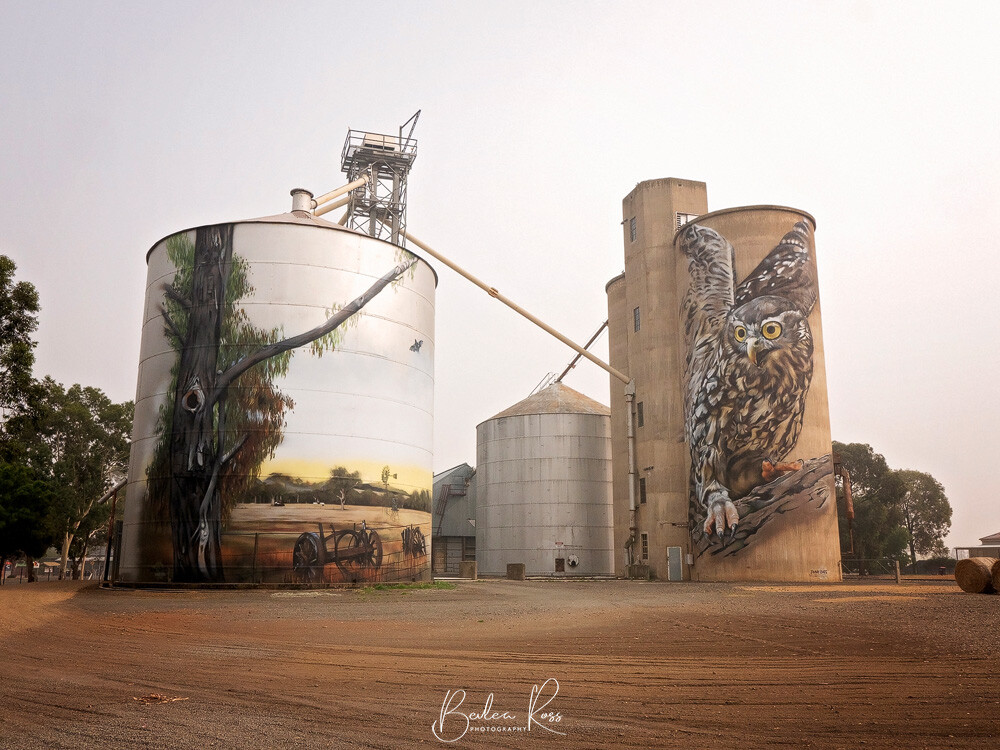
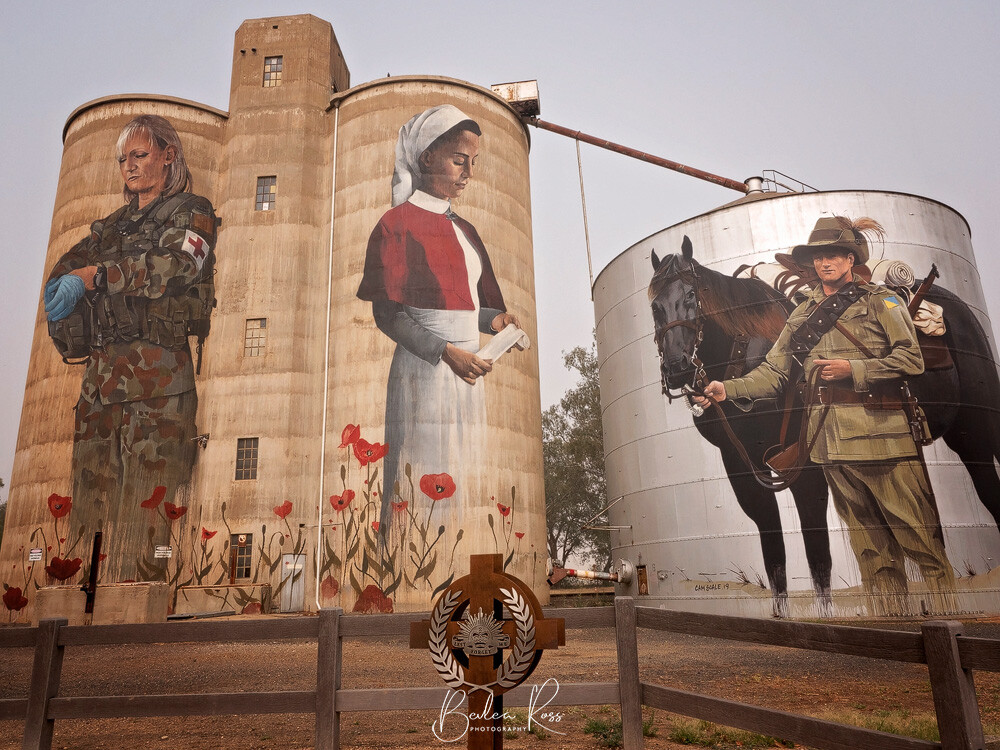
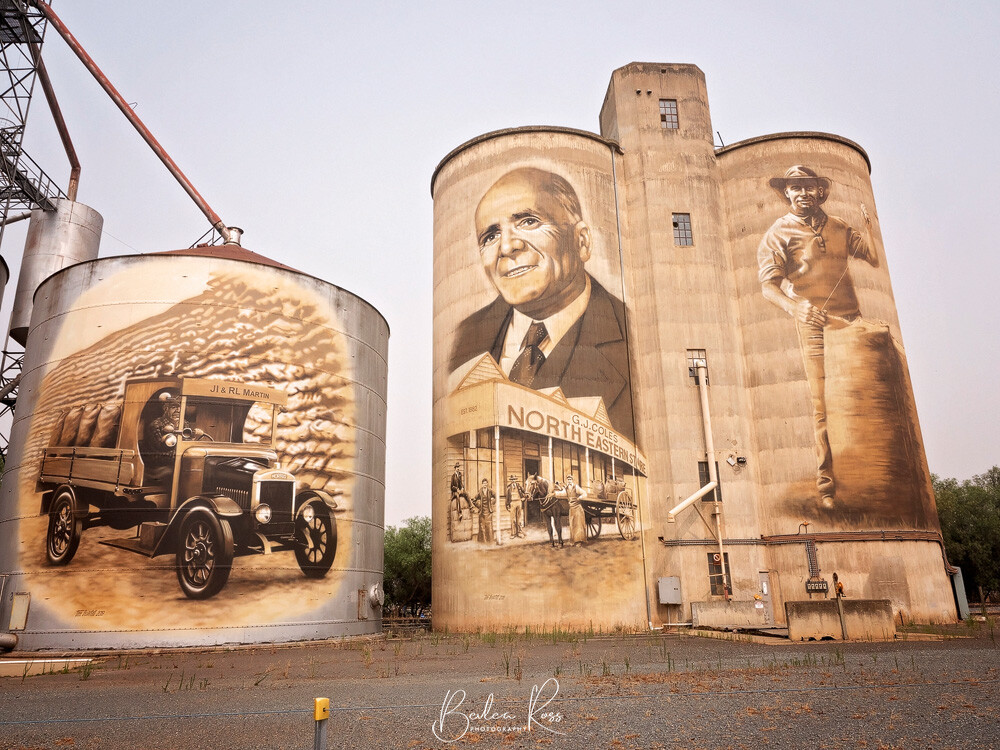
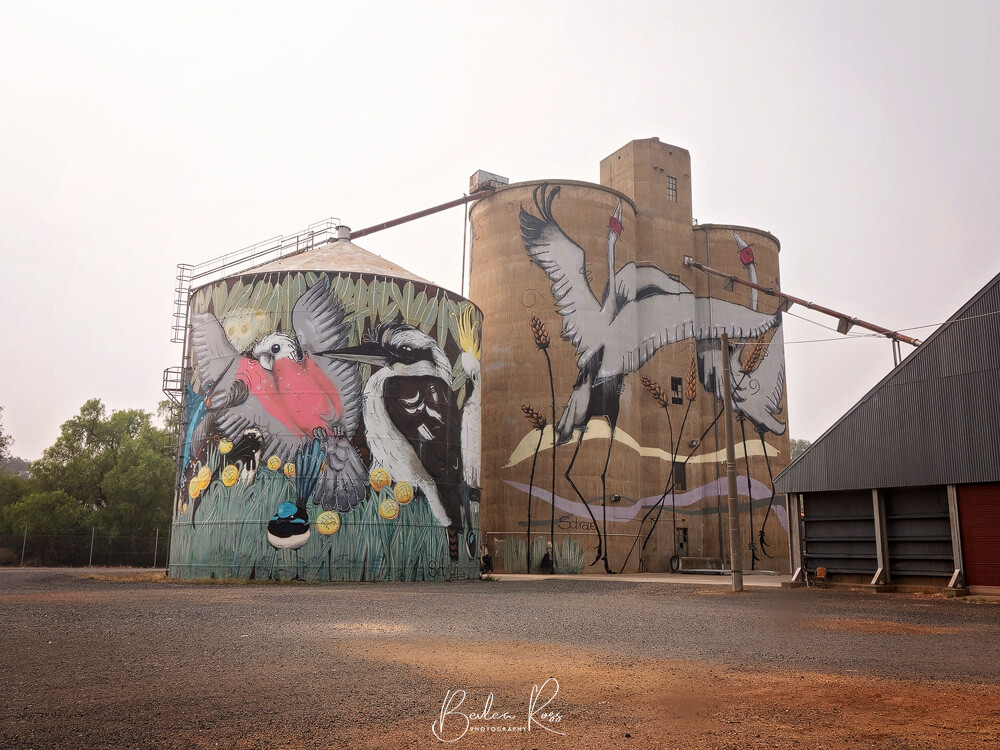
From there, it goes to Devenish, St James, Katatamite and Tungamah. The CFA Water tank at Winton Wetlands is a must-see on returning to Benalla. A North East Trail map is available for download.
Winton Wetlands
The Winton Wetlands Art in the Landscape project aims to improve the visitor experience and raise awareness about the ecological significance of the wetlands by incorporating art installations and sculptures throughout the area. Among these installations are the CFA water tanks. The tank depicts the faces of three CFA firefighters on its side. While in Winton, they are still part of the North East Silo Trail.
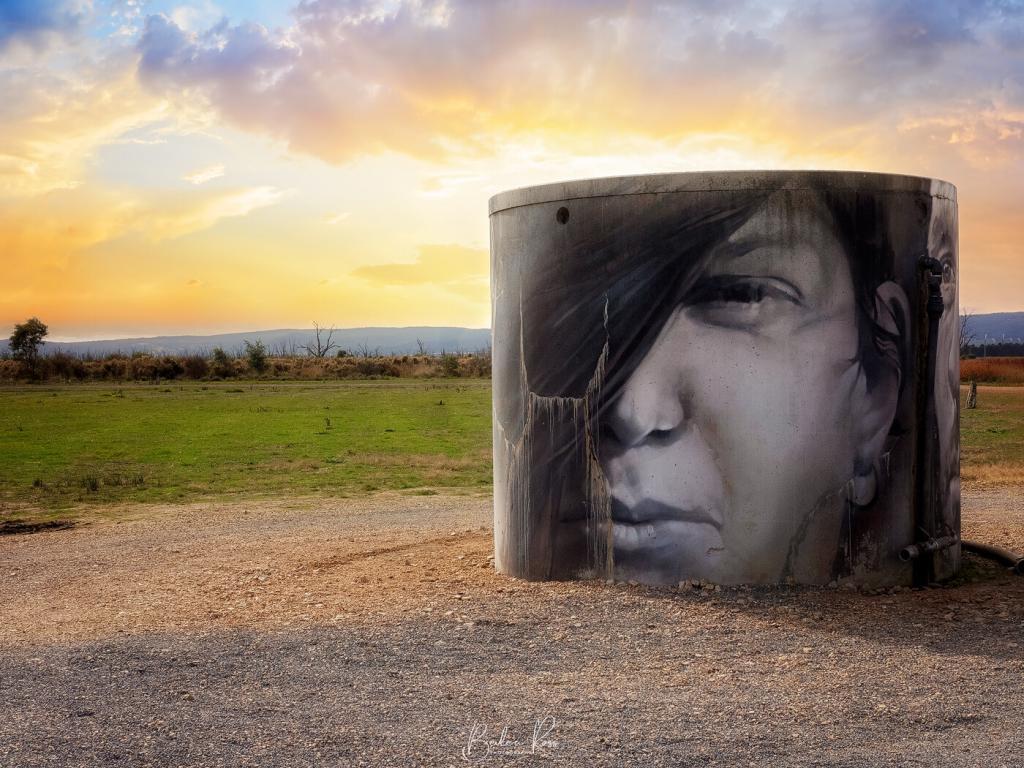
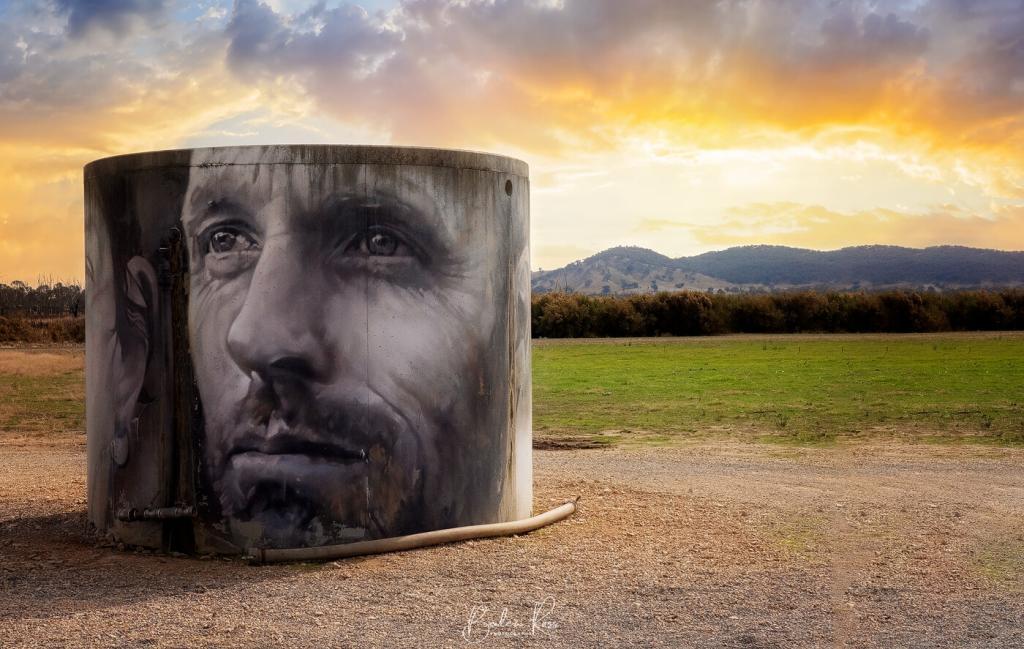
Guido Van Helton was commissioned in 2016, as part of the Wall to Wall Street Art Festival in Benalla, to paint the water tank in the heart of the Winton Wetlands.
Echuca-Moama Silo Trail
Echuca Moama and its surrounding regions house four silo and water tank art installations. The Echuca-Moama trail can be done in a full day, but can also be split it into two half-day drives. The total driving time, without any stops, is roughly between 3.5 to 4 hours.
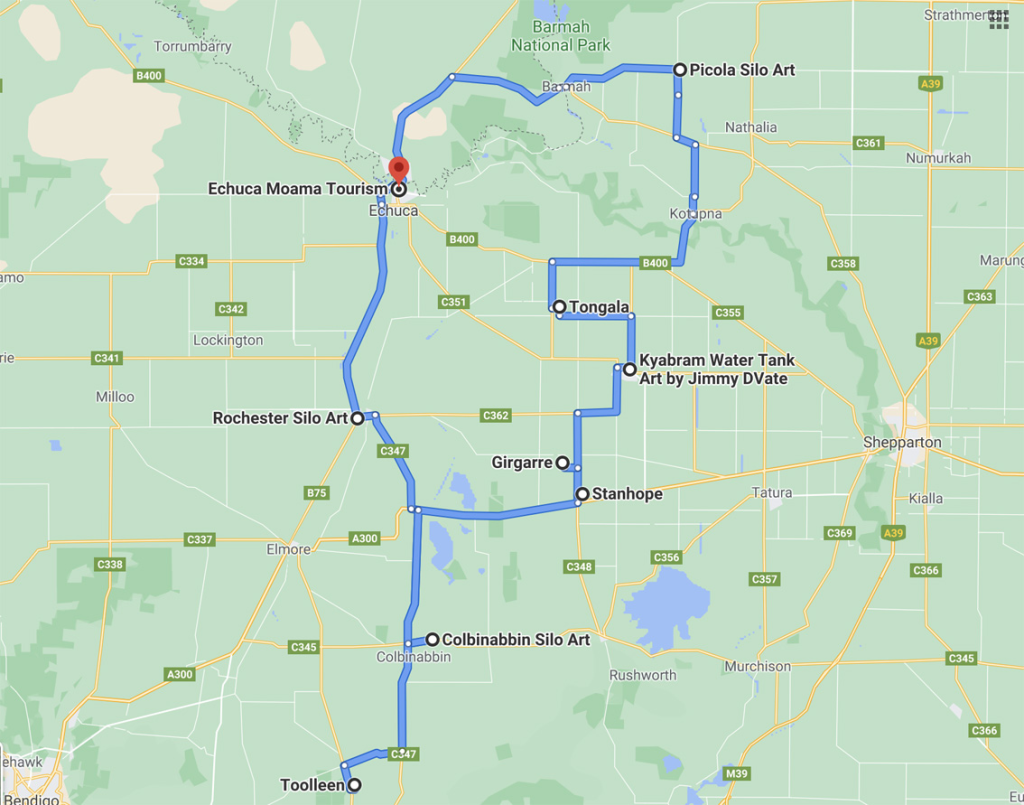
From Echuca, it’s a short 25-minute drive to Rochester where there are two silos painted by Jimmy Dvate. While n Rochester check out Iddles Lane featuring murals painted by Tim Bowtell celebrating Ron Iddles one of the state’s most respected detectives
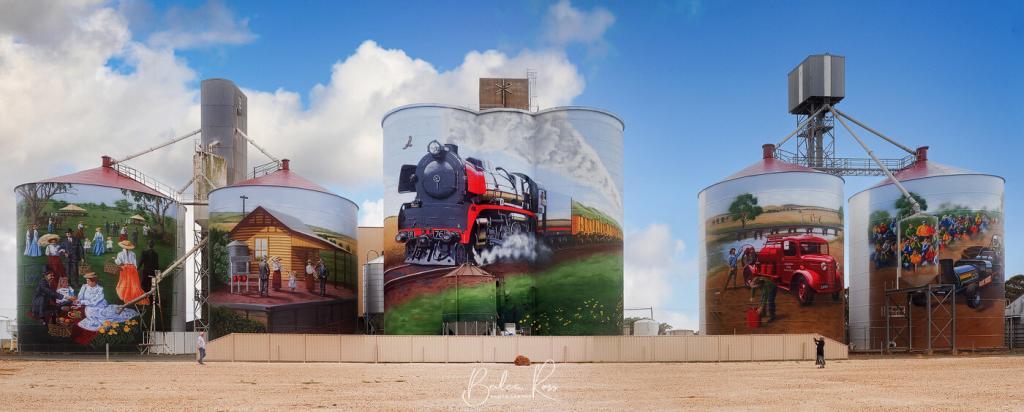
It takes approximately 25 minutes to drive from Rochester to Colbinabbin. In 2020, artist Tim Bowtell painted the silos in Colbinabbin, showcasing important moments from the town’s history. These moments include the town’s connection to agriculture, community, environment, and the construction of the railway.
The final destination is Picola, which is located 35 minutes away, again painted by Jimmy Dvate. The artwork showcases the culturally significant Barmah National Park and the various wildlife that inhabits it. After visiting Picola, it will take another 30 minutes to return to Echuca.
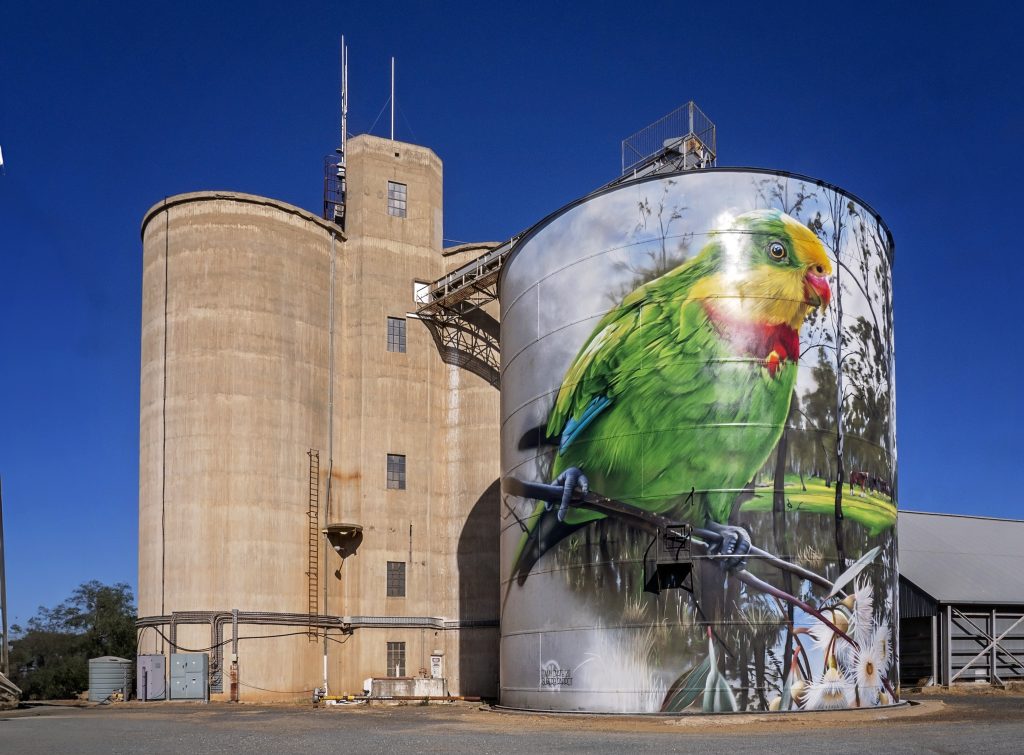
Woomeland Field Bins
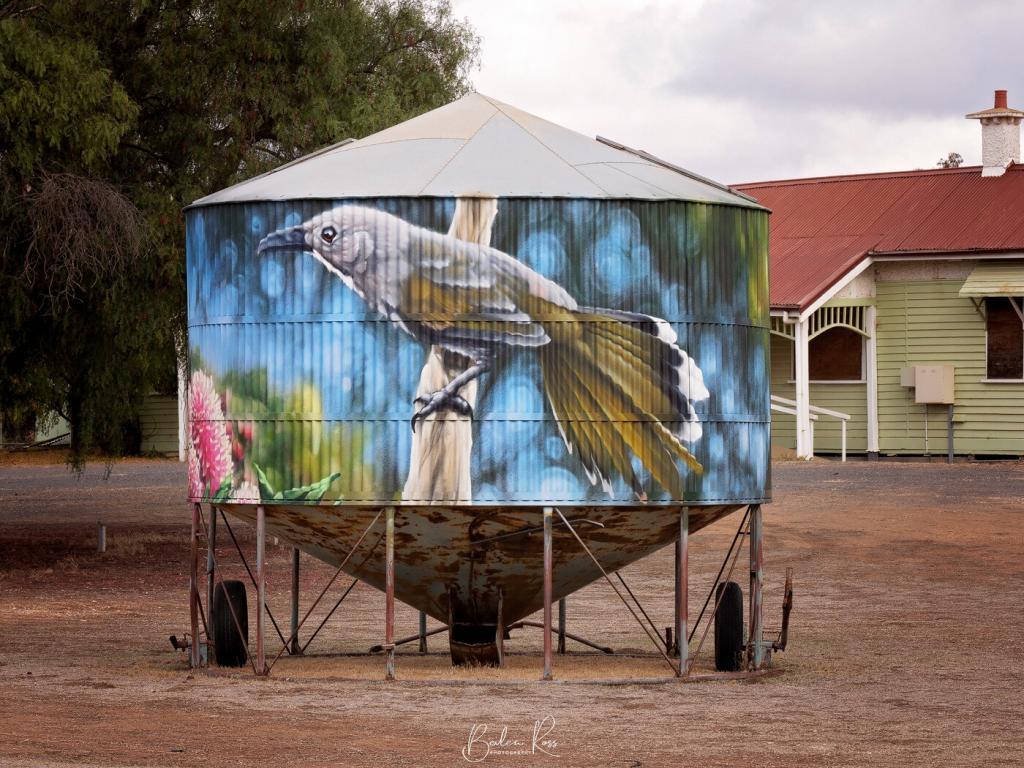
Explore Woomelang’s unique Mini Silo Art Trail, which offers a creative twist on the well-known Big Silo Art Trail. This trail features eight Mini Silos (Field Bins) scattered throughout the town, providing a fun and exciting way to discover the area. The Mini Silos celebrates the endangered species of the Mallee region.
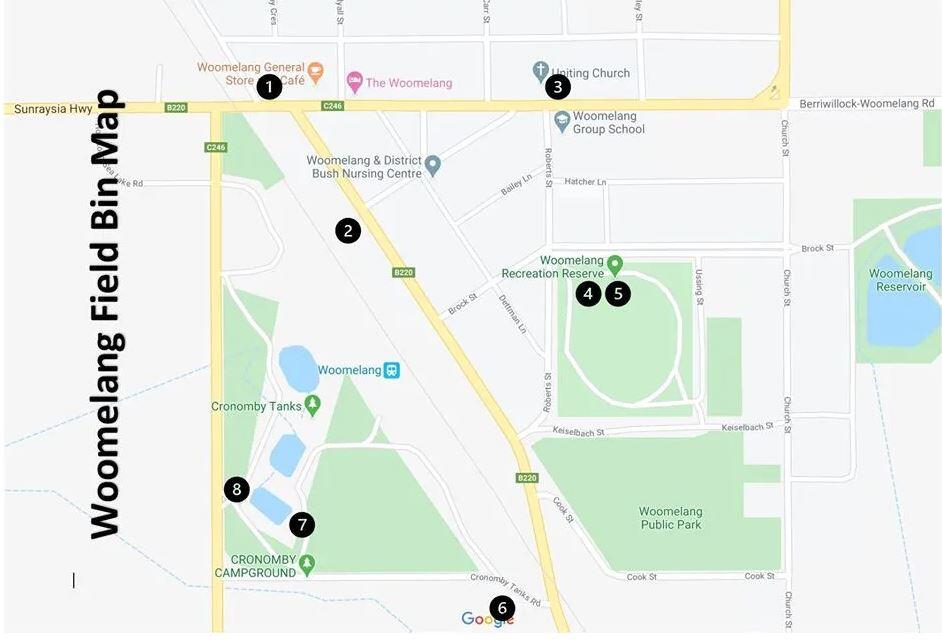
In June 2020, a group of seven artists, including Jimmy DVate, Andrew J Bourke, and Kaff-eine, converted mini silos into a popular tourist attraction for the town. The mini silos showcase endangered species that are native to the area.



The Silo Art Trail showcases the transformative power of art in enriching communities. This painted silos project has revitalised rural Australia by using ordinary grain silos as canvases for extraordinary murals, providing an unparalleled cultural experience for both locals and visitors. As you travel along the trail, you will witness breathtaking artwork and become part of the collective effort to preserve the essence of regional Australia.
The Silo Art Trail symbolises resilience, creativity, and the indomitable spirit of the Australian outback. So, pack your bags, hit the road, and let the vibrant stories told by the silos take you on an unforgettable adventure!

Photography is a versatile art form that enables people to capture moments in time, preserving them forever. While traditional photography prioritises sharpness and clarity, intentional camera movement (ICM) departs from this convention. ICM is a creative technique that involves deliberately moving the camera during the exposure, resulting in images characterised by blur, abstraction, and a sense of dynamism.
Historical Context
Photographers in the mid-20th century started experimenting with unconventional techniques to break free from the traditional photography constraints. Intentional camera movement is one technique that allows photographers to create images that focus on conveying emotion and energy. Ernst Hass and Aaron Siskind were among the pioneering artists who embraced this idea of intentionally moving the camera, marking the beginning of a new era in photographic expression.
Techniques of Intentional Camera Movement
Intentional Camera Movement (ICM) involves deliberately introducing motion during the exposure to achieve various visual effects. One of the most common methods is panning the camera horizontally or vertically while capturing a moving subject like a car or a river. This creates dynamic streaks of colour and light, giving the image a sense of speed and direction.

Another technique involves rotating the camera on its axis, producing circular or spiral patterns. This is often used to capture the energy and vitality of natural landscapes or seascapes. Additionally, camera shake, created by gently tilting or jostling the camera during exposure, can produce abstract and painterly images that go beyond the boundaries of traditional photography.
Visual Impact and Emotional Resonance:
Intentional camera movement has a unique ability to evoke emotions and engage viewers on a deeper level. ICM images often have an abstract, dreamlike quality that encourages subjective interpretation, creating a more immersive experience. The intentional introduction of blur can convey a sense of mystery and nostalgia, prompting viewers to contemplate the fleeting nature of time and space.
Moreover, ICM can be a powerful storytelling tool. Photographers can guide viewers’ attention by emphasising certain elements using movement and blur and creating a narrative within a single frame. The ambiguity and open-ended nature of ICM images challenge viewers to actively participate in making meaning. Thus resulting in a stronger connection between the photograph and the observer.

Challenges and Rewards:
Intentional camera movement is a technique that offers a wide range of creative possibilities. However, mastering it requires both technical skill and artistic intuition. Achieving the right balance between blur and clarity can be challenging, and the unpredictable results add a sense of experimentation to the process. However, this unpredictability makes ICM exciting and rewarding for photographers who want to push the boundaries of their craft.
Creating an ICM image
Select a Suitable Subject:
Intentional Camera Movement can effectively shoot scenes with distinct patterns, textures, or colours. Subjects with solid lines or shapes, such as beach scenes, trees, etc, can enhance the visual impact of ICM.
Choose the Right Settings:
Switch your camera to Manual (M) mode to control the exposure settings completely. Begin with a slow shutter speed, say 1/4s to 1s, to give enough time for the movement. Use low ISO to avoid any needless noise in the picture. Adjust the aperture to regulate the depth of field according to your artistic vision.
Use a Tripod or Handheld:
You can use a tripod or handheld for freedom of movement. I have always just handheld.
Experiment with Movement Techniques:
- – Panning: This technique involves following the movement of a subject either horizontally or vertically. It is particularly effective when photographing moving objects such as cars or people.
- – Rotating: In this technique, you rotate the camera on its axis during the exposure to create circular or spiral patterns in your image.
- – Shaking: Gently shaking or moving the camera in different directions can introduce random blur and abstraction to your photos.

Practical Considerations:
- When you take photographs, you can either manually focus or use autofocus, depending on your personal preference and the nature of your subject. Choosing a focal point in the scene that stays relatively still is essential to create an anchor within the blur and produce a recognisable image. Experiment with different shutter speeds and movements for unique effects.
- After taking a few photos, review them on your camera’s display to evaluate the results. Adjust your technique, settings, and movements based on the feedback from your initial attempts.
- Minimal post-processing can enhance ICM images by adjusting colour, contrast, and sharpness. Experiment with post-processing tools to achieve desired effects.
Adamski Effect
The Adamski effect is a photographic technique created by Josh Adamski, a renowned artist and photographer born in Tel Aviv in 1948. His unique method of impressionist photography involves utilising blur techniques to create the illusion of motion, resulting in abstract images with a dreamlike quality.

Adamski’s photos often capture the beauty of movement, transforming mundane scenes into captivating works of art. The Adamski effect has gained worldwide recognition for its ability to create visually stunning images that challenge our perceptions of the world around us.


It is important to remember that intentional camera movement is a technique that is highly subjective and experimental, and it does not follow strict rules. Therefore, allowing yourself to be creative and embrace the unpredictability of the results is essential. With practice, you will better understand how different movements and settings can influence the outcome, leading to more intentional and satisfying results.

Leopards, scientifically known as Panthera pardus, are one of the five ‘big cats’ of the genus Panthera. Known for their distinctive dark spots and agile bodies, leopards are remarkable members of the animal kingdom, boasting a combination of strength, intelligence, and beauty. Found across various regions of Africa and parts of Asia, they are versatile creatures that have adapted to different environments, from deserts and mountains to jungles and grasslands. Their solitary nature and incredible stealth and speed make them one of nature’s most efficient predators. However, they are more than just hunters; leopards are a vital part of their ecosystems, with their very existence contributing to the delicate balance of nature.
Physical Attributes
Leopards are medium-sized big cats, typically measuring between 1 and 2 metres in body length, with a tail that can extend an additional 90 centimetres. Males are usually larger than females, weighing between 36 and 180 kilograms, while females weigh between 27 and 155 kilograms.
One of the most striking features of the leopard is its coat. It is covered in a tawny or golden hue with black rosettes, unique to each individual, much like a human fingerprint. The rosettes are circular in East African leopards but square in southern African leopards. Some leopards are also melanistic, a trait more commonly known as ‘black panther’, which results from an overproduction of pigment and appears in dense, forested areas where light levels are lower.
Leopards have a robust build with a large skull. They also possess powerful jaws and necks, enabling them to carry their prey up trees to secure it from other predators. Their bodies are designed for power rather than long-distance running. They have a barrel-chested torso and thick, muscular limbs, and their retractable claws provide excellent grip, crucial for climbing trees and catching prey.
Leopard’s eyes are large and expressive, providing them with excellent night vision, essential for their predominantly nocturnal hunting habits. Leopards also have keen hearing and a strong sense of smell. This makes them one of the most effective predators in the animal kingdom.

Habitats and Distribution
Back in 1750, leopards were found in most parts of Africa below the Sahara and some regions in the north and northeast of the continent. They also lived in Asia Minor, Central Asia, India, China, and Manchuria. However, as of 2019, the species has lost a significant portion of its range, up to 75%. Although Leopards can still be found in scattered regions throughout Africa and parts of Asia, their wild population has dwindled to just 250,000.
These creatures are highly adaptable and are known for their versatility as predators. They can survive in various environments, such as savannas, woodlands, mountains, and even urban areas.
The Elusive Nature of Leopards
Being primarily nocturnal, leopards are shrouded in an air of mystery. Unlike their social counterparts, such as lions, they are generally solitary creatures, seeking solitude during the day and emerging under cover of darkness to hunt. Their stealthy and elusive behaviour has often made it challenging for them to study in the wild. Thus adding to the fascination surrounding these elusive big cats.
Hunting and Prey Preferences
Leopards are skilled and adaptable hunters who can capture a wide range of prey, from tiny rodents to large ungulates like deer and antelope. Their impressive strength enables them to hoist prey twice their size up into trees, keeping them safe from scavengers and other predators. This ability to climb trees is a distinctive trait of leopards and has significantly contributed to their evolutionary achievements.

Threats and Conservation
The decline of leopard populations is primarily due to poaching, with the Amur leopard being particularly vulnerable to trophy hunters. These majestic animals often live near human settlements, making them easy targets. The primary motivation behind poaching is the valuable fur of the leopard, which is usually sold as rugs or clothing. Poaching has adverse effects not only on the Amur leopards but also on their prey, such as deer and rabbits. This makes it challenging for them to survive. Moreover, the Amur leopard is facing difficulties in finding enough food in China as the population of its prey is declining.

Although criticised by conservationists, several countries still permit trophy hunting. African nations such as Zambia, Tanzania, and Mozambique have policies that allow it. Moreover, some farmers view leopards as pests and may take measures to eliminate them to protect their animals. As a result, the IUCN has categorised leopards as vulnerable. However, there are still a sufficient number of them that repopulation is feasible.
Nevertheless, some subspecies face more significant threats than others. The Amur leopard, for instance, is the rarest, with only about 100 individuals left in the wild. There are 180-200 in captivity. It is classified as Critically Endangered and may soon vanish. Similarly, the Javan leopard, with only about 250 mature adults in the wild, is also on the Critically Endangered list. Sadly, human activity is diminishing its chances of survival. With just 200 individuals remaining, the Arabian leopard is also in serious danger of becoming extinct.

Conclusion
Leopards have fascinated humans with their stunning appearance and elusive nature for centuries. As top predators, they play a crucial role in maintaining the balance of their ecosystems. Sadly, human-induced factors are endangering their survival, making conservation efforts urgent.

Located in the heart of New South Wales, Australia, the quaint town of Gundagai is home to an enduring symbol of Australian folklore – the dog on the tuckerbox. This cultural landmark embodies the Australian spirit’s resilience, tenacity, and humour and has become an iconic monument. The story behind the dog on the tuckerbox has surpassed its origins and has become a beloved part of the country’s heritage.
The legend of the dog on the tuckerbox dates back to the mid-19th century during the construction of the Sydney to Melbourne railway line. Gundagai, situated along the route, became a significant hub for bullock teams and their drivers who transported goods between the two cities. Life on the road was challenging, with gruelling journeys that tested both man and beast’s endurance.

The Origin
The statue’s inspiration can be traced back to a poem called “Bullocky Bill,” published anonymously by “Bowyang Yorke” in 1857. The poem humorously narrates a series of misfortunes a bullock driver faces, ultimately ending with his dog either sitting on or defecating on the food in his tucker box.
BILL THE BULLOCKY (By “Bowyang York”).
As I was coming down Conroy’s Gap
I heard a maiden cry:
“There goes Bill the Bullocky,
He’s bound for Gundagai.
A better poor old ———
Never cracked an honest crust;
A tougher poor old ———
Never drug a whip through dust.
“His team got bogged at the five mile creek,
Bill lashed and swore and cried,
‘If Nobby don’t get me out of this
I’ll tattoo his ——— hide.’
But Nobby strained and broke his yoke,
And poked out the leader’s eye;
And the dog sat in the tucker box
Five miles from Gundagai.”
The Legend:
In the 1920s, Jack Moses wrote a less offensive poem than Bowyang Yorke’s. However, it referred to Bowyang Yorke’s poem “Nine Miles from Gundagai”. In Moses’ poem, a dog guarded the tuckerbox by sitting on it. The poem became famous and inspired the creation of a statue. Later, in 1937, Jack O’Hagan published a song titled “Where the Dog Sits on the Tuckerbox (5 miles from Gundagai)”, and Moses’ poem was included in his collection, “Nine Miles from Gundagai”, which was published in 1938.

Nine Miles From Gundagai
I’m used to punching bullock teams across the hills and plains
I’ve teamed outback these forty years in blazing droughts and rains
I’ve lived a heap of troubles down without a blooming lie
But I cant forget what happened to me nine miles from Gundagai
Twas getting dark the team got bogged the axel snapped in two
I lost my matches and my pipe ah what was I to do
The rain came on twas bitter cold and hungry too was I
And the dog sat in the tucker box nine miles from Gundagai
Some blokes I know have stacks of luck no matter how they fall
But there was I lord luvva duck no blessed luck at all
I couldn’t make a pot of tea nor get my trousers dry
And the dog sat in the tucker box nine miles from Gundagai
I can forgive the blinking team I can forgive the rain
I can forgive the dark and cold and go through it again
I can forgive my rotten luck but hang me till I die
I cant forgive that blooming dog nine miles from Gundagai
But that’s all dead and past and gone I’ve sold the team for meat
And where I got the bullocks bogged now there is an asphalt street
The dog ah well he took a bait and reckoned he would die
I buried him in that tucker box nine miles from Gundagai
The monument
A monument was erected in 1926, nine miles away from Gundagai. Two years later, Frank Rusconi, a stonemason, suggested a memorial based on the legend of the dog on the tuckerbox. In 1932, the Back to Gundagai Committee decided to take up the proposal. They chose the Five Mile camping site over the Nine Mile Peg as the location for the monument because it was more convenient to the Hume Highway and closer to the town, making it more beneficial for tourism.
Rusconi made a small clay model and sent it to Sydney, where a mould and a small bronze replica of the dog were cast at Oliver’s Foundry. After some minor modifications, the mould was enlarged and then cast in Olivers in Sydney. Rusconi thought the original plan for the dog was too much like a “thoroughbred”, and he changed the design to make it more like the “mongrel” dogs the drovers “really” used. Pattern maker Richard Fowler created the memorial’s base, also done at Oliver’s Foundry.
The dog on the Tuckerbox monument was unveiled in 1932 during ‘Back to Gundagai’ week. A large crowd gathered to witness the statue’s unveiling by Prime Minister Joseph Lyons on November 28, 1932. In addition to the monument, a souvenir shop was opened. Consequently, Gundagai Hospital, which holds the copyright of the memorial, received royalties from firms using its image for many years.
Later history
Since 1992, a festival to celebrate the “Dog on the Tuckerbox” monument has been held annually. The festival, which marks the 60th anniversary of the statue, includes a two-day Snake Gully Cup Racing Carnival and other festivities at the Dog on the Tuckerbox Centre.
Vandalised and Pilfered
On October 27, 1981, a group of students from the Canberra College of Advanced Education (now known as Canberra University) stole the statue as a prank under the cover of darkness. When the locals of Gundagai discovered their beloved dog statue was missing, the news quickly spread, and a nationwide search began. Later that morning, officers at Belconnen police station in Canberra received an anonymous tip-off. They immediately rushed to the campus, where they located and seized the dog statue. However, the perpetrators had already disappeared by then.

“We weren’t treating the situation lightly,” she recalls. “We thought what a stupid prank it was to steal a national icon, and we were focused on finding it and returning it to its rightful home.”
Melita Zielonko (Ret. Police Officer, Belconnen)

Unfortunately, in July 2019, the statue was vandalised when it was dislodged from its plinth, causing damage to the face and breaking off an ear. However, it was repaired and unveiled again on August 17, 2019. Sadly, a few months after its grand re-unveiling, someone deliberately chiselled away the name of Prime Minister Lyons from the base of the monument, presumably as a political act. According to Rusconi, the only way to fix this was to remove the marble slab and have it reworked.
Five mile creek
The Five Mile was initially established as an overnight stop on the overland route between Sydney and Melbourne. During the 1860s gold rush era, hopeful diggers prospected in the area. As time passed, a small farming community, which included a vineyard, grew up around Five Mile Creek in the 1880s.

Also, at the five-mile point, there was an inn run by Joseph and Rosanna Carberry. They opened the Limestone Inn in 1858, which had twelve rooms, a cellar, a detached kitchen, a storeroom, stables, and other stone-built outbuildings. The inn primarily catered to travellers passing between Melbourne and Sydney. In April 1861, Brushrange’ Jack in the Boots’ and an accomplice robbed patrons and staff of their money. After the Carberrys left, the inn was managed by a succession of licensees until it finally closed its doors in 1976.
Symbolism of Resilience:
The Dog on the Tuckerbox is an enduring image that symbolises the resilience of those who faced the harsh conditions of 19th-century Australia. The dog’s statue standing steadfast on the tuckerbox is a metaphor for the unwavering spirit of the pioneers and labourers who contributed to the nation’s development despite adversity.

Travel photography is all about capturing the essence of people. The landscapes, cultures, and experiences that one encounters while exploring different parts of the world. It is a visual diary, a record of one’s travels. It aims to transport viewers to unfamiliar destinations, evoking a sense of place. It’s also like a time capsule, preserving memories from a trip that can be cherished and enjoyed for years to come.

What is Travel Photography?
While travel photography is its own genre, it also encompasses food, landscape, portrait and street photography. In addition, every travel destination has its distinct characteristics, such as its culture, history, people, landscapes, and stories.
This entails capturing the beauty of the natural environment, exquisite architecture, local customs, and lively street scenes. It also includes people’s interactions within their cultural settings. Moreover, the photographer endeavours to capture the destination’s essence and create images that inspire viewers to explore and experience the world. Thus revealing its unique features through visual storytelling.

One Example
Picture yourself taking a road trip on the renowned Great Ocean Road in Australia. While driving along the rugged Victoria coastline, you come across the breathtaking Twelve Apostles. A striking formation of limestone stacks towering above the Southern Ocean. You position your camera on a cliff’s edge and capture the dreamy golden sunlight enveloping the apostles in a warm glow during the golden hour.

By carefully composing the scene, one can emphasize the striking contrast between the vivid blue ocean, the rugged rocks, and the dramatic sky overhead. You also effectively capture the crashing waves against the apostles, creating a dynamic and powerful image. One depicting nature’s raw beauty and immense power.
Your photograph captures a defining landmark of Australia’s coastline, showcasing the natural wonders of the Great Ocean Road. It invites viewers to immerse themselves in the breathtaking scenery, inspiring them to explore the country’s diverse landscapes. In addition, the image serves as a reminder of the vastness and awe-inspiring sights that Australia has to offer.

What Gear?
When taking photos while travelling, it’s crucial to balance having the right equipment while ensuring that your gear is lightweight and easy to carry. Here are some essential equipment suggestions for travel photography.
- Camera: When selecting a camera, it’s important to consider your specific needs and preferences. You have several options to choose from, including compact point-and-shoot cameras, mirrorless cameras, and DSLRs. Consider factors like image quality, size, weight, and versatility to make the best decision.
- Lenses: When packing for your trip, aim to bring a variety of lenses that can cover different focal lengths. A wide-angle lens, typically around 16-35mm, is ideal for capturing landscapes and architecture. On the other hand, a zoom lens like the 24-70mm or 70-200mm offers versatility for various types of shots.
- Tripod: For steady shots, long exposures, and self-portraits, a lightweight and sturdy tripod is essential. It’s important to find one that is compact and easily fits into your travel bag for convenience. (Carbon fibre tripods are the lightest).

Equipment is not just the camera.
- Extra Batteries and Memory Cards: Ensure you have spare batteries and sufficient memory cards. Nothing is worse than running out of power or storage space while on the go. It’s always better to have more than you think you’ll need.
- Camera Bag: Investing in a durable and comfortable camera bag is essential for protecting and organizing your gear. It’s important to choose one with padded compartments and convenient accessibility.
- Filters: When taking photos, it’s worth bringing along some useful filters like neutral density (ND) filters to manage the light and polarising filters to minimize glare and intensify colours.
- Cleaning Kit: It’s a good idea to have a compact cleaning kit. Look for one with a lens cloth, blower, and cleaning solution. This will keep your equipment in good condition and achieve dust-free pictures.
- Remote Shutter Release: When taking long exposures or self-portraits, a remote shutter release or cable release can come in handy to minimize camera shake.
- Portable External Hard Drive: It is important to regularly back up your images to avoid losing valuable data and to free up space on your memory card. You can use a portable external hard drive or cloud storage.
- Travel Adapter and Charger: When planning to travel abroad, it is advisable to bring a travel adapter and charger compatible with the destination country’s electrical outlets. This will ensure you can charge your devices and stay connected while travelling.

Tips to get you started
- Plan and Research: Before you travel, research your destination to understand its culture, landmarks, and points of interest. This will help you identify unique and photogenic locations.
- Pack Light and Smart: Travel photography often involves a lot of walking, so it’s essential to pack light. Carry only the necessary camera gear and accessories. Consider a versatile lens that covers a wide range of focal lengths.
- Capture the Local Culture: Focus on capturing the essence of the destination by photographing local people, their daily lives, traditions, and customs. Be respectful and seek permission when photographing individuals.
- Seek Unique Perspectives: Look for different angles and perspectives and experiment with low angles, high angles, and different compositions to add interest to your shots.
- Golden Hour and Blue Hour: Take advantage of the beautiful lighting during the golden hour (shortly after sunrise or before sunset) and the blue hour (before sunrise or after sunset). The soft, warm, and diffused light during these times can enhance your photos.
- Tell a Story: Look for scenes that tell a story or evoke emotions. Include elements that provide context and create a sense of place.
- Pay Attention to Details: Details can often make for compelling photographs. Capture close-up shots of interesting textures, patterns, architecture, or local cuisine to add depth and variety to your travel album.
- Be Mindful of Composition: Use the rule of thirds, leading lines, and framing techniques to create visually pleasing compositions. Consider the foreground, middle ground, and background to add depth and balance to your images.
- Experiment with Long Exposures: If you have a tripod, try long exposure photography to capture motion blur of waterfalls, flowing rivers, or bustling city streets.
- Practice Patience and Observation: Take the time to observe your surroundings, anticipate moments, and wait for the perfect shot. Patience can often lead to capturing unique and memorable images.
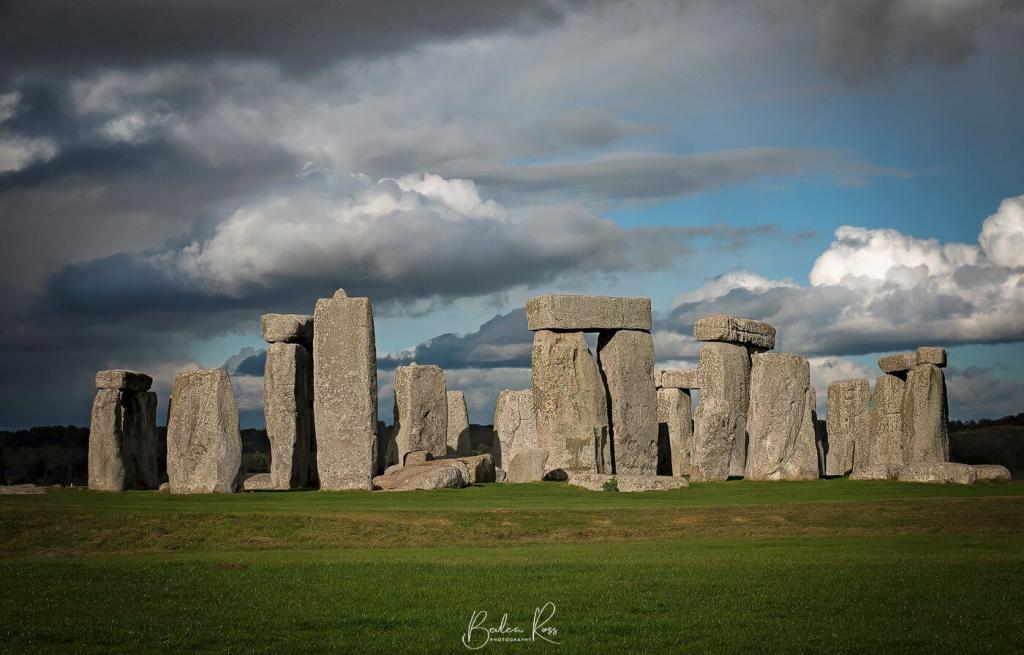
Locations not gear
Explore the world! Visiting breathtaking destinations will yield better photographic opportunities than investing in pricey equipment. Don’t underestimate the capabilities of your phone camera either – it can capture stunning shots.

Travel photography can transport viewers to different corners of the globe, fueling a desire to see these awe-inspiring landscapes in person. This is the essence of travel photography: to inspire adventure, ignite wanderlust and encourage appreciation for the beauty of the world’s natural and cultural wonders.